


Minister of Finance Lee Sush-der (李述德) confirmed yesterday the government is considering slashing the stock transaction tax in an attempt to boost the stock market after it plunged 11 percent, or 783.83 points, last week.
Lee told a morning news conference that the ministry was weighing the pros and cons of lowering the stock transaction tax as different sectors have called for the move to increase confidence in the local bourse.
“Like the public, the government is deeply concerned about the stock performance,” Lee said. “We have heard the call to lower the stock transaction tax and will give serious thought to the matter.”
However, the Ministry of Finance (MOF) issued an emergency statement last night, saying it has yet to reach a conclusion on whether or not to lower the stock transaction tax after local media portrayed the cut as a done deal.
“The proposed tax cut, [if accepted], will have to go through legal revisions before it can be put into practice,” the ministry said in the statement.
The tax currently stands at 0.3 percent of all stock transactions. The business community has pressed the government to halve the levy, arguing that an immediate and concrete measure is necessary to reverse bearish sentiment among investors.
Lee said that the ministry has been authorized to take steps as it sees fit to bolster the TAIEX, though he openly remarked last week that it would be ill-advised for the government to intervene.
As for the size and timing of the cut, Lee said the ministry was still assessing the measure and would unveil the details after they are finalized.
“The ministry is approaching the matter cautiously and had better avoid making comments until the evaluation is over,” Lee said.
The minister said the government is considering lowering inheritance, business and corporate income taxes as part of the effort to make the country more favorable for economic growth.
Vice Minister of Finance Chang Sheng-ho (張盛和) said that when the government cut the stock transaction tax from 0.6 percent to the present 0.3 percent in 1993, the benchmark index shot up 29 percent in a month and remained up 17 percent six months later.
Meanwhile, a number of Chinese Nationalist Party (KMT) legislators yesterday said they were in favor of lowering the stock transaction tax.
When asked for comment, KMT Legislator Ting Shou-chung (丁守中) urged the government to lower the tax as soon as possible.
“Many other nations have also tried to boost their stock markets by lowering their stock transaction tax. Therefore, I believe the measure would prove effective in reviving the stock market,” Ting said.
KMT Legislator Chiu Yi (邱毅) said the government should work hard to lift investor confidence in the domestic stock market by lowering the tax even though the measure might only have a temporary positive impact on the market.
KMT Legislator Alex Fai (費鴻泰) told reporters that he only supported temporarily halving the transaction tax.
“We can halve the stock transaction tax from 0.3 percent to 0.15 percent now, but we need to adjust the rate back to 0.3 percent once the TAIEX reaches 8,000 because the stock transaction tax accounts for more than 10 percent of the nation’s tax revenue,” Fai said.
However, KMT Legislator Lee Hung-chun (李鴻鈞) voiced opposition to the idea, saying that the recent plunge in the domestic stock market was the result of a poor global economy.
He said the government should overhaul the entire tax system instead of only “treating where the pain is.”
Meanwhile, saying that the reduction of the stock transaction tax is a serious matter that requires comprehensive discussion, the director of the Democratic Progressive Party’s (DPP) Department of Youth Development, Chao Tien-lin (趙天麟), said, adding that the effect would be limited if the government introduces the measure only to boost the stock market’s short-term performance.
ADDITIONAL REPORTING BY RICH CHANG
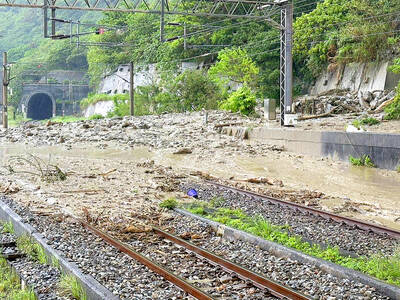
ROLLER-COASTER RIDE: More than five earthquakes ranging from magnitude 4.4 to 5.5 on the Richter scale shook eastern Taiwan in rapid succession yesterday afternoon Back-to-back weather fronts are forecast to hit Taiwan this week, resulting in rain across the nation in the coming days, the Central Weather Administration said yesterday, as it also warned residents in mountainous regions to be wary of landslides and rockfalls. As the first front approached, sporadic rainfall began in central and northern parts of Taiwan yesterday, the agency said, adding that rain is forecast to intensify in those regions today, while brief showers would also affect other parts of the nation. A second weather system is forecast to arrive on Thursday, bringing additional rain to the whole nation until Sunday, it
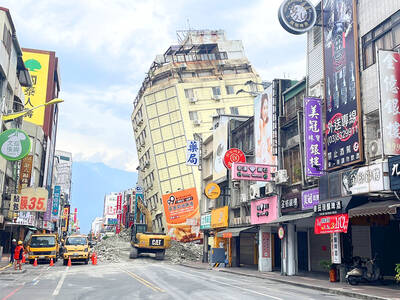
LANDSLIDES POSSIBLE: The agency advised the public to avoid visiting mountainous regions due to more expected aftershocks and rainfall from a series of weather fronts A series of earthquakes over the past few days were likely aftershocks of the April 3 earthquake in Hualien County, with further aftershocks to be expected for up to a year, the Central Weather Administration (CWA) said yesterday. Based on the nation’s experience after the quake on Sept. 21, 1999, more aftershocks are possible over the next six months to a year, the agency said. A total of 103 earthquakes of magnitude 4 on the local magnitude scale or higher hit Hualien County from 5:08pm on Monday to 10:27am yesterday, with 27 of them exceeding magnitude 5. They included two, of magnitude

CONDITIONAL: The PRC imposes secret requirements that the funding it provides cannot be spent in states with diplomatic relations with Taiwan, Emma Reilly said China has been bribing UN officials to obtain “special benefits” and to block funding from countries that have diplomatic ties with Taiwan, a former UN employee told the British House of Commons on Tuesday. At a House of Commons Foreign Affairs Committee hearing into “international relations within the multilateral system,” former Office of the UN High Commissioner for Human Rights (OHCHR) employee Emma Reilly said in a written statement that “Beijing paid bribes to the two successive Presidents of the [UN] General Assembly” during the two-year negotiation of the Sustainable Development Goals. Another way China exercises influence within the UN Secretariat is
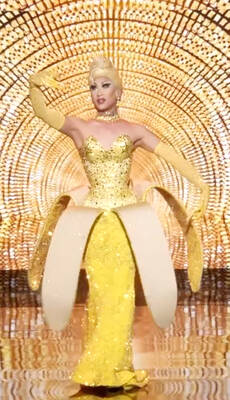
Taiwan’s first drag queen to compete on the internationally acclaimed RuPaul’s Drag Race, Nymphia Wind (妮妃雅), was on Friday crowned the “Next Drag Superstar.” Dressed in a sparkling banana dress, Nymphia Wind swept onto the stage for the final, and stole the show. “Taiwan this is for you,” she said right after show host RuPaul announced her as the winner. “To those who feel like they don’t belong, just remember to live fearlessly and to live their truth,” she said on stage. One of the frontrunners for the past 15 episodes, the 28-year-old breezed through to the final after weeks of showcasing her unique


 RSS
RSS