


Michael Reilly is known in Taiwan’s diplomatic circle as the director of the British Trade and Cultural Office (BTCO), but few probably know that he is also a railway fan.
“I would call myself an ‘average’ railway fan,” Reilly said in an interview with the Taipei Times. “I like traveling by trains, but I’ve never done that to the exclusion of something else.”
“I don’t think my wife will consider herself a train widow,” he joked.
During his second visit to Taiwan in 1974, Reilly checked out the Alishan Railway as he had heard it was still using the Shay locomotive, a US-made steam engine specifically designed for logging railways.
And when he returned two years ago to assume the post as the BTCO director, he soon joined the Railway Culture Society, Taiwan (鐵道文化協會), becoming one of its few foreign members.
Reilly has toured Taiwan on both Taiwan Railway Administration (TRA) and Taiwan High Speed Rail Corp (THSRC) trains.
He named the TRA’s Pingshi Line (平溪線) and the South Link (南迴線) as two of his favorite railway lines in Taiwan.
The Pingshi Line runs from Houtong (侯硐) to Jintong (菁桐) in Taipei County.
Reilly says the rural line has “all the charm of a brunch line,” particularly the scenery in Shifen (十分).
The South Link — connecting Kaohsiung and Taitung — is a slightly busier but nonetheless scenic route.
“You go through the tunnels and spectacular waterfalls and come across the scenery of the East Coast. That, to me, rivals any of the alpine lines,” he said.
Reilly said that the construction of the high-speed rail system was impressive and has made a difference in the way people travel in Taiwan.
“There are very few countries in the world that have got dedicated high speed lines,” he said. “Building a line like [the high speed rail], where you have very high population density, challenges of earthquakes and all the rest of it, is a big feat.”
Coming from a small town in the northwest of England, Reilly became interested in railways when he was about nine years old. To pass the time, he and other boys would watch the trains go by at the railway station, which was a short walk from his house.
Reilly was impressed by the friendliness of railway people in general.
“In those days, crews on the engine would chat to small boys on the platform. This makes you feel that you are part of the bigger adult world,” he said.
Reilly’s fascination with the variety of steam locomotives — as well as daydreams of taking a train to somewhere exotic — also explain why he became a railway enthusiast.
Having a doctorate in urban transport, Reilly was once offered a job at the London Transport. Though tempted to take the position, he eventually chose to work for the foreign service instead.
Nowadays, he sometimes drives steam engines on private railway lines in the UK for fun. Reilly said that he did not know the historical connection between the UK and Taiwan in the railway sector before he came. He was surprised to learn that one of the two locomotives displayed in front of the National Taiwan Museum was built by the British company Avonside in 1871. The electrification of the TRA main line was done by a British firm as well, he said.
The nation’s high speed rail system also adopted the Independent Verification and Validation System, a certification mechanism for safety imported from the UK.
Reilly is aware that people in Taiwan complain a great deal about the two railway services, particularly about the lateness of the trains. He has found, however, that both TRA and THSRC trains were by and large punctual. Some of the complaints were unjustified, he said, given the density of the network and overall frequency and reliability of the systems.
Reilly was also amazed at the rich railway heritage that Taiwan possesses. Aside from the Alishan Railway, he said the fan-shaped railway depot in Changhwa County, built in 1922, was a well-preserved historical treasure.
Currently, the depot also keeps two functional locomotives.
Reilly encouraged the nation to advertise its railway culture more in the international community.
He mentioned that some British parliament members of a railway lobby group came last fall and traveled by railway. They went on a TRA cruise train called Formosa Star (寶島之星) and were surprised that nobody had told them about it before, Reilly said.
“Taiwan has got the image problem; it doesn’t do enough to promote its attractions and its charms,” he said. “Things always have to come through word of mouth.”
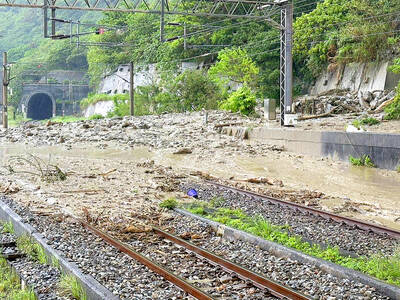
ROLLER-COASTER RIDE: More than five earthquakes ranging from magnitude 4.4 to 5.5 on the Richter scale shook eastern Taiwan in rapid succession yesterday afternoon Back-to-back weather fronts are forecast to hit Taiwan this week, resulting in rain across the nation in the coming days, the Central Weather Administration said yesterday, as it also warned residents in mountainous regions to be wary of landslides and rockfalls. As the first front approached, sporadic rainfall began in central and northern parts of Taiwan yesterday, the agency said, adding that rain is forecast to intensify in those regions today, while brief showers would also affect other parts of the nation. A second weather system is forecast to arrive on Thursday, bringing additional rain to the whole nation until Sunday, it
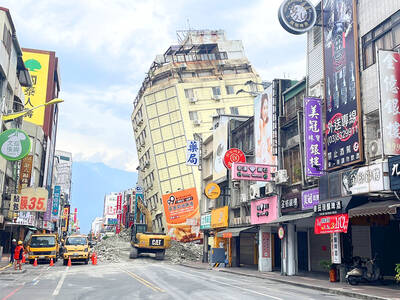
LANDSLIDES POSSIBLE: The agency advised the public to avoid visiting mountainous regions due to more expected aftershocks and rainfall from a series of weather fronts A series of earthquakes over the past few days were likely aftershocks of the April 3 earthquake in Hualien County, with further aftershocks to be expected for up to a year, the Central Weather Administration (CWA) said yesterday. Based on the nation’s experience after the quake on Sept. 21, 1999, more aftershocks are possible over the next six months to a year, the agency said. A total of 103 earthquakes of magnitude 4 on the local magnitude scale or higher hit Hualien County from 5:08pm on Monday to 10:27am yesterday, with 27 of them exceeding magnitude 5. They included two, of magnitude

CONDITIONAL: The PRC imposes secret requirements that the funding it provides cannot be spent in states with diplomatic relations with Taiwan, Emma Reilly said China has been bribing UN officials to obtain “special benefits” and to block funding from countries that have diplomatic ties with Taiwan, a former UN employee told the British House of Commons on Tuesday. At a House of Commons Foreign Affairs Committee hearing into “international relations within the multilateral system,” former Office of the UN High Commissioner for Human Rights (OHCHR) employee Emma Reilly said in a written statement that “Beijing paid bribes to the two successive Presidents of the [UN] General Assembly” during the two-year negotiation of the Sustainable Development Goals. Another way China exercises influence within the UN Secretariat is

Taiwan’s first drag queen to compete on the internationally acclaimed RuPaul’s Drag Race, Nymphia Wind (妮妃雅), was on Friday crowned the “Next Drag Superstar.” Dressed in a sparkling banana dress, Nymphia Wind swept onto the stage for the final, and stole the show. “Taiwan this is for you,” she said right after show host RuPaul announced her as the winner. “To those who feel like they don’t belong, just remember to live fearlessly and to live their truth,” she said on stage. One of the frontrunners for the past 15 episodes, the 28-year-old breezed through to the final after weeks of showcasing her unique


 RSS
RSS