


Hong Kong’s people turned out in thinner numbers yesterday for legislative elections that threatened to set back the pro-democracy opposition and its push for greater political freedoms in the territory.
The opposition camp was expected to win fewer votes than in the 2004 election as concerns about wages, education and inflation overshadowed issues of democratic reform. Four years ago, democratic parties captured new seats amid widespread anger over Beijing-backed officials and policies.
“The democrats face a tough fight,” said Ma Ngok (馬嶽), a political analyst at Hong Kong’s Chinese University. “They could see their presence in the legislature diminished.”
Polls were to stay open for 15 hours, with results expected this morning. Turnout was lagging the pace of the last legislative poll, reaching less than 27 percent by early yesterday evening. A record 55 percent of registered voters cast ballots in 2004.
With all 60 legislative seats up for grabs, aspirants fanned out across the territory to rally supporters.
They chanted slogans from open-top buses cruising through neighborhoods and visited restaurants armed with bundles of campaign leaflets. Election banners and flags adorned buildings everywhere.
Opinion polls showed that high-profile, pro-democracy figures such as Emily Lau (劉慧卿), who has been fighting for democracy in the legislature for 17 years, and maverick activist Leung Kwok-hung (梁國雄) might lose their seats.
Voters directly pick 30 of Hong Kong’s lawmakers, but the other 30 are chosen by special-interest groups such as business leaders, doctors and accountants, who are expected to back pro-Beijing candidates.
The former British colony returned to Chinese rule in 1997. China sought to quel debate over democratic reform last year when it announced that the territory could elect its own leader in 2017 and all of its legislators in 2020, at the earliest.
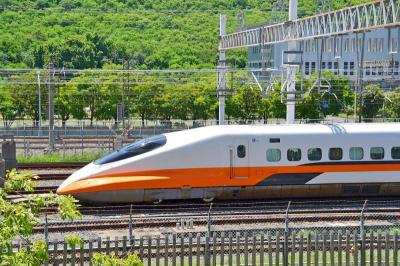
A signaling system malfunction disrupted high-speed rail (HSR) services beginning at 8am today, with trains temporarily reduced to three northbound and three southbound trains per hour as authorities conduct inspections. The malfunction occurred on a section of track in Miaoli County during pre-operation checks early this morning, forcing northbound and southbound trains to use a single track, the HSR operator said. The regular schedule has been replaced with three hourly trains offering only nonreserved seating in each direction, stopping at every station, it said, adding that business class cars would still have reserved seating. Departures from terminal stations are scheduled at the top

Taiwan is still in the process of assessing the possibility of recruiting workers from Eswatini, the Ministry of Foreign Affairs said yesterday, adding that its goal is to help Eswatini upgrade its vocational training centers. If there are plans to recruit workers from Eswatini, safeguarding national security, protecting public health and ensuring the employment rights of Taiwanese would be prerequisites, Department of West Asian and African Affairs Director-General Yen Chia-liang (顏嘉良) told a news conference. Key considerations would also include filling labor shortages in specific industries, and fostering bilateral professional and technical exchanges, he said. Yen was asked about the progress of labor
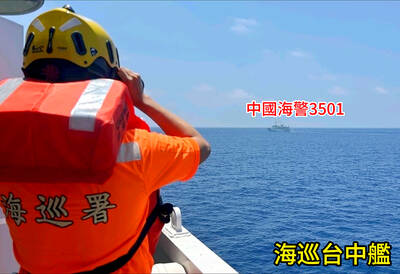
VERBOSE VESSELS: A CGA cutter and a China Coast Guard exchanged verbal barbs for more than a day in Taiwanese-controlled waters before the Chinese vessel left The Taiwanese and Chinese coast guards had a standoff near the strategically located Pratas Islands (Dongsha Islands, 東沙群島) in the north of the South China Sea, the Coast Guard Administration (CGA) said yesterday. The two sides engaged in intense radio exchanges over sovereignty claims during the 33-hour standoff. China Coast Guard vessel 3501 eventually left the restricted waters, 26.6 nautical miles (49.2km) west of the Pratas Islands, at 5pm yesterday, the CGA said. Lying approximately between southern Taiwan and Hong Kong, the Taiwan-controlled Pratas are seen by some security experts as vulnerable to Chinese attack due to their distance — more than

A US uncrewed surface vessel (USV) encountered multiple Chinese warships during an autonomous transit of the Taiwan Strait, US defense company Seasats said in a statement on Wednesday. Seasats announced that a Lightfish USV had completed the first autonomous transit of the Taiwan Strait. Over five days, the USV traversed the entire length of the Strait while constantly monitoring surface vessel traffic, the company said. The Lightfish encountered multiple Chinese warships, one of which was a Chinese People’s Liberation Army Navy (PLAN) Type 056 corvette, it said. The Chinese vessels were operating “well within Taiwan’s exclusive economic zone without transmitting their identity via the


 RSS
RSS