


Clad in a black bikini with shining water beads trickling down her light caramel skin, the American girl with the sun-kissed hair stuck out like a sore thumb on the beach.
But as soon as she picked up her board and paddled out to sea, Jennie Miller of Texas looked like she was in her element, as did the hundred other surfers at Jialeshui (佳樂水), Kenting.
“It was love at first surf,” said Miller, describing her first encounter with the increasingly popular sport in Taiwan.
“I have wanted to learn to surf for a long time and when I saw the opportunity, I grabbed it,” said the Tamkang University MBA student at last month’s Third Annual Kenting Cup International Open Surf Contest.
Miller, who had never surfed before she came to Taiwan two years ago, was among the handful of foreigners who in recent years have discovered the thrills and spills Taiwan’s waves have to offer.
Taiwan may be considered a tropical island, but contrary to the typical image of Pacific islanders, Taiwanese are not known as water sports enthusiasts.
In fact, many adults born in the 1950s can hardly swim without the aid of a floating device.
Seeking to explain the paradox, Soochow University political science professor Luo Chih-cheng (羅致政) said older generations had been raised to dread the ocean because the Chinese Nationalist Party (KMT) regime had deployed barbed wire and gigantic cement blocks along the shores to turn the beaches into military bases during the Martial Law era.
People were not taught to swim, he said, while recreational beaches were only open to a select few.
By no means a major destination on the world’s surfing radar screen, Taiwan has nevertheless been gaining in popularity among locals and expatriates.
Comparing the waves in Taiwan with those in Hong Kong, Indonesia, Australia and the UK, Neil MacDonald, a 52-year-old Englishman and long-term resident of Kenting, touted the waves here as “world class,” albeit quite inconsistent.
“Seventeen years ago, there were maybe two or three American surfers. Six people sharing the beach was considered a crowded day,” he said.
“Now there are too many people,” he said.
Hawaiian Duggar Parrish, 49, said he relished the good old days when he started surfing in Taiwan 11 years ago.
“There was hardly anyone here,” he said. “Back then, there were only a few local boys. The surfing scene in Taiwan has definitely changed.”
Looking “cool,” Parrish said, is the main reason behind the sudden boom.
“It’s the surfing lifestyle that is attracting the young people. The surfing equipment industry in Taiwan is also pumping up the excitement. And most all, surfing is fun, relatively easy to learn and not that expensive,” he said.
Neil Narbonne, another fan of Taiwan’s waves and who grew up both in Taiwan and the US, attributed the growing popularity to the fashion industry.
“Clothing manufacturers made a big push into Taiwan, some are pure surfing brands [OP, RipCurl, O’Neill, Stussy, Billabong] while others are just outdoor manufacturers that also include a surf line [Reef, etc] tied together with the media promoting surfing as a cool sport, as well as a general liberalizing of the youth as can be seen at local night spots,” he said.
Moreover, girls today are more willing to wear bikinis and both boys and girls are more willing to try action sports, he said.
For some seasoned surfers, however, Taiwan is still off their recommended list because of the dangers of surfing — mainly the result of poor supervision, underqualified swimmers and lack of “etiquette” among surfers.
“It is rare to find a lifeguard on beaches, and even if you see one, they are often not properly equipped,” Parrish said, recounting how he and MacDonald rescued two or three unskilled surfers in recent months.
A surfer should be able to swim at least 1km without touching the ocean floor before he can hit the waves, he said.
“But most importantly, you must learn to first understand and respect the ocean,” Parrish said
Surfing is also about maintaining an inner balance of peace and learning how to coexist with Mother Nature, said Michael Cosby, a sexagenarian surfer from Seattle.
“The surfers must be in harmony with the waves, the wind, the board and most of all with yourself [sic]. You must be physically, mentally and emotionally balanced so you can be focused and centered,” he said.
For MacDonald, the danger arises when people violate the surfing “code of ethics.”
Surfing etiquette, among other things, is knowing when to leave a wave alone, especially if another surfer is already riding it, he said.
The lack of surfing etiquette can sometimes be the source of friction between locals and foreign surfers, Narbonne said.
“The locals feel there’s a need to protect their local turf. This tends not to be a problem if you remain courteous and adhere to surfing etiquette, which is the same around the globe. I have seen some small skirmishes that were calmed once the non-local apologized. After all, this is still Taiwan and the ‘face’ issue still exists,” he said.
All the talk about the possible perils of surfing Taiwan seem to be lost on younger surfers like Narbonne, however, who says that surfing in Taiwan is “perfectly safe.”
Typhoons make the sand shift frequently, he said, but even then, it remains very smooth and the water covers the rocks.
“Over the past few years the Coast Guard has been actively issuing warnings and tickets to those who defy warnings to surf during typhoons after the government has issued official typhoon warnings,” he said.
Her eyes firmly glued on the ocean, Miller said she does not worry about safety because the sport is more exciting without the lifeguards.
“Hey, it’s more fun to live on the edge, right?” she said.
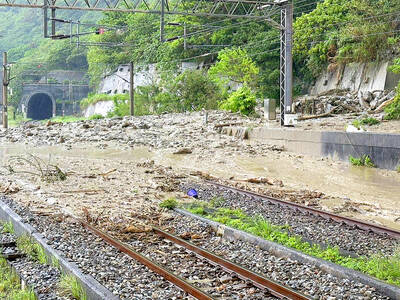
ROLLER-COASTER RIDE: More than five earthquakes ranging from magnitude 4.4 to 5.5 on the Richter scale shook eastern Taiwan in rapid succession yesterday afternoon Back-to-back weather fronts are forecast to hit Taiwan this week, resulting in rain across the nation in the coming days, the Central Weather Administration said yesterday, as it also warned residents in mountainous regions to be wary of landslides and rockfalls. As the first front approached, sporadic rainfall began in central and northern parts of Taiwan yesterday, the agency said, adding that rain is forecast to intensify in those regions today, while brief showers would also affect other parts of the nation. A second weather system is forecast to arrive on Thursday, bringing additional rain to the whole nation until Sunday, it
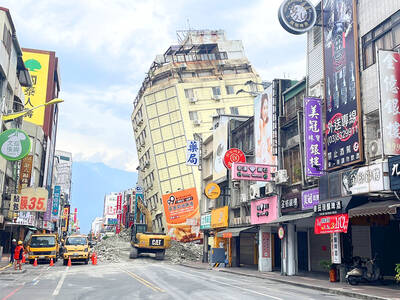
LANDSLIDES POSSIBLE: The agency advised the public to avoid visiting mountainous regions due to more expected aftershocks and rainfall from a series of weather fronts A series of earthquakes over the past few days were likely aftershocks of the April 3 earthquake in Hualien County, with further aftershocks to be expected for up to a year, the Central Weather Administration (CWA) said yesterday. Based on the nation’s experience after the quake on Sept. 21, 1999, more aftershocks are possible over the next six months to a year, the agency said. A total of 103 earthquakes of magnitude 4 on the local magnitude scale or higher hit Hualien County from 5:08pm on Monday to 10:27am yesterday, with 27 of them exceeding magnitude 5. They included two, of magnitude

CONDITIONAL: The PRC imposes secret requirements that the funding it provides cannot be spent in states with diplomatic relations with Taiwan, Emma Reilly said China has been bribing UN officials to obtain “special benefits” and to block funding from countries that have diplomatic ties with Taiwan, a former UN employee told the British House of Commons on Tuesday. At a House of Commons Foreign Affairs Committee hearing into “international relations within the multilateral system,” former Office of the UN High Commissioner for Human Rights (OHCHR) employee Emma Reilly said in a written statement that “Beijing paid bribes to the two successive Presidents of the [UN] General Assembly” during the two-year negotiation of the Sustainable Development Goals. Another way China exercises influence within the UN Secretariat is

Taiwan’s first drag queen to compete on the internationally acclaimed RuPaul’s Drag Race, Nymphia Wind (妮妃雅), was on Friday crowned the “Next Drag Superstar.” Dressed in a sparkling banana dress, Nymphia Wind swept onto the stage for the final, and stole the show. “Taiwan this is for you,” she said right after show host RuPaul announced her as the winner. “To those who feel like they don’t belong, just remember to live fearlessly and to live their truth,” she said on stage. One of the frontrunners for the past 15 episodes, the 28-year-old breezed through to the final after weeks of showcasing her unique


 RSS
RSS