


Taiwan will seek “meaningful participation” in the 16 auxiliary agencies of the UN and forgo the quest for full membership this year, the Ministry of Foreign Affairs said yesterday.
“Our approach this year is based on the principles of pragmatism and flexibility to meet the expectations of the public,” said Andrew Hsia (夏立言), deputy foreign minister, adding that the tactic did not mean the government had given up on seeking full membership in the future.
The text of the ministry’s proposal called for the General Assembly to consider “the fundamental rights of the 23 million people of the Republic of China (Taiwan) to participate meaningfully in the activities of the United Nations specialized agencies.”
The proposal, cosponsored by 17 of Taiwan’s allies — but not the Vatican, Haiti, Guatemala, Paraguay, Panama and the Dominican Republic — must first pass the General Affairs Committee on Sept. 16 before going to the General Assembly.
Only three of Taiwan’s allies are on the 28-member committee.
“It is an extremely difficult task,” Hsia said, adding that Beijing was the stumbling block in Taiwan’s bid to join international organizations.
“The ministry urges China to understand the expectations and will of the 23 million people of Taiwan and calls on Beijing to respond with goodwill and flexibility,” he said.
“China claims it wants to win the hearts and minds of the Taiwanese people. What could be a better way than to stop obstructing our UN bid?” he said.
Hsia said that the focus at this point was not what name the nation should use to join the organization “because the name will not become an issue until the international community has reached a consensus welcoming Taiwan into the fold.”
Hsia said major players such as the US and the EU had reacted “more positively” this year than in previous years.
American Institute in Taiwan spokesman Thomas Hodges declined to comment on the US’ reaction to the strategy except to repeat Washington’s policy that the US does not support membership for Taiwan at international organizations that require statehood, but supports meaningful participation in organizations where full membership is not possible and organizations where statehood is not required.
This year will be Taiwan’s 16th appeal to the UN since 1993 after it forfeited its seat in 1971. Last year Taiwan’s bid sparked strong opposition from the US, EU countries and other countries. The bid used the name “Taiwan.”
President Ma Ying-jeou (馬英九) said at a press conference in Paraguay that this year’s strategy would help the public participate in the UN without harming the nation’s diplomatic interests and cross-strait relations.
Ma said the government was handling the bid in a cautious manner in view of the failure of the two referendums on the country’s membership in the UN earlier this year.
He was referring to the fact that neither the Chinese Nationalist Party (KMT)-initiated referendum on “rejoining” the UN under the name “Republic of China” or any other practical title that would uphold the country’s dignity, nor the Democratic Progressive Party-backed referendum on joining the UN using the name “Taiwan” passed the voter threshold.
Ma said the government had three considerations in mind in determining the bid — public opinion, the reality of the international community and the consequences of the two failed UN referendums.
“Considering all the three factors, the UN proposal should be realistic and flexible,” Ma said.
Ma said the failure of the UN referendums had left the country with less room to strive for UN membership from a legal perspective.
The fact that the participation rate for both referendums was under 36 percent meant that the people of Taiwan felt regret that they could not participate in the UN but that the public at the same time did not consider adopting the referendums urgent, Ma said.
Ma said the government must take the referendum results seriously as they have symbolic meaning.
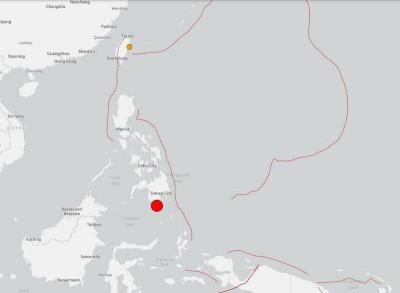
A magnitude 7.8 earthquake struck off the southern coast of Mindanao in the Philippines at 7:38am today, prompting the US Tsunami Warning System to issue an alert for neighboring countries, including Taiwan. The system issued a purple alert indicating a "tsunami threat." The potential threat zone includes Taiwan, the Philippines, Papua New Guinea, Yap and Palau. Philippine authorities were assessing the damage from the quake, with the office of civil defense seeking to verifying initial reports that 15 people had been killed and 129 injured in the region, mostly from falling debris. Arlene Hollero, disaster chief of Maasim town in the Philippines' Sarangani Province,
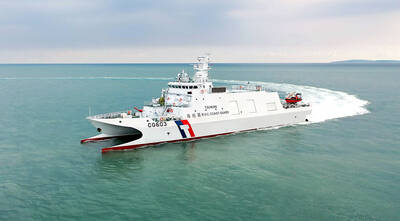
‘GRAY ZONE’ PRESSURE: Beijing’s activities are intended to create the deceitful impression that China has jurisdiction over the area around Taiwan, the CGA said Taiwan’s rights over its territorial waters and exclusive economic zone must not be violated by any country, the Mainland Affairs Council said yesterday, adding that it will not accept any unprovoked actions. The council issued the remarks in response to the China Coast Guard conducting maritime enforcement drills near eastern Taiwan and claiming to fully exercise China’s maritime administrative law enforcement authority. The Coast Guard Administration (CGA) has been closely monitoring the situation and is taking concrete steps to defend the nation’s sovereignty and secure its waters, the council said. China has no sovereign rights over the waters off eastern

RESILIENCE: Taiwan plays a key role in semiconductors, energy, information infrastructure and advanced manufacturing, AIT Director Raymond Greene said Taiwan’s continued investment in deterrence and resilience remains vital, especially in uncrewed systems and other emerging technologies, American Institute in Taiwan (AIT) Director Raymond Greene said yesterday. Greene made the remarks at the annual National Strategic Summit on Supply Chain Resilience held by the Research Institute for Democracy, Society and Emerging Technology (DSET), a government-backed think tank. As Taiwan last year became the US’ fourth-largest trading partner and supply chain security is becoming more important, cooperation in emerging technologies continues to deepen between the two countries, he said. The US is committed to accelerating innovation, building key infrastructure, strengthening cooperation

RIGHT DIRECTION: Taiwan’s efforts to prevent forced labor include a proposal to ‘fully prohibit’ employers from withholding workers’ documents, an official said Taiwan is to establish a mechanism to restrict imports of goods linked to forced labor, the Executive Yuan said yesterday, after the US proposed imposing additional tariffs on Taiwanese goods over labor concerns. “The Ministry of Labor and the Ministry of Economic Affairs are to establish an interministerial review procedure,” Executive Yuan spokesperson Michelle Lee (李慧芝) said at a news briefing in Taipei. “The government is to use the Foreign Trade Act [貿易法] as the legal basis to restrict imports of goods produced with forced labor” and bring its supply chain governance more in line with international standards on human rights, resilience


 RSS
RSS