


International Olympic Committee (IOC) officials have cut a deal with China to allow the blocking of sensitive Web sites from media during the Beijing Games, press chief Kevan Gosper said yesterday.
Gosper, chairman of the IOC’s press commission, had previously said that Internet access for the 21,500 media accredited for the Games would be “open.”
“I ... now understand that some IOC officials negotiated with the Chinese that some sensitive sites would be blocked on the basis they were not considered Games related,” the Australian said.
“It has been my belief, and I have expressed it consistently, that the international media would enjoy free and open access to the Internet at Games time for reporting the Olympic Games and that censorship would not be an issue,” Gosper said.
“I regret that it now appears BOCOG [Beijing Organizing Committee for the Olympic Games] has announced that there will be limitations on Web site access during Games time and, while I understand that sensitive material not related to the Olympic Games continues to be a matter for the Chinese, I believe BOCOG and the IOC should have conveyed a clear message to the international media, in so far as this affects Internet access, at an earlier stage,” he said.
Beijing organizers said censorship would not stop journalists doing their jobs in reporting the Games.
“We are going to do our best to facilitate the foreign media to do their reporting work through the Internet,” BOCOG spokesman Sun Weide (孫維德) told a news conference.
However, Sun said China’s pledge was only to allow foreign reporters enough information to carry out their duties to cover the Games, not to have unfettered Internet access.
“Our promise was that journalists would be able to use the Internet for their work during the Olympic Games,” he said. “So we have given them sufficient access to do that.”
Liu Binjie (柳斌杰), the head of China’s Ministry of Press and Publications, told Xinhua new agency yesterday that critics defamed China “with stereotypes constructed from hearsay and prejudice in their mind, regardless of the reality.”
He also said new media regulations were being drawn up to replace those issued for the Olympics, which will expire in October.
“China’s open door to the foreign media will not close after the Games,” Liu said.
Press freedom advocates Reporters Without Borders, however, described the reversal of the press freedom pledge as a humiliation for IOC president Jacques Rogge.
“When China applied to host the Games they promised total press freedom and that must include Internet access,” said Vincent Brossel, the group’s Asia Director.
“What a total humiliation this is for Jacques Rogge. How can the IOC be so weak and feeble,” Brossel said.
Web sites that deal with subjects deemed too sensitive by China were blocked at the Olympic media center yesterday, prompting the message: “Impossible to display the page.” These included sites dealing the the Falun Gong as well as US and European broadcasters.
Meanwhile, the Foreign Correspondents’ Club (FCC) of Hong Kong yesterday criticized China’s treatment of reporters at the chaotic final sale of Olympic tickets on Friday, calling it “wholly unacceptable.”
The FCC, in a letter to China’s foreign ministry office in Hong Kong, called on Beijing to issue stricter guidelines to police and security forces on how to deal with journalists, after a photographer was manhandled and detained.
Felix Wong, a photojournalist for the South China Morning Post, was detained for several hours on Friday by Beijing police for “not following control measures” during the ticket sale. Other journalists trying to cover the scramble of some 40,000 Olympic ticket buyers for last-minute tickets said they were injured by officers at the scene.
Also See: Bush shares human rights worries with Chinese dissidents

SILENCING CRITICS: In addition to blocking Taiwan, China aimed to prevent rights activists from speaking out against authoritarian states, a Cabinet department said The Ministry of Foreign Affairs (MOFA) yesterday condemned transnational repression by Beijing after RightsCon, a major digital human rights conference scheduled to be held in Zambia this week, was abruptly canceled due to Chinese pressure over Taiwanese participation. This year’s RightsCon, the world’s largest conference discussing issues “at the intersection of human rights and technology,” was scheduled to take place from tomorrow to Friday in Lusaka, and expected to draw 2,600 in-person attendees from 150 countries, along with 1,100 online participants. However, organizers were forced to cancel the event due to behind-the-scenes pressure from China, the ministry said, expressing its “strongest condemnation”
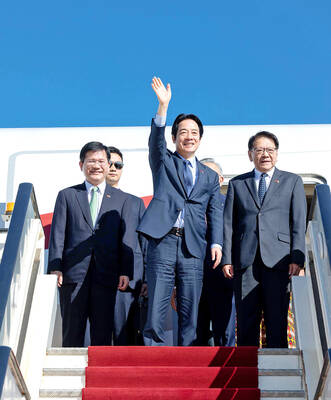
DELAYED BUT DETERMINED: The president’s visit highlights Taiwan’s right to international engagement amid regional pressure from China President Willaim Lai (賴清德) yesterday arrived in Eswatini, more than a week after his planned visit to Taiwan’s sole African ally was suspended because of revoked overflight permits. “The visit, originally scheduled for April 22, was postponed due to unforeseen external factors,” Lai wrote on social media. “After several days of careful arrangements by our diplomatic and national security teams, we successfully arrived today.” Lai said he looked forward to further deepening Taiwan-Eswatini relations through closer cooperation in the economy, agriculture, culture and education, as well as advancing the nation’s international partnerships. The president was initially scheduled to arrive in time to celebrate
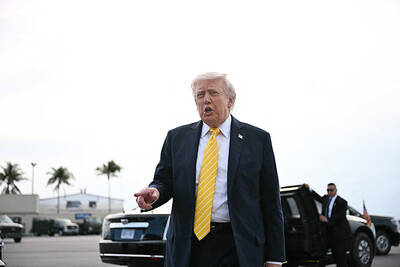
Iran’s Islamic Revolutionary Guard Corp (IRGC) yesterday said the US faced a choice between an “impossible” military operation or a “bad deal” with Tehran, after US President Donald Trump disparaged Iran’s latest peace proposal. Negotiations between the two countries have been deadlocked since a ceasefire came into effect on April 8, with only one round of direct peace talks held so far. Iran’s Tasnim and Fars news agencies reported that Tehran had submitted a 14-point proposal to mediator Pakistan, but Trump was quick to cast doubt on it. “I will soon be reviewing the plan that Iran has just sent to us, but

A group affiliated with indicted Chinese immigrant Xu Chunying (徐春鶯) is to be dissolved for monitoring Chinese immigrants in Taiwan, a source said yesterday. Xu, the secretary-general of the Cross-Strait Marriage and Family Service Alliance, was indicted on March 24 on charges of violating the Anti-Infiltration Act (反滲透法). The alliance “illegally monitored" Chinese immigrants living in Taiwan on behalf of the Chinese Communist Party (CCP) and the Ministry of the Interior is expected to dissolve the organization in the coming days under provisions of the Civil Associations Act (人民團體法), the source said. Xu, who married a Taiwanese in 1993 and became a Republic


 RSS
RSS