


Taiwan and China agreed yesterday to set up permanent offices in each other’s territories to coordinate ongoing contacts.
Both also announced they had reached an agreement on all provisions regarding the launch of weekend cross-strait charter flights, with negotiations on cargo charter flights expected to be completed within three months.
The agreements came on the first day of talks between the Straits Exchange Foundation (SEF) and its Chinese counterpart, the Association for Relations Across the Taiwan Strait (ARATS).
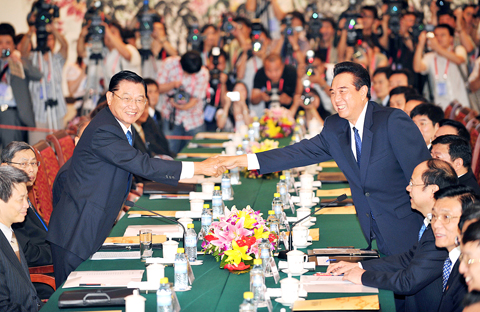
PHOTO: AFP
A SEF spokeswoman said a consensus on the move to set up offices in each other’s capitals was reached during talks yesterday in Beijing. The spokeswoman, speaking on condition of anonymity, said a formal announcement would be made later, although details had yet to be hammered out.
China’s Xinhua news agency cited SEF Deputy Secretary-General Pang Chien-kuo (龐建國) as implying that the offices could perform some consular functions because they would “facilitate people’s exchanges and traveling across the Strait.”
The announcement injected a whiff of drama into an otherwise relatively mundane talks agenda that seeks mainly to finalize agreements on charter flights and tourism.
As for weekend charter flights, the two sides were expected to officially sign the agreement today, after which SEF Chairman Chiang Pin-kung (江丙坤) was scheduled to meet Chinese President Hu Jintao (胡錦濤).
The negotiations should lay the foundation for “a long-term peaceful relationship between the two sides,” Chiang said as the talks opened. “The two sides have ... established mutual trust.”
His counterpart, Chen Yunlin (陳雲林), said “the compatriots on both sides” were counting on the talks to produce results and alter the often combative tone between the two governments.
Chen yesterday also accepted an invitation from Chiang to visit Taiwan later this year. After concluding talks on the charter flight issue yesterday morning, negotiators discussed issue of the Chinese tourists to Taiwan.
Meanwhile, in Taipei, Premier Lu Chao-shiuan (劉兆玄) was quoted as saying by Cabinet spokeswoman Vanessa Shih (史亞平) yesterday that “the government should make an all- out effort to make preparations for the opening of the nation to more Chinese tourists and the implementation of weekend passenger charter flights,” expected to start next month.
The preparation work includes enhancing software and hardware facilities in airports, training reception personnel and planning tourist attractions, Shih said, adding that Liu would make inspections to monitor progress when necessary.
The Democratic Progressive Party (DPP) yesterday reiterated its criticism of the Chinese Nationalist Party (KMT) administration for allowing China to set the course for the talks and vowed to closely monitor the negotiations with Beijing.
Lin Chen-wei (林成蔚), director of the DPP’s Department of International Affairs, said the party was stunned to see two new issues placed on the agenda — establishing liaison offices and joint exploration of oil resources.
The DPP asked if the Mainland Affairs Council (MAC) had authorized the SEF to discuss such matters, Lin said, adding that the negotiators may have gone beyond their brief if they were not authorized to talk about the extra items.
Lin said President Ma Ying-jeou (馬英九) should say whether he had directly ordered the SEF to talk about the new issues and kept the MAC in the dark.
Lin said the KMT must tell the public how they plan to ensure the interest of the people of Taiwan and dignity of the country if both sides are to establish a representative office.
The DPP caucus criticized China for “faking peace,” noting that Chinese missiles remain aimed at Taiwan.
“They will try to stab you in the back while smiling at you. This is what they are,” DPP caucus whip William Lai (賴清德) told a press conference. “Our new government tried to please China by downgrading ourselves. This is not ‘negotiation.’ This is surrendering.’”
ADDITIONAL REPORTING BY SHIH HSIU-CHUAN, KO SHU-LING AND JIMMY CHUANG
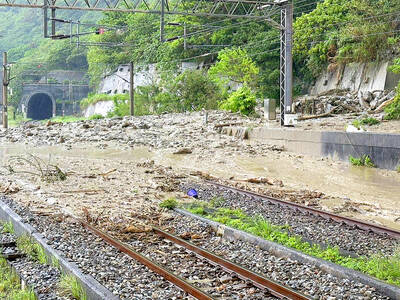
ROLLER-COASTER RIDE: More than five earthquakes ranging from magnitude 4.4 to 5.5 on the Richter scale shook eastern Taiwan in rapid succession yesterday afternoon Back-to-back weather fronts are forecast to hit Taiwan this week, resulting in rain across the nation in the coming days, the Central Weather Administration said yesterday, as it also warned residents in mountainous regions to be wary of landslides and rockfalls. As the first front approached, sporadic rainfall began in central and northern parts of Taiwan yesterday, the agency said, adding that rain is forecast to intensify in those regions today, while brief showers would also affect other parts of the nation. A second weather system is forecast to arrive on Thursday, bringing additional rain to the whole nation until Sunday, it
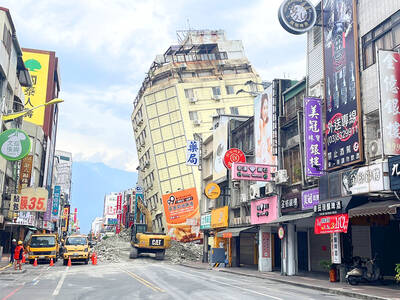
LANDSLIDES POSSIBLE: The agency advised the public to avoid visiting mountainous regions due to more expected aftershocks and rainfall from a series of weather fronts A series of earthquakes over the past few days were likely aftershocks of the April 3 earthquake in Hualien County, with further aftershocks to be expected for up to a year, the Central Weather Administration (CWA) said yesterday. Based on the nation’s experience after the quake on Sept. 21, 1999, more aftershocks are possible over the next six months to a year, the agency said. A total of 103 earthquakes of magnitude 4 on the local magnitude scale or higher hit Hualien County from 5:08pm on Monday to 10:27am yesterday, with 27 of them exceeding magnitude 5. They included two, of magnitude

CONDITIONAL: The PRC imposes secret requirements that the funding it provides cannot be spent in states with diplomatic relations with Taiwan, Emma Reilly said China has been bribing UN officials to obtain “special benefits” and to block funding from countries that have diplomatic ties with Taiwan, a former UN employee told the British House of Commons on Tuesday. At a House of Commons Foreign Affairs Committee hearing into “international relations within the multilateral system,” former Office of the UN High Commissioner for Human Rights (OHCHR) employee Emma Reilly said in a written statement that “Beijing paid bribes to the two successive Presidents of the [UN] General Assembly” during the two-year negotiation of the Sustainable Development Goals. Another way China exercises influence within the UN Secretariat is

Taiwan’s first drag queen to compete on the internationally acclaimed RuPaul’s Drag Race, Nymphia Wind (妮妃雅), was on Friday crowned the “Next Drag Superstar.” Dressed in a sparkling banana dress, Nymphia Wind swept onto the stage for the final, and stole the show. “Taiwan this is for you,” she said right after show host RuPaul announced her as the winner. “To those who feel like they don’t belong, just remember to live fearlessly and to live their truth,” she said on stage. One of the frontrunners for the past 15 episodes, the 28-year-old breezed through to the final after weeks of showcasing her unique


 RSS
RSS