


The Ministry of Foreign Affairs (MOFA) yesterday performed an about turn on its recommendation on Wednesday that embassies and representative offices use the title “Republic of China (ROC)” instead of “Taiwan” on invitations to foreign dignitaries.
The recommendation also included using the term “Mainland China” instead of “The People’s Republic of China (PRC)” when referring to China.
The Chinese-language Liberty Times (the Taipei Times’ sister newspaper) reported yesterday that the ministry had sent a notice to all embassies and representative offices two weeks ago informing them of its decision, saying the name “ROC” could best safeguard the nation’s sovereignty because it referred to the country by its official designation.
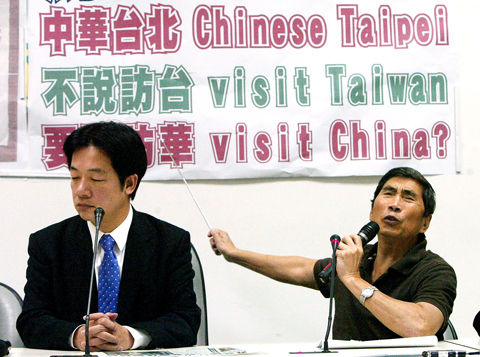
PHOTO: CNA
The document said that the decision was in keeping with President Ma Ying-jeou’s (馬英九) stance on cross-strait relations based on the so-called “1992 consensus.” To maintain the “status quo,” all official documents henceforth had to use “Mainland China” or “Mainland” when referring to China and use “visit the Republic of China” instead of “visit Taiwan” when referring to foreigners interested in visiting the nation, it said.
Many envoys were reportedly surprised when informed of the ministry’s decision. Some voiced surprise at why they could not continue using the name “Taiwan” and had to replace it with “ROC” even while reverting to the use of “Mainland China” or “Mainland.”
Minister of Foreign Affairs Francisco Ou (歐鴻鍊) said yesterday morning that the recommendation to use the name “ROC” was not meant to downplay Taiwan, but to promote the Republic of China.
He added that using the term “Mainland China” not only suited the new administration’s stance, but also got around the issue of “two separate countries.”
The minister, however, changed his tune less than three hours later, saying the ministry would postpone the recommendation until a consensus on the issue had been reached.
“We saw from the news that there were many opposing voices. I think it would be better to hold off for now,” Ou said in an emergency press conference yesterday afternoon.
Democratic Progressive Party (DPP) spokesman Cheng Wen-tsang (鄭文燦) condemned the attempted change yesterday, saying it was tantamount to eradicating Taiwanese consciousness.
He also said that most people now refer to relations between Taiwan and the US as “Taiwan-US” relations and not “China-US” relations.
DPP Legislator Chai Trong-rong (蔡同榮) said yesterday that he would question Ou on the English translation.
“It took us a lot of time to establish the image of ‘Taiwan’ in international society so people would not be confused between the ‘Republic of China’ and the ‘People’s Republic of China.’ Ou is trying to take us back to where we were years ago. This is absurd,” Chai said.
Ministry spokeswoman Phoebe Yeh (葉非比) later told the Taipei Times that the recommendation on using the term “Mainland China” would also be held back until a public consensus was reached.
She said that the ministry’s recommendation was only meant to advise the offices that it would be more appropriate to use those terms, but that the ministry would also allow a certain degree of flexibility.
Additional reporting by Fan Cheng-hsiang, Li Hsin-fang, Peng Hsien-chun and Jimmy Chuang

A signaling system malfunction disrupted high-speed rail (HSR) services beginning at 8am today, with trains temporarily reduced to three northbound and three southbound trains per hour as authorities conduct inspections. The malfunction occurred on a section of track in Miaoli County during pre-operation checks early this morning, forcing northbound and southbound trains to use a single track, the HSR operator said. The regular schedule has been replaced with three hourly trains offering only nonreserved seating in each direction, stopping at every station, it said, adding that business class cars would still have reserved seating. Departures from terminal stations are scheduled at the top

Taiwan is still in the process of assessing the possibility of recruiting workers from Eswatini, the Ministry of Foreign Affairs said yesterday, adding that its goal is to help Eswatini upgrade its vocational training centers. If there are plans to recruit workers from Eswatini, safeguarding national security, protecting public health and ensuring the employment rights of Taiwanese would be prerequisites, Department of West Asian and African Affairs Director-General Yen Chia-liang (顏嘉良) told a news conference. Key considerations would also include filling labor shortages in specific industries, and fostering bilateral professional and technical exchanges, he said. Yen was asked about the progress of labor

VERBOSE VESSELS: A CGA cutter and a China Coast Guard exchanged verbal barbs for more than a day in Taiwanese-controlled waters before the Chinese vessel left The Taiwanese and Chinese coast guards had a standoff near the strategically located Pratas Islands (Dongsha Islands, 東沙群島) in the north of the South China Sea, the Coast Guard Administration (CGA) said yesterday. The two sides engaged in intense radio exchanges over sovereignty claims during the 33-hour standoff. China Coast Guard vessel 3501 eventually left the restricted waters, 26.6 nautical miles (49.2km) west of the Pratas Islands, at 5pm yesterday, the CGA said. Lying approximately between southern Taiwan and Hong Kong, the Taiwan-controlled Pratas are seen by some security experts as vulnerable to Chinese attack due to their distance — more than

A US uncrewed surface vessel (USV) encountered multiple Chinese warships during an autonomous transit of the Taiwan Strait, US defense company Seasats said in a statement on Wednesday. Seasats announced that a Lightfish USV had completed the first autonomous transit of the Taiwan Strait. Over five days, the USV traversed the entire length of the Strait while constantly monitoring surface vessel traffic, the company said. The Lightfish encountered multiple Chinese warships, one of which was a Chinese People’s Liberation Army Navy (PLAN) Type 056 corvette, it said. The Chinese vessels were operating “well within Taiwan’s exclusive economic zone without transmitting their identity via the


 RSS
RSS