


Myanmar’s junta impounded two UN food aid shipments at Yangon airport yesterday, officials said, triggering more outrage at the military government’s refusal to accept a major international relief operation.
“We’re going to have to shut down our very small airlift operation until we get guarantees from the authorities,” a furious World Food Programme regional director Tony Banbury told CNN.
The two shipments, 38 tonnes of high-energy biscuits, were enough to feed 95,000 people — a tiny fraction of the estimated 1.5 million destitute survivors of Cyclone Nargis, which ripped into the Southeast Asian nation six days ago.
“It should be on trucks headed to the victims. You’ve seen the conditions they are in. That food is now sitting on a tarmac doing no good,” Banbury said.
The generals are adamant that only they will distribute the emergency aid that is arriving after the worst cyclone to hit Asia since 1991, when 143,000 people were killed in Bangladesh.
Thai Prime Minister Samak Sundaravej had to cancel a planned trip to Myanmar this weekend to ask the junta to open their doors just hours after he said he would go.
“After they said today they would not welcome foreign staff, there is no point in me going there,” Samak said.
In a statement in the official media after Myanmar turned back a team of Qatari rescue workers coming in on an aid flight this week, the foreign ministry said Myanmar would accept “relief in cash and kind” but not foreign aid workers.
“Myanmar is not in a position to receive rescue and information teams from foreign countries at the moment,” the statement said. “But at present Myanmar is giving priority to receiving relief aid and distributing it to the storm-hit regions.
The junta’s refusal to let in foreign aid workers has not stopped donors from opening their wallets.
The Gates Foundation donated US$3 million for relief efforts in Myanmar and will provide software to help reunite family members separated in the cyclone, Gates, the Microsoft chairman, said yesterday.
The funds were sent to aid agencies Mercy Corps, Worldvision and Care “so they can go in there and help as quickly as possible,” Gates said.
Gates’ donation is about as much as the total money pledged by the US government — US$3.25 million.
However, Myanmar’s military government has refused to allow US relief planes to fly in. It also refuses to give visas to UN experts who want to assess the damage and manage logistics.
By Thursday the UN had recorded donations to Myanmar totaling US$25 million from 28 nations, the EU and charities. An additional US$25 million has been pledged by donors.
The figure also jumped yesterday with another US$10 million that Japan promised to give through the United Nations Children’s Fund, the Office of the United Nations High Commissioner for Refugees and the World Food Programme.
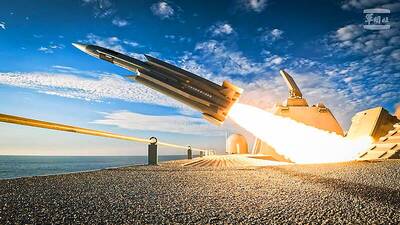
DETERRENCE: With 1,000 indigenous Hsiung Feng II and III missiles and 400 Harpoon missiles, the nation would boast the highest anti-ship missile density in the world With Taiwan wrapping up mass production of Hsiung Feng II and III missiles by December and an influx of Harpoon missiles from the US, Taiwan would have the highest density of anti-ship missiles in the world, a source said yesterday. Taiwan is to wrap up mass production of the indigenous anti-ship missiles by the end of year, as the Chungshan Institute of Science and Technology has been meeting production targets ahead of schedule, a defense official with knowledge of the matter said. Combined with the 400 Harpoon anti-ship missiles Taiwan expects to receive from the US by 2028, the nation would have

North Korea yesterday fired about 10 ballistic missiles to the sea toward Japan, the South Korean Joint Chiefs of Staff (JCS) said, days after Pyongyang warned of “terrible consequences” over ongoing South Korea-US military drills. Pyongyang recently dashed hopes of a diplomatic thaw with Seoul, Washington’s security ally, describing its latest peace efforts as a “clumsy, deceptive farce.” Seoul’s military detected “around 10 ballistic missiles launched from the Sunan area in North Korea toward the East Sea [Sea of Japan] at around 1:20pm,” JCS said in a statement, referring to South Korea’s name for the body of water. The missiles

‘UNWAVERING FRIENDSHIP’: A representative of a Japanese group that co-organized a memorial, said he hopes Japanese never forget Taiwan’s kindness President William Lai (賴清德) yesterday marked the 15th anniversary of the Tohoku earthquake and tsunami, urging continued cooperation between Taiwan and Japan on disaster prevention and humanitarian assistance. Lai wrote on social media that Taiwan and Japan have always helped each other in the aftermath of major disasters. The magnitude 9 earthquake struck northeastern Japan on March 11, 2011, triggering a massive tsunami that claimed more than 19,000 lives, according to data from Japanese authorities. Following the disaster, Taiwan donated more than US$240 million in aid, making it one of the largest contributors of financial assistance to Japan. In addition to cash donations and
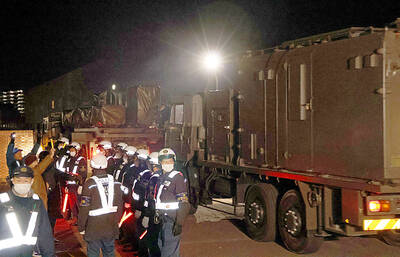
CLOSER TO CHINA: The upgraded Type-12 missile has a range of about 1,000km, compared with the original model’s range of 200km, and can reach mainland China Japan is preparing to deploy its first batch of domestically developed long-range missiles, with their launchers arriving at an army camp yesterday, as the country accelerates its offensive capability in response to rising challenges in the region. The upgraded Type-12 land-to-ship missiles are to be deployed at Camp Kengun in Japan’s southwestern prefecture of Kumamoto by the end of this month, completing the process of deployment, Japanese Chief Cabinet Secretary Minoru Kihara said without giving details. Army vehicles carrying the launchers and other equipment arrived past midnight in a highly secretive mission criticized by residents. Dozens of people stood outside of the


 RSS
RSS