


China and France sought yesterday to cool tempers over Tibet and the Olympics, with a former French prime minister heading to Beijing for top-level talks criticizing a decision to honor the Dalai Lama.
Jean-Pierre Raffarin, who arrives today bearing a message from French President Nicolas Sarkozy, said the Paris city council had contradicted official policy by conferring honorary citizenship on the Tibetan spiritual leader.
Raffarin is one of three senior French figures visiting Beijing this week, all carrying letters from Sarkozy as the president tries to repair relations damaged by pro-Tibet protests in France and hurt pride in China.
At the same time, the Chinese commerce ministry warned against an ongoing boycott of French supermarket giant Carrefour, noting that it employs 40,000 workers here and that up to 95 percent of its products are made in China.
Raffarin is due today to meet the Chinese premier and is expected to pass on Sarkozy’s letter at a separate meeting to the Chinese president.
In the southern city of Zhuzhou, protesters reportedly attacked a young US teacher on Sunday evening after he emerged from a local Carrefour.
Accounts on numerous Internet boards said the man was punched, pushed and chased and was only rescued by police after taking refuge in a taxi. The US embassy in Beijing said it had no information it could release about the incident under rules requiring a privacy waiver.
Meanwhile, six people were arrested as the Olympic flame arrived in Australia yesterday, while officials said they were prepared for more protests on the latest leg of the troubled global torch relay.
Even before a chartered airliner carrying the flame touched down in Canberra under tight security, protesters used the Sydney Harbour Bridge as a backdrop for their pro-Tibet message.
A man and a woman attempting to unfurl a banner and a Tibetan flag on the iconic landmark were arrested hours after lasers beamed pro-Tibet slogans including “Don’t torch Tibet” onto one of the structure’s pylons.
Four more people were taken into custody after raising a pro-Tibet banner on a prominent billboard in the city’s King’s Cross nightlife district, police said.
Australian officials have shortened today’s relay route through Canberra over concerns about security at an event expected to attract thousands of pro-China supporters and pro-Tibet demonstrators.
Barriers have been erected along the 16km route and more than half of the city’s police force will be on patrol.
Police said they were confident that security would be adequate, despite a dispute between Australian and Chinese officials over the role of the torch’s Chinese escorts.
A Beijing Olympics torch relay spokesman, backed by the Chinese ambassador, said that the escorts could use their bodies to protect the flame if necessary.
But Stanhope said this condition had not been agreed to by the Australian government.
In related developments, China has altered plans for foreign media coverage of the Olympic flame’s ascent of Mount Everest, citing weather conditions.
Changes to the plans mean foreign reporters would spend only 10 days overall in Tibet — about half the time initially planned.

SILENCING CRITICS: In addition to blocking Taiwan, China aimed to prevent rights activists from speaking out against authoritarian states, a Cabinet department said The Ministry of Foreign Affairs (MOFA) yesterday condemned transnational repression by Beijing after RightsCon, a major digital human rights conference scheduled to be held in Zambia this week, was abruptly canceled due to Chinese pressure over Taiwanese participation. This year’s RightsCon, the world’s largest conference discussing issues “at the intersection of human rights and technology,” was scheduled to take place from tomorrow to Friday in Lusaka, and expected to draw 2,600 in-person attendees from 150 countries, along with 1,100 online participants. However, organizers were forced to cancel the event due to behind-the-scenes pressure from China, the ministry said, expressing its “strongest condemnation”
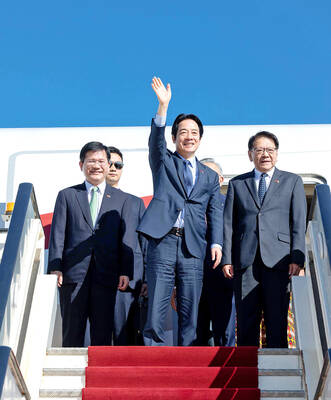
DELAYED BUT DETERMINED: The president’s visit highlights Taiwan’s right to international engagement amid regional pressure from China President Willaim Lai (賴清德) yesterday arrived in Eswatini, more than a week after his planned visit to Taiwan’s sole African ally was suspended because of revoked overflight permits. “The visit, originally scheduled for April 22, was postponed due to unforeseen external factors,” Lai wrote on social media. “After several days of careful arrangements by our diplomatic and national security teams, we successfully arrived today.” Lai said he looked forward to further deepening Taiwan-Eswatini relations through closer cooperation in the economy, agriculture, culture and education, as well as advancing the nation’s international partnerships. The president was initially scheduled to arrive in time to celebrate
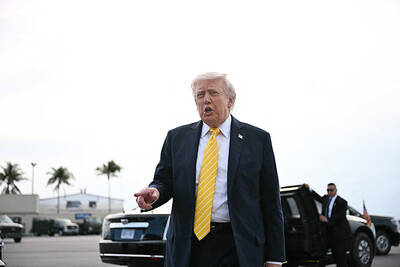
Iran’s Islamic Revolutionary Guard Corp (IRGC) yesterday said the US faced a choice between an “impossible” military operation or a “bad deal” with Tehran, after US President Donald Trump disparaged Iran’s latest peace proposal. Negotiations between the two countries have been deadlocked since a ceasefire came into effect on April 8, with only one round of direct peace talks held so far. Iran’s Tasnim and Fars news agencies reported that Tehran had submitted a 14-point proposal to mediator Pakistan, but Trump was quick to cast doubt on it. “I will soon be reviewing the plan that Iran has just sent to us, but

A group affiliated with indicted Chinese immigrant Xu Chunying (徐春鶯) is to be dissolved for monitoring Chinese immigrants in Taiwan, a source said yesterday. Xu, the secretary-general of the Cross-Strait Marriage and Family Service Alliance, was indicted on March 24 on charges of violating the Anti-Infiltration Act (反滲透法). The alliance “illegally monitored" Chinese immigrants living in Taiwan on behalf of the Chinese Communist Party (CCP) and the Ministry of the Interior is expected to dissolve the organization in the coming days under provisions of the Civil Associations Act (人民團體法), the source said. Xu, who married a Taiwanese in 1993 and became a Republic


 RSS
RSS