


Vietnam blasted into the satellite age yesterday when a rocket launch from South America propelled its first orbiter into space, allowing it to beam home telecoms data and TV signals.
From a command center set amid lush rice fields outside the capital, Hanoi, scientists tracked the Arianespace rocket as it propelled the Vinasat-1 on its path to hover 36,000km above the equator.
“This project is politically, economically and socially important,” Vietnamese Prime Minister Nguyen Tan Dung said soon after the launch, adding that it would help to “raise Vietnam’s image on the international stage.”
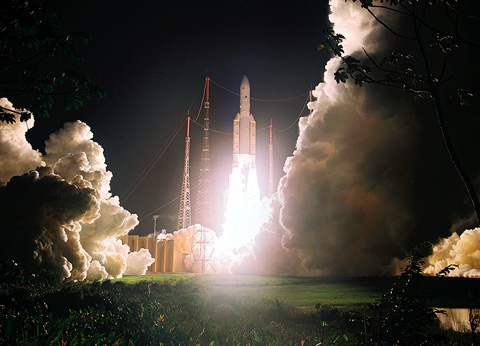
PHOTO: AP
The blast-off may only have been a small step for the European space agency in French Guiana, but it represents one great leap for Vietnam, a developing country with patchy phone coverage that only introduced the Internet a decade ago.
War-shattered and largely isolated until the early 1990s, Vietnam has seen a decade of rapid economic growth and is now racing to build the infrastructure to match the rising expectations of investors and its 86 million people.
ON THE MAP
The satellite project, which cost about US$300 million, “puts Vietnam on the map of the world for using satellite communications,” Deputy Information and Communications Minister Tran Duc Lai said.
“Demand for communications is now booming. Ten years ago we had only fixed telephones. Then we introduced mobiles. Since 1997 we started to introduce the Internet,” he said.
“Now there is very high demand. We have around 23 percent of people who can access the Internet. By 2010 the target is to reach 40 percent,” he said.
The nerve center of the satellite project is a walled compound packed with computers and a 13m wide satellite dish on Hanoi’s western urban outskirts in Ha Tay Province — an area where the old Vietnam meets the new.
In the shadow of the command and control center, where technicians’ eyes are peeled on flat-screen monitors, farmers use buffalo to plow rice fields and wood carvers make religious artifacts in nearby Son Dong village.
Yet only a few minutes’ drive away begins the urban sprawl of the capital, with construction crews and bulldozers forging a six-lane highway, lined with industrial plants, through centuries-old rice paddies.
Vinasat, a satellite made by US company Lockheed Martin, will seek to close the communication — and economic — gap between urban Vietnam and the other 70 percent of the population who live in the countryside, Lai said.
“The geography of Vietnam is very complicated [with] a lot of remote areas, a lot of high mountains, a lot of islands,” he said.
“A satellite can provide all kinds of services — telecom, Internet, radio and TV broadcasting — to every corner of the country,” he said.
Vietnam’s phone coverage has grown from 1 percent of the population in 1995 to 57 percent, with the largest gaps in the most remote areas, said Lam Hoang Vinh, vice president of the Vietnam Posts and Telecommunications Group.
“Thirty percent of people still don’t receive television,” he said. “With the satellite, people in mountainous and remote areas can now have the same facilities as people in urban areas.”
TELEMEDICINE
Vinasat, with a capacity equivalent to 120 TV channels, could also bring long-distance learning and telemedicine to the most isolated regions, said Jim Gribbon, Lockheed Martin’s vice president for Southeast Asia.
Vietnam got its first taste of satellite transmissions when a Russian Sputnik beamed in the 1980 Moscow Olympics, and it has so far been forced to lease satellite capacity from other countries.
With Vinasat now orbiting high above the Indonesia-Papua New Guinea border — casting a “footprint” that spans parts of Japan, Australia and Myanmar — Vietnam hopes to sell excess capacity to its neighbors.
“Other countries, like Thailand and Singapore, have already contacted us,” Vinh said.
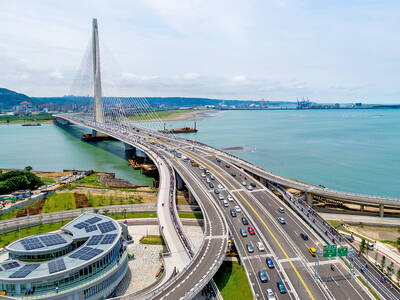
The Ministry of Transportation and Communications yesterday inaugurated the Danjiang Bridge across the Tamsui River in New Taipei City, saying that the structure would be an architectural icon and traffic artery for Taiwan. Feted as a major engineering achievement, the Danjiang Bridge is 920m long, 211m tall at the top of its pylon, and is the longest single-pylon asymmetric cable-stayed bridge in the world, the government’s Web site for the structure said. It was designed by late Iraqi-British architect Zaha Hadid. The structure, with a maximum deck of 70m, accommodates road and light rail traffic, and affords a 200m navigation channel for boats,
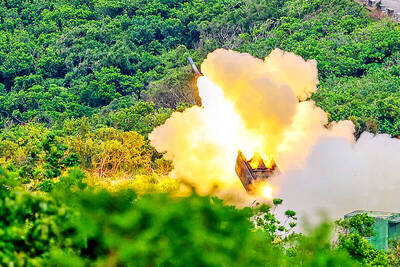
PRECISION STRIKES: The most significant reason to deploy HIMARS to outlying islands is to establish a ‘dead zone’ that the PLA would not dare enter, a source said A High Mobility Artillery Rocket System (HIMARS) would be deployed to Penghu County and Dongyin Island (東引) in Lienchiang County (Matsu) to force the Chinese military to retreat at least 100km from the coastline, a military source said yesterday. Taiwan has been procuring HIMARS and Army Tactical Missile Systems (ATACMS) from the US in batches. Once all batches have been delivered, Taiwan would possess 111 HIMARS units and 504 ATACMS, which have a range of 300km. Considering that “offense is the best defense,” the military plans to forward-deploy the systems to outlying islands such as Penghu and Dongyin so that

Taiwan Semiconductor Manufacturing Co (TSMC, 台積電), the world’s largest foundry service provider, yesterday said that global semiconductor revenue is projected to hit US$1.5 trillion in 2030, after the figure exceeds US$1 trillion this year, as artificial intelligence (AI) demand boosts consumption of token and compute power. “We are still at the beginning of the AI revolution, but we already see a significant impact across the whole semiconductor ecosystem,” TSMC deputy cochief operating officer Kevin Zhang (張曉強) said at the company’s annual technology symposium in Hsinchu City. “It is fair to say that in the past decade, smartphones and other mobile devices were

‘CLEAR MESSAGE’: The bill would set up an interagency ‘tiger team’ to review sanctions tools and other economic options to help deter any Chinese aggression toward Taiwan US Representative Young Kim has introduced a bill to deter Chinese aggression against Taiwan, calling for an interagency “tiger team” to preplan coordinated sanctions and economic measures in response to possible Chinese military or political action against Taiwan. “[Chinese President] Xi Jinping [習近平] has directed the People’s Liberation Army to be ready to invade Taiwan by 2027. China has a plan. America should have one too,” Kim said in a news release on Thursday last week. She introduced the “Deter PRC [People’s Republic of China] aggression against Taiwan act” to “ensure the US has a coordinated sanctions strategy ready should


 RSS
RSS