


A Chinese dissident outspoken on Tibet and other sensitive topics was jailed for three-and-a-half years yesterday, a conviction likely to become a focus of rights campaigns ahead of the Beijing Olympics.
Hu Jia (胡佳), 34, was found guilty of “inciting subversion of state power” for criticizing the Chinese Communist Party, a verdict at which the US expressed dismay.
“In this Olympic year, we urge China to seize the opportunity to put its best face forward and take steps to improve its record on human rights and religious freedom,” the US embassy said in a statement.
The International Olympic Committee (IOC) refused to comment.
“It is not up to us to comment on those cases,” Hein Verbruggen, head of the IOC's Coordination Commission, which is advising Beijing on how to prepare for the Games in August, told reporters.
“It is a matter of Chinese law and is not a matter for the Olympic Games or the IOC,” he said.
Xinhua news agency said Hu had made a “confession of crime and acceptance of punishment,” leading the court to issue a relatively light sentence. Hu's two lawyers said he had acknowledged “excesses.”
“In the end, I think that he came to accept that some of his statements were contrary to the law as it stands,” defense lawyer Li Jinsong (李勁松) said.
Hu has 10 days starting today to decide whether to appeal, but Li said he was unlikely to do so.
The “inciting subversion” charge can mean a jail term of five years or longer, and before the hearing lawyer Li Fangping (李方平) said a long sentence was likely.
After the hearing he said he was unaware of any deal in return for the sentence.
The Chinese foreign ministry defended the verdict and said critics were interfering in the country's internal affairs.
“We will not stop implementing the rule of law ahead of holding the Olympics,” spokeswoman Jiang Yu told reporters.
Another Chinese dissident, Yang Chunlin (楊春林), who called for human rights to take precedence over the Olympic Games, was sentenced to five years in jail late last month for the same crime.
Foreign reporters and diplomats were excluded from Hu's hearing, but Xinhua gave details of the offenses.
The court heard that from August 2006 to last October, Hu published articles on overseas-run Web sites, made comments in interviews with foreign media and “repeatedly instigated other people to subvert the state's political power and socialist system,” Xinhua said.
In two Web site articles, one on law enforcement ahead of last year's Communist Party Congress, and one entitled “One Country Doesn't Need Two Systems,” Hu spread “malicious rumors and committed libel,” Xinhua quoted the verdict as saying.
Dozens of well-wishers gathered outside the court to express support for Hu and rowdily air their own grievances.
“Hu Jia is a hero to us because he stood up to speak out, so we should also speak out,” said one of them, Li Hai.
Human-rights groups worldwide were quick to condemn the verdict.
“This verdict is a slap in the face for Hu Jia and a warning to any other activists in China who dare to raise human rights concerns publicly,” said Mark Allison of Amnesty International. “It also betrays promises made by Chinese officials that human rights would improve in the run-up to the Olympics.”
Starting with advocacy for rural AIDS sufferers, Hu emerged as one of the nation's most vocal advocates of democratic rights, religious freedom and self-determination for Tibet, recently shaken by protests and a security crackdown.
“Hu spread malicious rumors and committed libel in an attempt to subvert the state's political power and socialist system,” the court said, Xinhua said.
Hu was detained by police in late December after spending more than 200 days under house arrest in a Beijing apartment complex.
Hu's wife, Zeng Jinyan (曾金燕), who has also often criticized the government, and their infant daughter remain under house arrest and their telephone is cut off. Zeng attended the hearing, emerging with her baby from the courthouse visibly upset before being whisked away in a police vehicle.
Also See: Beijing asks Nepal to oust Tibet groups

SILENCING CRITICS: In addition to blocking Taiwan, China aimed to prevent rights activists from speaking out against authoritarian states, a Cabinet department said The Ministry of Foreign Affairs (MOFA) yesterday condemned transnational repression by Beijing after RightsCon, a major digital human rights conference scheduled to be held in Zambia this week, was abruptly canceled due to Chinese pressure over Taiwanese participation. This year’s RightsCon, the world’s largest conference discussing issues “at the intersection of human rights and technology,” was scheduled to take place from tomorrow to Friday in Lusaka, and expected to draw 2,600 in-person attendees from 150 countries, along with 1,100 online participants. However, organizers were forced to cancel the event due to behind-the-scenes pressure from China, the ministry said, expressing its “strongest condemnation”
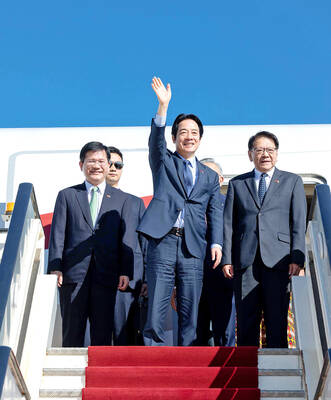
DELAYED BUT DETERMINED: The president’s visit highlights Taiwan’s right to international engagement amid regional pressure from China President Willaim Lai (賴清德) yesterday arrived in Eswatini, more than a week after his planned visit to Taiwan’s sole African ally was suspended because of revoked overflight permits. “The visit, originally scheduled for April 22, was postponed due to unforeseen external factors,” Lai wrote on social media. “After several days of careful arrangements by our diplomatic and national security teams, we successfully arrived today.” Lai said he looked forward to further deepening Taiwan-Eswatini relations through closer cooperation in the economy, agriculture, culture and education, as well as advancing the nation’s international partnerships. The president was initially scheduled to arrive in time to celebrate
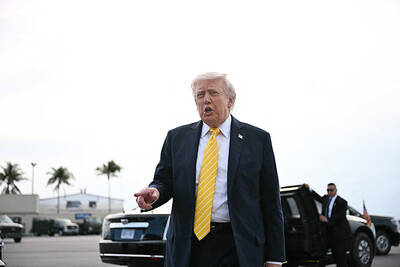
Iran’s Islamic Revolutionary Guard Corp (IRGC) yesterday said the US faced a choice between an “impossible” military operation or a “bad deal” with Tehran, after US President Donald Trump disparaged Iran’s latest peace proposal. Negotiations between the two countries have been deadlocked since a ceasefire came into effect on April 8, with only one round of direct peace talks held so far. Iran’s Tasnim and Fars news agencies reported that Tehran had submitted a 14-point proposal to mediator Pakistan, but Trump was quick to cast doubt on it. “I will soon be reviewing the plan that Iran has just sent to us, but

A group affiliated with indicted Chinese immigrant Xu Chunying (徐春鶯) is to be dissolved for monitoring Chinese immigrants in Taiwan, a source said yesterday. Xu, the secretary-general of the Cross-Strait Marriage and Family Service Alliance, was indicted on March 24 on charges of violating the Anti-Infiltration Act (反滲透法). The alliance “illegally monitored" Chinese immigrants living in Taiwan on behalf of the Chinese Communist Party (CCP) and the Ministry of the Interior is expected to dissolve the organization in the coming days under provisions of the Civil Associations Act (人民團體法), the source said. Xu, who married a Taiwanese in 1993 and became a Republic


 RSS
RSS