


Minister of National Defense Lee Tien-yu (
Lee, who assumed the post in May last year, expressed "deep regret" over the controversy surrounding the founding of Taiwan Goal, in which the Ministry of National Defense (MND) is the largest stakeholder at 45 percent.
As the minister of national defense, Lee said he was devoted to carrying out the nation's defense policy, promoting national security and caring for military personnel and their family.
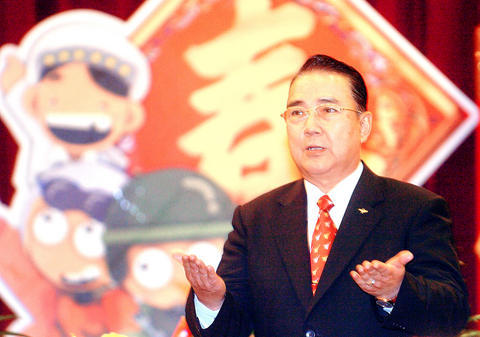
PHOTO: GEORGE TSORNG, TAIPEI TIMES
However, he decided to resign to take responsibility for failing to smoothly carry out an order to establish an arms company, incurring doubts and controversy along the way, he said.
Premier Chang Chun-hsiung (
"Lee insisted he had to take full responsibility for failing to properly deal with the Taiwan Goal matter," Chen told a press conference yesterday afternoon. "Everyone has his own career plan. We should all respect Lee's decision."
Tsai, 67, who has a doctorate from the California Western School of Law, served as a legislator for two terms and as a deputy representative to the US.
The premier confirmed the existence of Taiwan Goal on Feb. 15 following a report by the Chinese-language China Times that it had been established.
Since then, Chinese Nationalist Party (KMT) lawmakers have accused the government of seeking to make a profit from the arms trade.
Opposition lawmakers also alleged that Vice Premier Chiou I-jen (邱義仁) was involved in the firm, which was founded under the order of President Chen Shui-bian (陳水扁), and that Wu Nai-jen (吳乃仁), a Democratic Progressive Party (DPP) stalwart, was appointed company president to reward him for his dedication to the party.
The Cabinet has defended the establishment of such a national defense management, production and trading firm, saying it would resolve many obstacles the country faces when procuring arms from abroad given its sensitive political status.
Taiwan Goal registered with the Ministry of Economic Affairs on Jan. 28 as a private company, with capital of NT$1 billion (US$31.15 million) and paid-in capital totaling NT$80 million.
Chen Chin-jun said the government had acted in accordance with the National Defense Act (
At the press conference yesterday, Chen Chin-jun also announced the premier's decision prohibiting government investment in any private national defense company.
"The establishment of Taiwan Goal and the government's policy to develop the defense industry have been slurred," he said. "As such, the premier has decided that government funds will no longer be used to invest in the private defense industry."
That could mean Taiwan Goal might have difficulty sourcing its initial capital of NT$200 million.
The company's plan was to source 45 percent of its capital from the defense ministry; 15 percent from Yao Hua Glass Co (
Information provided by the Cabinet showed that NT$80 million of the NT$200 million initial funding has been collected -- NT$50 million from China Steel Machinery and NT$30 million from Chunghwa System.
But the target NT$90 million from the MND and NT$30 million from Yao Hua had yet to be injected.
The Cabinet has insisted that Taiwan Goal is a private company, as the MND holds only 45 percent of the company.
Asked whether Wu will stay on as president of Taiwan Goal, Chen Chin-jun said that would be Wu's decision.
President Chen, who was in Nantou County yesterday, did not comment on the matter. The KMT caucus applauded Lee's resignation.
"Lee offered his resignation and saved his reputation," KMT caucus whip Alex Fei (
KMT Legislator Lin Yu-fang (林郁方) said Lee's resignation highlighted the fact that the firm was problematic and lacked legitimacy.
The caucus urged the government to disband the company immediately, while lashing out at the Cabinet's decision to appoint Tsai to take over Lee's position, accusing Tsai of being Chen Shui-bian's "preferred candidate."
DPP caucus whip Ker Chien-ming (柯建銘) told a separate press conference that although he respected Lee's decision to take responsibility for the controversy -- a move which Ker said showed Lee's dignity as a military person -- he nonetheless thought it was unnecessary for Lee to leave.
The KMT caucus' endless attacks on the establishment of the arms company, Lee and his ministry were the main reasons that led to Lee's resignation, Ker said, adding that the KMT caucus had faulted almost every government policy without reason.
The DPP caucus continues to support a private arms company to promote and integrate the nation's defense industry, he said.
When asked by reporters for comments, DPP presidential candidate Frank Hsieh's (
"We hope the public would look at the matter from the viewpoint of the system," Hsieh camp spokesman Hsu Kuo-yong (
Lee graduated from the Air Force Academy in 1959, completing training courses and receiving his pilot's wings in 1965.
In 2001, the president promoted him to lieutenant general and Lee became the deputy commander-in-chief of the Air Force. One year later, he was promoted again to full general, becoming the commander-in-chief of the Air Force.
In 2004, the president promoted him to the highest rank in the armed forces, giving him his fourth star and assigning him as chief of the general staff.
ADDITIONAL REPORTING BY KO SHU-LING, MO YAN-CHIH AND CNA

FALSE DOCUMENTS? Actor William Liao said he was ‘voluntarily cooperating’ with police after a suspect was accused of helping to produce false medical certificates Police yesterday questioned at least six entertainers amid allegations of evasion of compulsory military service, with Lee Chuan (李銓), a member of boy band Choc7 (超克7), and actor Daniel Chen (陳大天) among those summoned. The New Taipei City District Prosecutors’ Office in January launched an investigation into a group that was allegedly helping men dodge compulsory military service using falsified medical documents. Actor Darren Wang (王大陸) has been accused of being one of the group’s clients. As the investigation expanded, investigators at New Taipei City’s Yonghe Precinct said that other entertainers commissioned the group to obtain false documents. The main suspect, a man surnamed
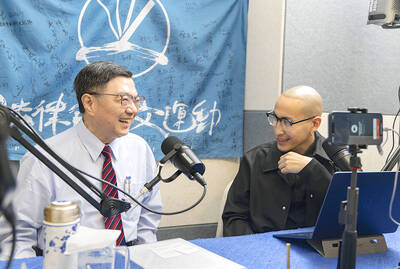
The government is considering polices to increase rental subsidies for people living in social housing who get married and have children, Premier Cho Jung-tai (卓榮泰) said yesterday. During an interview with the Plain Law Movement (法律白話文) podcast, Cho said that housing prices cannot be brought down overnight without affecting banks and mortgages. Therefore, the government is focusing on providing more aid for young people by taking 3 to 5 percent of urban renewal projects and zone expropriations and using that land for social housing, he said. Single people living in social housing who get married and become parents could obtain 50 percent more

DEMOGRAPHICS: Robotics is the most promising answer to looming labor woes, the long-term care system and national contingency response, an official said Taiwan is to launch a five-year plan to boost the robotics industry in a bid to address labor shortages stemming from a declining and aging population, the Executive Yuan said yesterday. The government approved the initiative, dubbed the Smart Robotics Industry Promotion Plan, via executive order, senior officials told a post-Cabinet meeting news conference in Taipei. Taiwan’s population decline would strain the economy and the nation’s ability to care for vulnerable and elderly people, said Peter Hong (洪樂文), who heads the National Science and Technology Council’s (NSTC) Department of Engineering and Technologies. Projections show that the proportion of Taiwanese 65 or older would
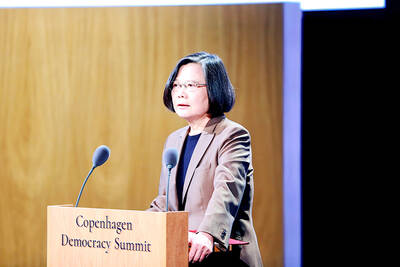
Democracies must remain united in the face of a shifting geopolitical landscape, former president Tsai Ing-wen (蔡英文) told the Copenhagen Democracy Summit on Tuesday, while emphasizing the importance of Taiwan’s security to the world. “Taiwan’s security is essential to regional stability and to defending democratic values amid mounting authoritarianism,” Tsai said at the annual forum in the Danish capital. Noting a “new geopolitical landscape” in which global trade and security face “uncertainty and unpredictability,” Tsai said that democracies must remain united and be more committed to building up resilience together in the face of challenges. Resilience “allows us to absorb shocks, adapt under


 RSS
RSS