


Democratic Progressive Party (DPP) presidential candidate Frank Hsieh (謝長廷) said yesterday that if elected, he would remove the 40 percent ceiling on China investment and restrictions imposed on local banks on opening branches in China with certain conditions.
Hsieh unveiled his cross-strait policies in his new book titled Viva Taiwan (
Hsieh promised to replace the China-bound investment cap of 40 percent of a local company's net worth, with a "case by case" review system.
The regulation could be readjusted in accordance with the impact of an applicant's China-bound investment on its global competitiveness, local industries and local labor market, Hsieh said.
"We should put strict restrictions on industries whose China-bound investment will make more local industries move to China or compete with local industries," Hsieh said.
"But for industries that consider their China-bound investment as a step for their advancement to the global market, the cap should be relaxed to ensure their global competitiveness," he said.
Hsieh said he would encourage local banks to establish branches in China on condition that both sides of the strait complete negotiations to establish a system for financial supervision and management so that financial supervisory agencies can exercise their right of jurisdiction.
This would ensure effective supervision and management of such branch operations, he said.
"With increasing Taiwanese investment in China, there is an enormous demand for financial services. Local banks should be allowed to seize the huge business opportunities," Hsieh said.
While advocating a more liberal and flexible approach to managing Taiwan's investment in China, Hsieh also suggested opening the country to Chinese capital.
"China's banks should be allowed to set up offices in Taiwan and then regulations should be gradually relaxed to allow Chinese banks to set up branches or sub-branches," Hsieh said.
He also proposed allowing Chinese businessmen to invest in Taiwan, with the exception of investments in residential property, agriculture and high-tech industries.
He also proposed allowing more Chinese tourists to visit Taiwan, with the ultimate aim of increasing their numbers to 3,000 a day.
Hsieh said that the so-called "92 consensus," embraced by his Chinese Nationalist Party (KMT) counterpart Ma Ying-jeou (
What both sides of the strait need is consensus about "time" and "procedure," Hsieh said.
"We should have a consensus that it might take about 10 to 20 years, or even longer, for both sides to resolve disagreements, enhance mutual understanding and reach a consensus that the solution to cross-strait relations must conform to the choice of the 23 million people of Taiwan," Hsieh said.
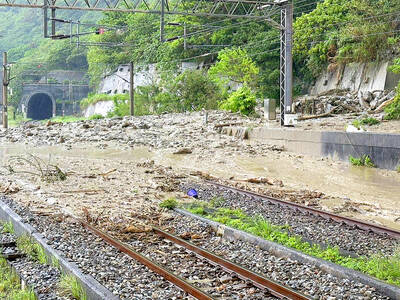
ROLLER-COASTER RIDE: More than five earthquakes ranging from magnitude 4.4 to 5.5 on the Richter scale shook eastern Taiwan in rapid succession yesterday afternoon Back-to-back weather fronts are forecast to hit Taiwan this week, resulting in rain across the nation in the coming days, the Central Weather Administration said yesterday, as it also warned residents in mountainous regions to be wary of landslides and rockfalls. As the first front approached, sporadic rainfall began in central and northern parts of Taiwan yesterday, the agency said, adding that rain is forecast to intensify in those regions today, while brief showers would also affect other parts of the nation. A second weather system is forecast to arrive on Thursday, bringing additional rain to the whole nation until Sunday, it
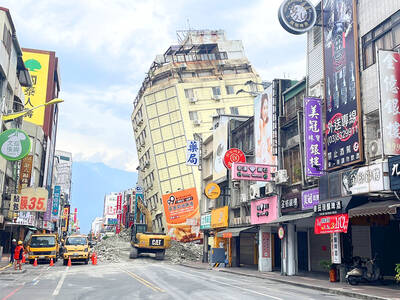
LANDSLIDES POSSIBLE: The agency advised the public to avoid visiting mountainous regions due to more expected aftershocks and rainfall from a series of weather fronts A series of earthquakes over the past few days were likely aftershocks of the April 3 earthquake in Hualien County, with further aftershocks to be expected for up to a year, the Central Weather Administration (CWA) said yesterday. Based on the nation’s experience after the quake on Sept. 21, 1999, more aftershocks are possible over the next six months to a year, the agency said. A total of 103 earthquakes of magnitude 4 on the local magnitude scale or higher hit Hualien County from 5:08pm on Monday to 10:27am yesterday, with 27 of them exceeding magnitude 5. They included two, of magnitude

CONDITIONAL: The PRC imposes secret requirements that the funding it provides cannot be spent in states with diplomatic relations with Taiwan, Emma Reilly said China has been bribing UN officials to obtain “special benefits” and to block funding from countries that have diplomatic ties with Taiwan, a former UN employee told the British House of Commons on Tuesday. At a House of Commons Foreign Affairs Committee hearing into “international relations within the multilateral system,” former Office of the UN High Commissioner for Human Rights (OHCHR) employee Emma Reilly said in a written statement that “Beijing paid bribes to the two successive Presidents of the [UN] General Assembly” during the two-year negotiation of the Sustainable Development Goals. Another way China exercises influence within the UN Secretariat is

Taiwan’s first drag queen to compete on the internationally acclaimed RuPaul’s Drag Race, Nymphia Wind (妮妃雅), was on Friday crowned the “Next Drag Superstar.” Dressed in a sparkling banana dress, Nymphia Wind swept onto the stage for the final, and stole the show. “Taiwan this is for you,” she said right after show host RuPaul announced her as the winner. “To those who feel like they don’t belong, just remember to live fearlessly and to live their truth,” she said on stage. One of the frontrunners for the past 15 episodes, the 28-year-old breezed through to the final after weeks of showcasing her unique


 RSS
RSS