


Loyalists of former Iraqi president Saddam Hussein gathered at his graveside on Sunday to mark the first anniversary of his execution, as former opponents expressed joy over the end of his rule.
Dozens of Sunni Arab tribal leaders, clerics and students stood at Saddam's burial site in his birthplace of Awja in central Iraq and read verses from the Koran.
"We will observe this day every year as Saddam is in our hearts," said Ghalib Hammudi, a relative of the former president who was hanged for crimes against humanity on Dec. 30, 2006.
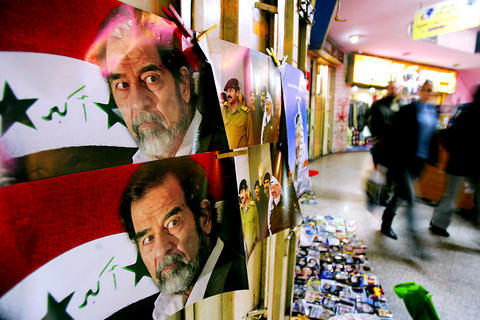
PHOTO: AFP
Iraqi security officials had said they would deal with any unrest in the Sunni heartland north and west of Baghdad, although the US military said no violence associated with the date had been reported.
Ali al-Nida, chief of the Baijat tribe to which Saddam belonged, said the followers of the Sunni leader held a simple ceremony in Awja to remember him for his role in "maintaining the dignity" of the Iraqi people.
Several posters of Saddam were posted in the village, while loudspeakers played verses from the Koran.
Civilian volunteers guarded the hall which houses Saddam's grave, and police and troops patrolled outside.
In the former dictator's onetime powerbase of Tikrit, walls were painted with fresh slogans paying tribute to him.
"We will take revenge for president Saddam Hussein," one read.
The village of Dawr, just south of Tikrit where Saddam was captured hiding in a hole by US forces in December 2003, was under indefinite curfew.
Posters of Saddam also appeared overnight on walls in Baghdad's strongly Sunni district of Adhamiyah in the north of the capital.
Similar posters were seen as far away as the Palestinian territories.
At the gallows, Saddam's executioners taunted him in scenes that were captured on a mobile phone camera, triggering outrage around the world and embarrassing Iraq's Shiite-led government.
Even US President George W. Bush, who hailed Saddam's capture after the US-led invasion toppled his regime in April 2003, said the execution resembled a sectarian "revenge killing."
Iraqi officials ordered that Saddam be buried at night without the lying in state traditionally accorded to presidents.
The hanging further deepened the rift between Sunnis and Shiites that was inflamed by the bombing of a revered Shiite shrine by suspected al-Qaeda militants in February 2006.
Shiites, who suffered under Saddam's Sunni regime and who now lead the government, celebrated on Sunday.
Haider al-Jabiri, a member of powerful Shiite cleric Moqtada al-Sadr's office, said: "We are happy today because it was a day that justice came down from the heavens against Saddam Hussein."
"The homes of the people he made widows and orphans can be joyful," he said, speaking from Najaf.
Saddam and three aides were sentenced to death for the killing of around 140 Shiites from the village of Dujail after an attempt on his life there in 1982.
The ousted dictator -- who had ruled with an iron fist since 1979 -- was hanged in Baghdad at the age of 69.
Saddam's half-brother, Barzan Ibrahim, and Awad Ahmed al-Bandar, the former chief of Iraq's Revolutionary Court, were hanged two weeks later over the Dujail case, with Saddam's deputy Taha Yassin Ramada also hanged in March last year.
Jamal Abdallah, spokesman for Iraq's regional Kurdish administration, said: "The execution of Saddam was a turning point in the country's history that marked the end of dictatorship."
"Since then we have worked to establish a stable and democratic regime in the country. We hope that no more dictators are born in Iraq," he said.
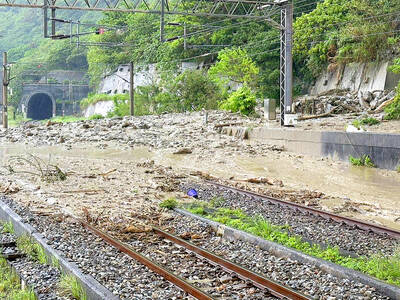
ROLLER-COASTER RIDE: More than five earthquakes ranging from magnitude 4.4 to 5.5 on the Richter scale shook eastern Taiwan in rapid succession yesterday afternoon Back-to-back weather fronts are forecast to hit Taiwan this week, resulting in rain across the nation in the coming days, the Central Weather Administration said yesterday, as it also warned residents in mountainous regions to be wary of landslides and rockfalls. As the first front approached, sporadic rainfall began in central and northern parts of Taiwan yesterday, the agency said, adding that rain is forecast to intensify in those regions today, while brief showers would also affect other parts of the nation. A second weather system is forecast to arrive on Thursday, bringing additional rain to the whole nation until Sunday, it
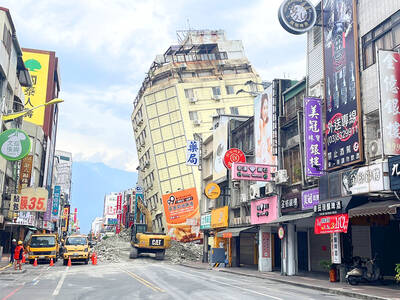
LANDSLIDES POSSIBLE: The agency advised the public to avoid visiting mountainous regions due to more expected aftershocks and rainfall from a series of weather fronts A series of earthquakes over the past few days were likely aftershocks of the April 3 earthquake in Hualien County, with further aftershocks to be expected for up to a year, the Central Weather Administration (CWA) said yesterday. Based on the nation’s experience after the quake on Sept. 21, 1999, more aftershocks are possible over the next six months to a year, the agency said. A total of 103 earthquakes of magnitude 4 on the local magnitude scale or higher hit Hualien County from 5:08pm on Monday to 10:27am yesterday, with 27 of them exceeding magnitude 5. They included two, of magnitude

CONDITIONAL: The PRC imposes secret requirements that the funding it provides cannot be spent in states with diplomatic relations with Taiwan, Emma Reilly said China has been bribing UN officials to obtain “special benefits” and to block funding from countries that have diplomatic ties with Taiwan, a former UN employee told the British House of Commons on Tuesday. At a House of Commons Foreign Affairs Committee hearing into “international relations within the multilateral system,” former Office of the UN High Commissioner for Human Rights (OHCHR) employee Emma Reilly said in a written statement that “Beijing paid bribes to the two successive Presidents of the [UN] General Assembly” during the two-year negotiation of the Sustainable Development Goals. Another way China exercises influence within the UN Secretariat is

Taiwan’s first drag queen to compete on the internationally acclaimed RuPaul’s Drag Race, Nymphia Wind (妮妃雅), was on Friday crowned the “Next Drag Superstar.” Dressed in a sparkling banana dress, Nymphia Wind swept onto the stage for the final, and stole the show. “Taiwan this is for you,” she said right after show host RuPaul announced her as the winner. “To those who feel like they don’t belong, just remember to live fearlessly and to live their truth,” she said on stage. One of the frontrunners for the past 15 episodes, the 28-year-old breezed through to the final after weeks of showcasing her unique


 RSS
RSS