


Pakistan indicated yesterday it would delay next month's elections because of the turmoil caused by the death of former prime minister Benazir Bhutto, as a bitter dispute erupted over how the opposition leader was killed.
Violent protests and looting that have left at least 33 people dead have rocked the nation since Bhutto was assassinated in the northern city of Rawalpindi on Thursday.
The US and Western powers have urged Pakistan to commit to the democratic process in the aftermath of her death, but leading opposition figure Nawaz Sharif has already said his party would boycott the polls.
Bhutto's Pakistan People's Party (PPP), which has accused the government of trying to cover up the details of her death, has said it will take a decision today on whether to take part in the parliamentary elections scheduled for Jan. 8.
Pakistan's commission said it would hold a meeting tomorrow to decide the election's fate, but indicated a delay was possible.
"All activities pertaining to pre-poll arrangements, including printing of ballot papers and logistics as well as training of polling personnel, have been adversely affected," it said in a statement.
In some places, the commission said, the security situation was "not conducive" to holding the elections that Bhutto had come home from exile in October to contest.
It cited the death of an election candidate in a bomb blast and said election commission offices in nine districts had been set on fire and that voter lists had been "reduced to ashes."
The polls would lack credibility without the participation of Bhutto's PPP, which has been infuriated by the government's official account of their leader's death.
Bhutto died after a suicide attack targeted her vehicle at a campaign rally in the northern city of Rawalpindi. Early reports and witnesses said she had been shot before a bomb exploded nearby.
However, the interior ministry said she had no gunshot or shrapnel wounds. It said Bhutto died after smashing her head on her car's sunroof as she tried to duck.
The ministry also blamed al-Qaeda, saying intelligence services had intercepted a call from Baitullah Mehsud, considered the extremist group's top leader for Pakistan.
Senior members of Bhutto's party dismissed the government's version of events as "lies."
"There was a bullet wound I saw that went in from the back of her head and came out the other side," said Bhutto's spokeswoman Sherry Rehman, who was involved in washing her body for burial. "This is ridiculous, dangerous nonsense because it is a cover-up of what actually happened."
Farooq Naik, Bhutto's lawyer, said Bhutto had a second bullet wound in the abdomen.
Bhutto was an outspoken critic of al-Qaeda-linked militants blamed for scores of bombings in Pakistan and had received threats.
But she had also accused elements from the intelligence services of involvement in a suicide attack on a rally in October that left 139 dead and which she only narrowly escaped.
Maulana Omar, a spokesman for alleged al-Qaeda kingpin Mehsud, denied involvement in the attack and expressed grief over Bhutto's death.
"This is a conspiracy of the government, army and intelligence agencies," said the spokesman from Waziristan, a lawless tribal region where al-Qaeda leaders, including possibly Osama bin Laden, are alleged to be hiding.
Pakistan was virtually paralyzed yesterday with most people unable to buy food or petrol, with all shops, fuel stations, banks and offices closed down.
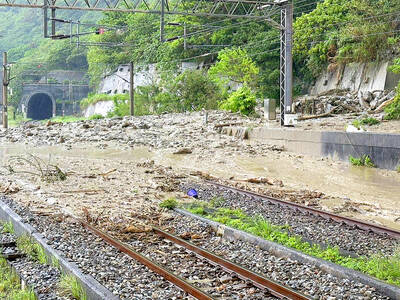
ROLLER-COASTER RIDE: More than five earthquakes ranging from magnitude 4.4 to 5.5 on the Richter scale shook eastern Taiwan in rapid succession yesterday afternoon Back-to-back weather fronts are forecast to hit Taiwan this week, resulting in rain across the nation in the coming days, the Central Weather Administration said yesterday, as it also warned residents in mountainous regions to be wary of landslides and rockfalls. As the first front approached, sporadic rainfall began in central and northern parts of Taiwan yesterday, the agency said, adding that rain is forecast to intensify in those regions today, while brief showers would also affect other parts of the nation. A second weather system is forecast to arrive on Thursday, bringing additional rain to the whole nation until Sunday, it
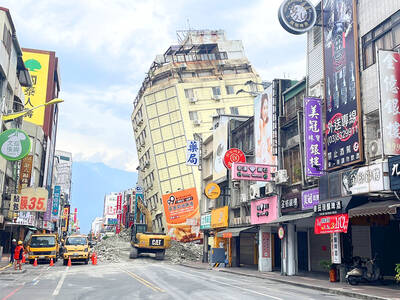
LANDSLIDES POSSIBLE: The agency advised the public to avoid visiting mountainous regions due to more expected aftershocks and rainfall from a series of weather fronts A series of earthquakes over the past few days were likely aftershocks of the April 3 earthquake in Hualien County, with further aftershocks to be expected for up to a year, the Central Weather Administration (CWA) said yesterday. Based on the nation’s experience after the quake on Sept. 21, 1999, more aftershocks are possible over the next six months to a year, the agency said. A total of 103 earthquakes of magnitude 4 on the local magnitude scale or higher hit Hualien County from 5:08pm on Monday to 10:27am yesterday, with 27 of them exceeding magnitude 5. They included two, of magnitude
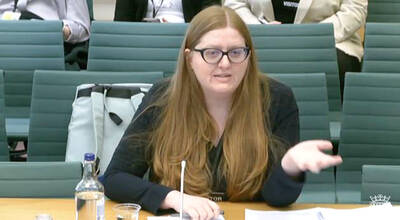
CONDITIONAL: The PRC imposes secret requirements that the funding it provides cannot be spent in states with diplomatic relations with Taiwan, Emma Reilly said China has been bribing UN officials to obtain “special benefits” and to block funding from countries that have diplomatic ties with Taiwan, a former UN employee told the British House of Commons on Tuesday. At a House of Commons Foreign Affairs Committee hearing into “international relations within the multilateral system,” former Office of the UN High Commissioner for Human Rights (OHCHR) employee Emma Reilly said in a written statement that “Beijing paid bribes to the two successive Presidents of the [UN] General Assembly” during the two-year negotiation of the Sustainable Development Goals. Another way China exercises influence within the UN Secretariat is

Taiwan’s first drag queen to compete on the internationally acclaimed RuPaul’s Drag Race, Nymphia Wind (妮妃雅), was on Friday crowned the “Next Drag Superstar.” Dressed in a sparkling banana dress, Nymphia Wind swept onto the stage for the final, and stole the show. “Taiwan this is for you,” she said right after show host RuPaul announced her as the winner. “To those who feel like they don’t belong, just remember to live fearlessly and to live their truth,” she said on stage. One of the frontrunners for the past 15 episodes, the 28-year-old breezed through to the final after weeks of showcasing her unique


 RSS
RSS