


The Cabinet yesterday said it would proceed with the one-step voting system for the legislative elections and two referendums on Jan. 12 and did not rule out replacing defiant local election personnel.
Cabinet Spokesman Shieh Jhy-wey (
He ruled out deploying the military, however.
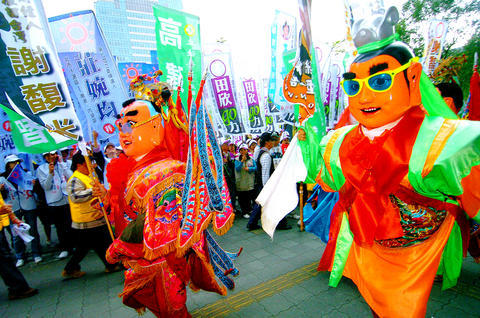
PHOTO: CHIEN JUNG-FONG, TAIPEI TIMES
"There are many ways to achieve this goal. Relieving election personnel of their posts is one of them," he said. "Taking over election affairs is another. We are in the process of preparing for replacements and replacement personnel are ready [if needed]."
The decision of the Central Election Commission (CEC) to use the one-step voting system was clear, Shieh said.
"We are calling on local governments run by the pan-blue camp to refrain from challenging the law," he said. "We will not allow `one country, two systems' to prevail."
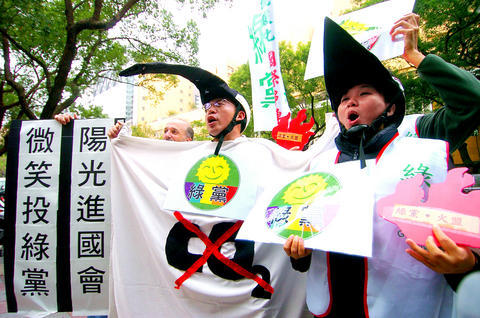
PHOTO: WANG MIN-WEI, TAIPEI TIMES
The CEC adopted the one-step voting system, but the Chinese Nationalist Party (KMT) prefers a two-step voting system in which voters would receive legislative ballots and cast them first before receiving the referendum ballots.
There are tough and soft measures to deal with the problem, Shieh said. The former include legal repercussions, while the latter could involve communicating with local election commissions on the matter.
Shieh emphasized, however, that there would be no room for compromise.
He denied that executive officials would "intimidate" local election personnel, but they would come to understand the consequences of defying the law and the best way of protecting themselves.
The government was confident that law-abiding voters would be well-protected, he said.
If any disturbances did occur, Shieh said, the KMT should be held fully responsible.
Shieh said that Vice Premier Chiou I-jen (
THE TAIPEI WAY
Elsewhere yesterday, Taipei Mayor Hau Lung-bin (
Yeh Chin-yuan (
"According to regulations on local election commissions, the commissioners are guaranteed a three-year term. Although the commissioners were named by the Executive Yuan, it has no right to displace them," Yeh said yesterday at Taipei City Hall.
Yeh said the post of election commissioner is often filled by the deputy mayor rather than the mayor to prevent electoral procedures from being influenced by politics, and that no laws or regulations grant the Executive Yuan the right to remove commissioners.
The CEC has said it will only print out the illustration of the one-step voting procedure for the election, but Samuel Wu (
The KMT caucus also slammed the CEC yesterday, raising fears of electoral fraud if the CEC officially announces the results of next month's legislative elections one week after the poll.
KMT caucus whip Kuo Su-chun (
"[CEC Secretary-General] Teng Tien-yu (
"If the CEC really enjoys the authority to decide who wins the elections one week after the elections, why would we still need to hold elections? The CEC could just designate [the legislators] they prefer," she said.
DPP Secretary-General Cho Jung-tai (
Finalizing election results within seven days of the election has always been mandated by the Election and Recall Law of Civil Servants (
At CEC headquarters, representatives from smaller political parties yesterday used the drawing of the order for parties listed on the legislator-at-large ticket to complain that the commission had treated them unfairly.
Legislator-at-large candidates from the New Party -- including current KMT Legislator Joanna Lei (雷倩), who changed parties after failing to secure KMT support for this poll -- the Home Party, the Taiwan Farmers Party, the Taiwan Solidarity Union (TSU), the Third Society Party and the Hakka Party said that the current version of a CEC poster explaining the new "single district, two vote" system only listed the DPP, the KMT, the People First Party, the TSU and the Non-Partisan Solidarity Union (NPSU).
Teng promised to print a new poster with the names and numbers of every party on the ballot.
In the new system, only one lawmaker will be elected from geographical districts.
But voters will cast a second ballot for a political party. The parties will then have extra legislators elected based on the proportion of the vote received.
In yesterday's draw, the Civil Party was listed first on the ballot, the Alliance for a New Constitution was second, the TSU third, the Third Society Party fourth, the DPP fifth, the New Party sixth, Green Party Taiwan seventh, the Taiwan Farmers Party eighth, the NPSU ninth, the KMT 10th, the Home Party 11th and the Hakka Party 12th.
Elsewhere, former DPP chairman Lin I-hsiung (林義雄) yesterday urged the public to vote in favor of the two referendums that seek UN membership for Taiwan during the presidential election in March.
Although local parties have different proposals, Taiwanese must tell the world that they are unanimous in wanting to join the UN, Lin said.
Lin said he was baffled by opposition to the UN referendum in Washington and Beijing.
The process would only help Beijing better understand the demands of Taiwanese people, he said.
Additional reporting by Mo Yan-chih and Flora Wang

‘NO SECURITY RISK’: The Railway Bureau reassured the public that the technicians’ activities were limited to technical guidance and did not involve sensitive systems The Railway Bureau yesterday said it had invited eight Chinese technicians to assist with an airport MRT construction project. The bureau issued the confirmation after an Internet user said Chinese nationals had entered the construction zone of Taiwan Taoyuan International Airport’s Terminal 3 project. They asked why “individuals from an enemy state” were allowed access to such a major national infrastructure project, which raised serious concerns over Taiwan’s industrial safety, sensitive systems and information security. The bureau’s Northern Region Engineering Branch Office said subcontractor Taiwan Handle Industrial Co (台灣手把工業) of the Taoyuan airport MRT’s “Contract No. CU05 Project A14 Station Civil, MEP &

The National Chungshan Institute of Science and Technology yesterday showcased its locally developed variants of the Vision 60 robotic patrol dog, which it plans to deploy on the nation’s outlying territories in the South China Sea. The variants were produced under the Joint Lab project — created by the institute and domestic companies — and assembled with domestically produced motors, lenses and artificial intelligence (AI) systems alongside licensed tech from the US, Missile and Rocket Systems Research Division deputy director Jen Kuo-kang (任國光) told the media event at a military base in Taipei’s Dazhi (大直) area. Taiwan has built up its strengths

TIT-FOR-TAT: The US allegedly revoked the visa of a Chinese national working at Xinhua News Agency in the US in response to Beijing’s expulsion of Vivian Wang The Presidential Office yesterday condemned China for expelling a New York Times correspondent from Beijing following the newspaper’s interview with President William Lai (賴清德), saying the move highlighted Beijing’s suppression of press freedom and its threat to international news media. Taiwan has noted a series of recent incidents in which Beijing used similar tactics to “threaten and pressure international media outlets and journalists,” Presidential Office spokeswoman Karen Kuo (郭雅慧) said in a statement. “This concerns not only press freedom and freedom of expression, but also the safety of journalists, and Taiwan and relevant partners are paying close attention to the situation,” she
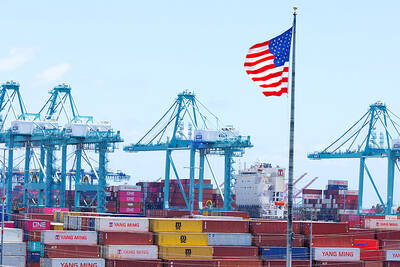
NOT IMMEDIATE: Taiwan has a chance to appeal the proposed 10 percent tariff before it starts, while other countries face a 12.5 percent tariff from the trade office Taiwan is among 60 economies determined by the US to have failed to impose or enforce a ban on the importation of goods produced with forced labor, according to a notice released on Tuesday by the Office of the US Trade Representative (USTR), which proposed imposing an additional 10 percent or more tariff on them. The USTR in a statement said that following an investigation, it had determined under Section 301 of the Trade Act of 1974 that the failure of the 60 economies to impose and effectively enforce a prohibition on the importation of goods produced with forced labor is


 RSS
RSS