

He has said it again and again, with increasing urgency, to anyone who will listen. And on Monday, former US vice president Al Gore used the occasion of his 2007 Nobel Peace Prize lecture here to tell the world in powerful, stark language: Climate change is a "real, rising, imminent and universal" threat to the future of the Earth.
Saying that "our world is spinning out of kilter" and that "the very web of life on which we depend is being ripped and frayed," Gore warned that "we, the human species, are confronting a planetary emergency -- a threat to the survival of our civilization that is gathering ominous and destructive potential even as we gather here."
But "there is hopeful news as well: we have the ability to solve this crisis and avoid the worst -- not all -- of its consequences, if we act boldly, decisively and quickly," Gore said.

PHOTO: EPA
The ceremony marking the 2007 prize, given to Gore and to the UN Intergovernmental Panel on Climate Change, comes as representatives of the world's governments are meeting in Bali to negotiate a new international pact on reducing greenhouse gas emissions to replace the Kyoto protocol.
At the ceremony in Oslo's City Hall, Gore called on the negotiators to establish a universal global cap on emissions and to ratify and enact a new treaty by the beginning of 2010, two years early. And he singled out the US and China for failing to meet their obligations in mitigating emissions.
They should "stop using each other's behavior as an excuse for stalemate," he said.
In his speech, Gore said his loss in the bitter 2000 presidential election had forced him to "read my own political obituary in a judgment that seemed to me harsh and mistaken, if not premature."
But the "unwelcome verdict also brought a precious if painful gift," he said -- the chance to focus on the environment.
In related news, the oldest person ever to receive a Nobel Prize got his award for economics in Minneapolis, Minnesota, on Monday because he was unable to make the trip to Sweden.
Swedish Ambassador Jonas Hafstrom presented Leonid Hurwicz, 90, with the prize in a concert hall on the University of Minnesota campus moments after the two other Americans to share the economics prize -- Eric Maskin and Roger Myerson -- received their awards in Stockholm.
He was not the only winner to miss the ceremony in Stockholm. The literature prize winner, 88-year-old British writer Doris Lessing, was to receive her award in London.

PATROL PARTNERS: The ‘Chiayi’ and the ‘Penghu’ departed for a two-day joint patrol of Palau’s exclusive economic zone, the CGA’s second diplomatic visit to the country The Coast Guard Administration (CGA) set a record for its southernmost deployment of a coast guard vessel as the vessels Chiayi and the Penghu reached Palau’s Pulo Anna Island on Saturday in a cooperative exercise between the two countries. The island, about 217 nautical miles (401km) southwest of Koror in the Palauan state of Sonsorol and 1,220 nautical miles from Taiwan’s southernmost point, Oluanpi (鵝鑾鼻), is the furthest south a CGA vessel has sailed. The two vessels are in Palau for the coast guard’s second diplomatic visit to the country. They docked at Malakal Harbor on Tuesday last week. The coast guard

The government is monitoring online rumors that a pneumonic plague outbreak has spread from Russia into China, and it might enhance quarantine measures, Premier Cho Jung-tai (卓榮泰) said yesterday. During a legislative meeting, Democratic Progressive Party Legislator Wang Ting-yu (王定宇) said that rumors had circulated that the disease had spread across several Chinese provinces. He asked Cho whether the government was prepared to prevent the disease spreading to Taiwan, given the volume of traffic between the two sides, and how concerned the government was about the alleged outbreak. The Ministry of Health and Welfare had implemented border quarantine measures after briefing the Executive
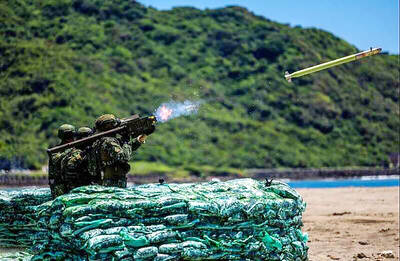
BATCH 1: The military has plans to assign the weapons to the army to defend Taiwan proper, as well as outlying islands and the navy for the Marine Corps, the official said Taiwan is to receive 500 Stinger missiles and 178 launchers from the US by the end of the year, the first batch under a planned two-stage acquisition totaling 2,621 missiles and 763 launchers, a defense official said yesterday on condition of anonymity. The portable missiles would play a vital role in the nation’s air defense capabilities, the source said. The army plans to deploy 2,235 missiles and 657 launchers to defend Taiwan proper and outlying islands, they said, citing military documents. The navy is allotted 295 missiles and 85 launchers to arm the Marine Corps and some surface vessels that lack air defense

RIGHT TO DIPLOMACY: Under the UN Charter, every state has the right to conduct foreign policy free from external pressure, Belize said in a statement Belize and Paraguay on Monday condemned Beijing sanctions over their countries’ ties with Taiwan, saying China’s actions create unnecessary tensions. Earlier on Monday, Beijing announced sanctions against Paraguayan Minister of Information and Communication Technologies Gustavo Villate and Belizean Minister of Foreign Affairs Francis Fonseca. The Paraguayan Ministry of Foreign Affairs said it rejected the sanctions, writing on X that they created unnecessary friction. It added that it reaffirmed its support for Taiwan and its commitment to democratic values and principles. Villate told the Spanish-language Paraguayan daily ABC Color the sanctions were “predictable” and linked them to several cooperation projects between Taiwan and Paraguay. The projects


 RSS
RSS