


Chinese Nationalist Party (KMT) presidential candidate Ma Ying-jeou (馬英九) yesterday vowed to push for an amendment to abolish all financial requirements for foreign spouses seeking naturalization.
"[Couples in] international marriages have existing structural problems such as language and customs to tackle," Ma said when receiving immigrant rights activists at his campaign office yesterday afternoon.
"The requirement of financial proof [upon seeking naturalization] only constitutes another obstacle for them," he said.
Under the Nationality Law (國籍法), immigrant spouses seeking naturalization are required to submit proof that they have at least NT$414,720 (US$13,000) -- the equivalent of twice the average annual salary based on the legal minimum wage -- in a savings account.
In response to protests from foreign spouses against the regulation, the Ministry of the Interior said last Friday it would "include more accepted forms of financial proof and allow alternative ways to calculate the total amount."
In addition to financial proof based on savings, new forms will include "verification of employment with the salary and period of employment, movable properties with a total estimated value of more than 24 times the legal minimum [monthly] wage, real estate property with a total estimated value of more than 24 times the legal minimum [monthly] wage, or a certificate of professional skills issued by the government."
However, activists advocating migrant spouses' rights said yesterday that the requirements still represent a difficult threshold for many foreign spouses.
Calling the requirements "discriminatory," Ma said that foreign spouses who have been living in Taiwan for several years are still deprived of their right to work because the new forms of financial proof do not make the naturalization process any easier for them.
"[Taiwan] is a nation of immigrants. It doesn't make sense for those who came to Taiwan earlier to discriminate against migrant spouses who arrived later," he said.
Commenting on the financial requirements, Hsia Hsiao-chuan (
"Spouses must have lived in Taiwan for three to four years before they can seek naturalization," Hsia said.
Hsia said many of the spouses are full-time housewives who take care of their families and do household chores so that their husbands can work hard to earn money for the family.
"They contribute a lot to Taiwan's stability. However, [the new financial requirements] still ignore their hard work," Hsia said.
Li Li-hua (李麗華), a representative of the Alliance for Immigration Rights Protection, said that through its efforts to push for the abolition of the financial requirements, the alliance had found that politicians across party lines were "indifferent" to the issue of immigration.
Li told Ma the alliance hoped the KMT would help put the proposed amendment directly to a second reading before the legislature goes into recess later this month.

‘NO SECURITY RISK’: The Railway Bureau reassured the public that the technicians’ activities were limited to technical guidance and did not involve sensitive systems The Railway Bureau yesterday said it had invited eight Chinese technicians to assist with an airport MRT construction project. The bureau issued the confirmation after an Internet user said Chinese nationals had entered the construction zone of Taiwan Taoyuan International Airport’s Terminal 3 project. They asked why “individuals from an enemy state” were allowed access to such a major national infrastructure project, which raised serious concerns over Taiwan’s industrial safety, sensitive systems and information security. The bureau’s Northern Region Engineering Branch Office said subcontractor Taiwan Handle Industrial Co (台灣手把工業) of the Taoyuan airport MRT’s “Contract No. CU05 Project A14 Station Civil, MEP &

The National Chungshan Institute of Science and Technology yesterday showcased its locally developed variants of the Vision 60 robotic patrol dog, which it plans to deploy on the nation’s outlying territories in the South China Sea. The variants were produced under the Joint Lab project — created by the institute and domestic companies — and assembled with domestically produced motors, lenses and artificial intelligence (AI) systems alongside licensed tech from the US, Missile and Rocket Systems Research Division deputy director Jen Kuo-kang (任國光) told the media event at a military base in Taipei’s Dazhi (大直) area. Taiwan has built up its strengths
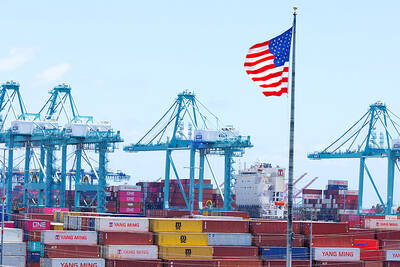
NOT IMMEDIATE: Taiwan has a chance to appeal the proposed 10 percent tariff before it starts, while other countries face a 12.5 percent tariff from the trade office Taiwan is among 60 economies determined by the US to have failed to impose or enforce a ban on the importation of goods produced with forced labor, according to a notice released on Tuesday by the Office of the US Trade Representative (USTR), which proposed imposing an additional 10 percent or more tariff on them. The USTR in a statement said that following an investigation, it had determined under Section 301 of the Trade Act of 1974 that the failure of the 60 economies to impose and effectively enforce a prohibition on the importation of goods produced with forced labor is
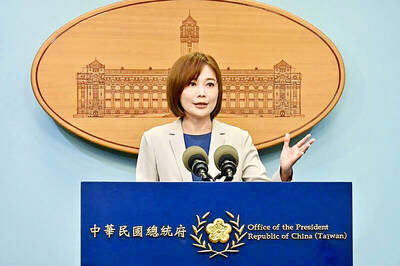
TIT-FOR-TAT: The US allegedly revoked the visa of a Chinese national working at Xinhua News Agency in the US in response to Beijing’s expulsion of Vivian Wang The Presidential Office yesterday condemned China for expelling a New York Times correspondent from Beijing following the newspaper’s interview with President William Lai (賴清德), saying the move highlighted Beijing’s suppression of press freedom and its threat to international news media. Taiwan has noted a series of recent incidents in which Beijing used similar tactics to “threaten and pressure international media outlets and journalists,” Presidential Office spokeswoman Karen Kuo (郭雅慧) said in a statement. “This concerns not only press freedom and freedom of expression, but also the safety of journalists, and Taiwan and relevant partners are paying close attention to the situation,” she


 RSS
RSS