


Vice President Annette Lu (
Lu yesterday became the nation's first incumbent vice president to be a defendant at a hearing.
"Prosecutors unfairly chose me as an investigation target and then indicted me. The prosecutorial system should have thoroughly probed the nation's more than 6,500 government officials in their use of their discretionary funds before deciding whether or not to indict me and other officials," Lu said, while making a short statement at the Taipei District Court before she entered the courtroom.
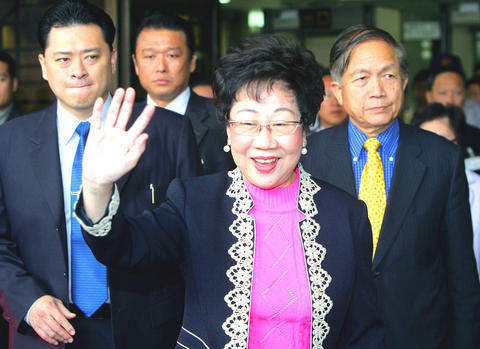
PHOTO: CNA
Lu said that former premier Su Tseng-chang (
"We must not allow the faults from an incomplete system of the old era to bring new disasters," she said.
Asked by judges how she would plead, Lu said: "I am not guilty of these charges."
Lu told the judges she did not know the details of the process involved in the reimbursement of special allowance funds, never received the funds illegally or directed her subordinates to use fraudulent receipts to claim her special allowance fund.
She said the charitable donations she had made during her term of office as vice president exceeded the special allowance funds she had received.
The Supreme Prosecutors Office in September indicted Lu, Democratic Progressive Party (DPP) Chairman Yu Shyi-kun and National Security Council Secretary-General Mark Chen (陳唐山) on suspicion of misusing their special allowance funds.
Lu, Yu and Chen were charged with corruption and forgery.
Prosecutors alleged that between December 2000 and May last year Lu used a total of 1,005 fraudulent receipts to claim reimbursements from her special allowance fund.
Prosecutors added that the receipts, collected by Lu's office staff and security guards, amounted to NT$5.6 million (US$170,000).
Earlier this year, Chinese Nationalist Party (KMT) presidential candidate Ma Ying-jeou (
A district court accepted his argument that by law the fund was an official subsidy, and acquitted him in August.
However, prosecutors have filed an appeal to a higher court to challenge the acquittal.
DPP presidential candidate Frank Hsieh (謝長廷) was investigated for misuse of discretionary funds during his tenure as mayor of Kaohsiung. No charges were made against him.
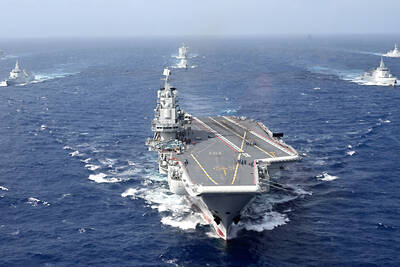
PROVOCATIVE: Chinese Deputy Ambassador to the UN Sun Lei accused Japan of sending military vessels to deliberately provoke tensions in the Taiwan Strait China denounced remarks by Japan and the EU about the South China Sea at a UN Security Council meeting on Monday, and accused Tokyo of provocative behavior in the Taiwan Strait and planning military expansion. Ayano Kunimitsu, a Japanese vice foreign minister, told the Council meeting on maritime security that Tokyo was seriously concerned about the situation in the East China and South China seas, and reiterated Japan’s opposition to any attempt to change the “status quo” by force, and obstruction of freedom of navigation and overflight. Stavros Lambrinidis, head of the EU delegation to the UN, also highlighted South China Sea
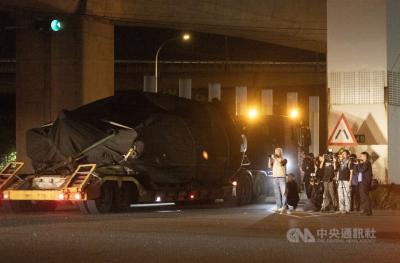
The final batch of 28 M1A2T Abrams tanks purchased from the US arrived at Taipei Port last night and were transported to the Armor Training Command in Hsinchu County’s Hukou Township (湖口), completing the military’s multi-year procurement of 108 of the tanks. Starting at 12:10am today, reporters observed more than a dozen civilian flatbed trailers departing from Taipei Port, each carrying an M1A2T tank covered with black waterproof tarps. Escorted by military vehicles, the convoy traveled via the West Coast Expressway to the Armor Training Command, with police implementing traffic control. The army operates about 1,000 tanks, including CM-11 Brave Tiger
Taiwan Semiconductor Manufacturing Co (TSMC, 台積電), the world’s largest contract chipmaker, said it expects its 2-nanometer (2nm) chip capacity to grow at a compound annual rate of 70 percent from this year to 2028. The projection comes as five fabs begin volume production of 2-nanometer chips this year — two in Hsinchu and three in Kaohsiung — TSMC senior vice president and deputy cochief operating officer Cliff Hou (侯永清) said at the company’s annual technology symposium in Silicon Valley, California, last week. Output in the first year of 2-nanometer production, which began in the fourth quarter of last year, is expected to
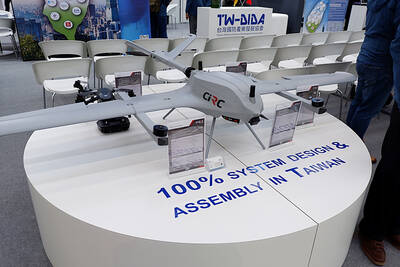
Taiwan’s drone exports surged past US$100 million in the first quarter, exceeding last year’s full-year total, with the Czech Republic emerging as the largest buyer, the Ministry of Economic Affairs said. Exports of complete drones reached US$115.85 million in the period, about 1.2 times the total recorded for all of last year, the ministry said in a report. Exports to the Czech Republic accounted for about US$100 million, far outpacing other markets. Poland, last year’s top destination, recorded about US$11.75 million in the first quarter. Taiwan’s drone exports have expanded rapidly in the past few years, with last year’s total


 RSS
RSS