


The presidential candidates of the two main parties yesterday thanked former United Microelectronics Corp (聯電) chairman Robert Tsao (曹興誠) for his proposal that they work together for a cross-strait peace agreement between Taiwan and China.
Tsao ran an advertisement in four major Chinese-language newspapers yesterday, including the Liberty Times (the Taipei Times' sister newspaper) and the United Daily News, urging Chinese Nationalist Party (KMT) presidential candidate Ma Ying-jeou (馬英九) and his Democratic Progressive Party (DPP) rival, Frank Hsieh (謝長廷), to cooperate and push for cross-strait "peaceful coexistence legislation" to "completely solve the cross-strait problem and end the political wrangling within the nation."
Calling himself "a citizen concerned about the nation," Tsao said the cross-strait conflict could be resolved if the two sides of the Taiwan Strait use referendums as a peaceful means to solve the cross-strait gridlock.
Hsieh said that he appreciated Tsao's proposal and concern for the political situation.
"Cross-strait peace is a common goal shared by all parties," he said. "I myself will strive to reach the goal if I am elected."
Asked whether he would be willing to work together with Ma to put Tsao's proposal into practice, Hsieh said he would make every effort to push for peace, but not with Ma.
"The suggestion that we jointly push the initiative sounds strange," he said. "Since there is only one president, it makes more sense that the president and the government lead the country to advance that goal."
He said political parties can cooperate like businesses and that they should not always try to annihilate one another, but sometimes work together to create a win-win situation.
"The media seem to be more interested in seeing Ma and I brawl like professional wrestlers," he said. "Actually we can work together and find common ground."
Meanwhile, Ma reiterated that he would pursue peace talks with China under the premise that China first remove its missiles targeting Taiwan, if he wins the presidential election.
"The most important thing at the moment is to establish the groundwork for [cross-strait] peace because whether the nation should be united [with China] or not is a long-term matter," Ma said.
"What we need to do at the moment is put an end to the hostility the two sides show toward each other. If we do not put an end to the hostility, leaders of both sides will have some blind spots and leave some urgent problems aside. This is a real pity," he said.
Ma said he had previously proposed the signing of a peace agreement with China and was grateful for Tsao's suggestion, but he believed dealing with cross-strait affairs through negotiation would be more effective.
Ma said the KMT and China had reached an "initial consensus" when former KMT chairman Lien Chan (
In the ad, Tsao also called on the two presidential candidates to halt their parties' respective referendum bids on entry to the UN, saying that the proposed referendums were nothing but "slogans."
"The world may question the validity of Taiwan's other referendums if we hold the two referendums recklessly," Tsao said.
Tsao said his proposed legislation should include six focal points, including confirmation that Taiwan will not hold an independence referendum because "Taiwan, or the Republic of China [ROC], has stated its independent statehood."
The legislation should include an announcement that the nation would not exclude the possibility of uniting with China, but unification should not happen unless a unification referendum is passed, Tsao said.
However, Taiwan will only hold such a unification referendum if China requests it, he said, adding that this could enhance direct communication between Taiwanese and Chinese.
If Taiwan were to hold a unification referendum, China should first reveal the details of its proposal for a "high degree of autonomy" to Taiwanese, Tsao said, adding that if such a referendum passes, this means the majority of Taiwanese agree that unification with China is more advantageous than asserting independence.
If such a referendum fails to pass, this means Taiwanese people remain doubtful about China's definition of autonomy, Tsao said, adding that China should revise its proposal and propose another referendum bid on unification about a decade later.
Earlier yesterday morning, Hsieh spokesman Chao Tien-lin (
While Tsao urged the DPP and KMT to abandon their respective referendum proposals seeking UN membership, Chao said that the will of the 3 million people who endorsed the DPP's referendum proposal should be respected.
Premier Chang Chun-hsiung (
He said the likelihood of the Cabinet withdrawing the referendum bid on applying for UN membership using the name "Taiwan" was remote.
"The government is not authorized by the Referendum Law (
Regarding Tsao's proposal for cross-strait peace, Chang said that different people have different propositions and he hoped the public understands that cross-strait policy is not set by the Cabinet but the president.
Chang said the suggestions made by Tsao were not workable in practice, even though it is everybody's wish to achieve cross-strait stability and peace.
"The cross-strait relationship can't be unilaterally decided [by the Taiwanese side]," Chang said when approached by the medias for comment on Tsao's letter.
Additional reporting by Shih Hsiu-chuan
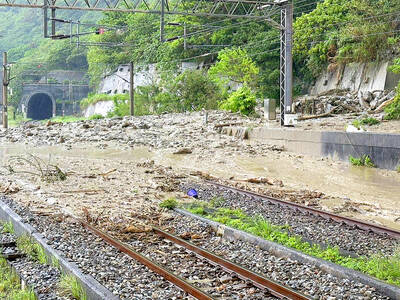
ROLLER-COASTER RIDE: More than five earthquakes ranging from magnitude 4.4 to 5.5 on the Richter scale shook eastern Taiwan in rapid succession yesterday afternoon Back-to-back weather fronts are forecast to hit Taiwan this week, resulting in rain across the nation in the coming days, the Central Weather Administration said yesterday, as it also warned residents in mountainous regions to be wary of landslides and rockfalls. As the first front approached, sporadic rainfall began in central and northern parts of Taiwan yesterday, the agency said, adding that rain is forecast to intensify in those regions today, while brief showers would also affect other parts of the nation. A second weather system is forecast to arrive on Thursday, bringing additional rain to the whole nation until Sunday, it
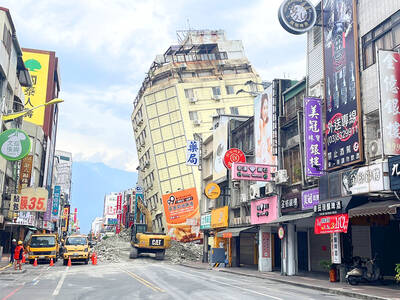
LANDSLIDES POSSIBLE: The agency advised the public to avoid visiting mountainous regions due to more expected aftershocks and rainfall from a series of weather fronts A series of earthquakes over the past few days were likely aftershocks of the April 3 earthquake in Hualien County, with further aftershocks to be expected for up to a year, the Central Weather Administration (CWA) said yesterday. Based on the nation’s experience after the quake on Sept. 21, 1999, more aftershocks are possible over the next six months to a year, the agency said. A total of 103 earthquakes of magnitude 4 on the local magnitude scale or higher hit Hualien County from 5:08pm on Monday to 10:27am yesterday, with 27 of them exceeding magnitude 5. They included two, of magnitude

CONDITIONAL: The PRC imposes secret requirements that the funding it provides cannot be spent in states with diplomatic relations with Taiwan, Emma Reilly said China has been bribing UN officials to obtain “special benefits” and to block funding from countries that have diplomatic ties with Taiwan, a former UN employee told the British House of Commons on Tuesday. At a House of Commons Foreign Affairs Committee hearing into “international relations within the multilateral system,” former Office of the UN High Commissioner for Human Rights (OHCHR) employee Emma Reilly said in a written statement that “Beijing paid bribes to the two successive Presidents of the [UN] General Assembly” during the two-year negotiation of the Sustainable Development Goals. Another way China exercises influence within the UN Secretariat is
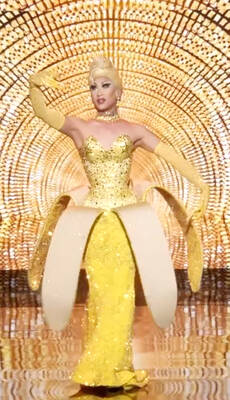
Taiwan’s first drag queen to compete on the internationally acclaimed RuPaul’s Drag Race, Nymphia Wind (妮妃雅), was on Friday crowned the “Next Drag Superstar.” Dressed in a sparkling banana dress, Nymphia Wind swept onto the stage for the final, and stole the show. “Taiwan this is for you,” she said right after show host RuPaul announced her as the winner. “To those who feel like they don’t belong, just remember to live fearlessly and to live their truth,” she said on stage. One of the frontrunners for the past 15 episodes, the 28-year-old breezed through to the final after weeks of showcasing her unique


 RSS
RSS