


Four days after retail fuel prices reached an all-time high, sending consumer prices soaring, the Cabinet yesterday effectively froze pump prices.
The government decided in September that fuel prices would not be allowed to rise above their levels on Sept. 2 by more than 15 percent. But that cap has now been set at 12 percent.
"As fuel prices have increased by 11.75 percent [since Sept. 2], it's unlikely that they will be raised further," Government Spokesman Shieh Jhy-wey (
Shieh made the announcement following a meeting of a Cabinet task force convened by Vice Premier Chiou I-jen (
However, the task force hasn't decided how long fuel prices will be capped at their present levels.
Chen refused to comment on whether the cap could be revised further, saying only that this depended on "the trend in international crude oil prices."
The state-run CPC Corp, Taiwan (台灣中油) raised wholesale gasoline and diesel prices by NT$0.9 per liter on Thursday, bringing the retail price for 92-octane unleaded gasoline to NT$30, the retail price for 95-octane unleaded gasoline to NT$30.7 per liter, the retail price for 98-octane unleaded gasoline to NT$32.2 per liter and the retail price for premium diesel oil to NT$27.5 per liter.
Had the cap been maintained at 15 percent, the retail price for 92-octane unleaded gasoline could have risen to NT$30.5 per liter, while 95-octane unleaded gasoline could have increased to NT$31.2.
Cabinet officials denied that the change in policy amounted to an about face.
Chen said it was "reasonable" to lower the cap.
"We didn't expect international oil prices to increase at such a rapid rate when the 15 percent ceiling was put in place," he said.
Premier Chang Chun-hsiung (張俊雄), facing calls from the Democratic Progressive Party (DPP) caucus to resign if the government fails to address soaring commodities prices, promised yesterday to stabilize prices "as soon as possible."
"As the premier, I have to give consideration to commodity prices and market competition. I will not shirk this responsibility," Chang said in response to questions from Chinese Nationalist Party (KMT) Legislator Lee Ching-hua (李慶華).
Lee said the consumer price index was 5.34 percent last month, the highest since October 1994.
Chang said he respected the opinions of fellow DPP legislators but did not specify whether he would tender his resignation if prices continued to rise.
Chang also said he would step up investigations into whether any businesses were raising prices unnecessarily. He said anyone found to be hiking prices would be severely punished.
Meanwhile, privately run Formosa Petrochemical Corp (台塑石化) refused to say whether it would follow CPC in freezing fuel prices.
The nation's second-largest oil refiner bases its fuel prices on CPC's pump prices and has been investigated by the Fair Trade Commission for price fixing.
Formosa Petrochemical sells about 70 percent of its fuel to overseas markets.
Formosa Petrochemical's net income for the first three quarters of the year increased by 6.68 percent to NT$51.37 billion, or NT$5.55 per share, from a year ago.
In related developments, President Chen Shui-bian (陳水扁) said the increases in fuel and commodity prices were mostly attributable to the rising prices of raw ingredients sourced from international markets.
He said the CPI had been affected by higher vegetable and fruit prices as a result of a series of typhoons this summer.
Chen urged the public to refrain from breaking the law by hoarding consumer goods, saying offenders would be brought to justice.
KMT presidential candidate Ma Ying-jeou (
"Vice Premier Chiou I-jen lauded Chang's `guts' when he introduced the system and now he has decided to freeze prices. Were his guts removed in an operation?" Ma said during a visit to Taipei County.
Ma also said he would focus on controlling prices if elected.
"If [DPP presidential candidate Frank] Hsieh (謝長廷) continues to focus on the UN referendum bid, I can't think of a better name for him than `Jin Hui-ti' (晉惠帝)," Ma said.
Jin Hui-ti, the second emperor of the Jin Dynasty, is remembered for causing great suffering by not understanding the needs of his people.
Hsieh was quick to respond. He said his emphasis on joining the UN under the name "Taiwan" does not mean that it was the only thing he was concerned about.
Ma's remarks reflected his own incompetence because it seemed Ma was only capable of doing one thing a day, Hsieh said.
Additional reporting by Mo Yan-chih, Ko Shu-ling and Jessie Ho
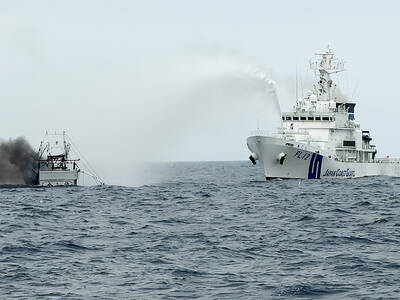
CREDIT-GRABBER: China said its coast guard rescued the crew of a fishing vessel that caught fire, who were actually rescued by a nearby Taiwanese boat and the CGA Maritime search and rescue operations do not have borders, and China should not use a shipwreck to infringe upon Taiwanese sovereignty, the Coast Guard Administration (CGA) said yesterday. The coast guard made the statement in response to the China Coast Guard (CCG) saying it saved a Taiwanese fishing boat. The Chuan Yu No. 6 (全漁6號), a fishing vessel registered in Keelung, on Thursday caught fire and sank in waters northeast of Diaoyutai Islands (釣魚台). The vessel left Keelung’s Badouzih Fishing Harbor (八斗子漁港) at 3:35pm on Sunday last week, with seven people on board — a 62-year-old Taiwanese captain surnamed Chang (張) and six
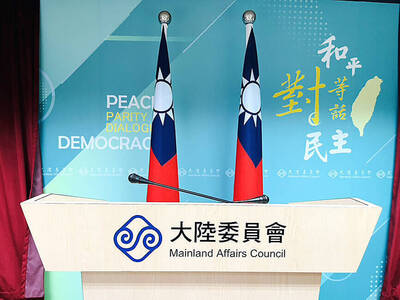
RISKY BUSINESS: The ‘incentives’ include initiatives that get suspended for no reason, creating uncertainty and resulting in considerable losses for Taiwanese, the MAC said China’s “incentives” failed to sway sentiment in Taiwan, as willingness to work in China hit a record low of 1.6 percent, a Ministry of Labor survey showed. The Directorate-General of Budget, Accounting and Statistics (DGBAS) also reported that the number of Taiwanese workers in China has nearly halved from a peak of 430,000 in 2012 to an estimated 231,000 in 2024. That marked a new low in the proportion of Taiwanese going abroad to work. The ministry’s annual survey on “Labor Life and Employment Status” includes questions respondents’ willingness to seek employment overseas. Willingness to work in China has steadily declined from

The Legislative Yuan’s Finance Committee yesterday approved proposed amendments to the Amusement Tax Act (娛樂稅法) that would abolish taxes on films, cultural activities and competitive sporting events, retaining the fee only for dance halls and golf courses. The proposed changes would set the maximum tax rate for dance halls and golf courses at 50 and 20 percent respectively, with local governments authorized to suspend the levies. Article 2 of the act says that “amusement tax shall be levied on tickets sold or fees charged by amusement places, facilities or activities” in six categories: “Cinema; professional singing, story-telling, dancing, circus, magic show, acrobatics
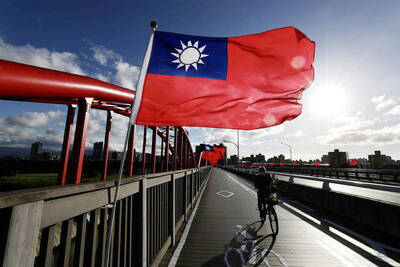
INFLATION UP? The IMF said CPI would increase to 1.5 percent this year, while the DGBAS projected it would rise to 1.68 percent, with GDP per capita of US$44,181 The IMF projected Taiwan’s real GDP would grow 5.2 percent this year, up from its 2.1 percent outlook in January, despite fears of global economic disruptions sparked by the US-Iran conflict. Taiwan’s consumer price index (CPI) is projected to increase to 1.5 percent, while unemployment would be 3.4 percent, roughly in line with estimates for Asia as a whole, the international body wrote in its Global Economic Outlook Report published in the US on Monday. The figures are comparatively better than the IMF outlook for the rest of the world, which pegged real GDP growth at 3.1 percent, down from 3.3 percent


 RSS
RSS