


Chinese Nationalist Party (KMT) presidential candidate Ma Ying-jeou (
"The `1992 consensus' has always been my and the party's policy. The KMT's position on cross-strait policy is clear, and I have never stopped emphasizing the `1992 consensus,'" Ma said in Taipei County.
His remarks came one day after the KMT Central Standing Committee approved a draft of the party's key missions for next year. That draft omits the guidelines and the "1992 consensus" from its guidance on cross-strait policy.

PHOTO: WANG MIN-WEI, TAIPEI TIMES
Ma also denied a report in the Chinese-language United Daily News that the KMT had omitted the two in order to solicit more support from "neutral" voters to boost his election chances. He said the draft did not reflect the party's policies.
"Key policies such as the `1992 consensus' are listed in the party's charter, but not necessarily mentioned in an annual document like this one. It's unnecessary to make a fuss about it," he said.
The so-called "1992 consensus" refers to an alleged consensus reached between Chinese and Taiwanese negotiators during talks in Hong Kong in 1992 that there is "one China, with each side having its own interpretation."
KMT Legislator Su Chi (蘇起) admitted in March last year that he made up the term "1992 consensus" before the transfer of power in 2000.
KMT Chairman Wu Poh-hsiung (
"If people are confused or have misunderstandings about the missions, we will deal with that next week. However, I've made it clear that the KMT's cross-strait policies are based on the `1992 consensus,'" Wu said at KMT headquarters.
Nevertheless, former KMT chairman Lien Chan (連戰) condemned the party for scrapping the guidelines and the "1992 consensus," and urged it not to abandon its beliefs for election purposes.
"I am deeply stunned and confused by this absurd move ? The `1992 consensus' has been the KMT's cross-strait policy and a firm belief shared by party members and supporters," Lien said yesterday in a written statement.
"Winning elections is the expectation of all party members, but we can't dance to other people's tunes and budge from our position," he said.
Lien insisted that the "1992 consensus" was part of history, the status quo and a fact. He warned a move away from them could cost the party some of its deep-blue support.
Legislative Speaker Wang Jin-pyng (
"For the KMT to abandon the `1992 consensus' is like the Democratic Progressive Party [DPP] giving up on Taiwan independence. It would have a serious impact on the party," Wang said.
He said the move had sparked criticism from many deep-blue members, who said they could not understand the decision.
"Scrapping the consensus may have a huge impact on the elections ? I urge the party to seek consensus before making any decisions on major policies," Wang said.
President Chen Shui-bian (陳水扁) slammed the KMT move to eliminate unification rhetoric from its internal documents as an election ploy aimed at deceiving voters.
Chen said no one should be fooled by the KMT's tricks because its charter still embraces unification with China.
The president noted that the government has stopped observing Oct. 31st as a national holiday commemorating the birth of dictator Chiang Kai-shek (蔣介石).
"He is the main culprit of the `228 Incident,' a butcher and a murderer who occupied Taiwan and imposed 38 years of martial law," Chen said at a campaign activity in Yunlin County yesterday morning.
"KMT presidential candidate Ma Ying-jeou, however, looks up to him. I'm wondering whether Ma will become a second Chiang Kai-shek if he is elected president."
Meanwhile, DPP presidential candidate Frank Hsieh (
"His wayward attitude may help his election hopes a little, but will not help the country's stable development," Hsieh said. "A country must have steady development and prospects and the government must lead the people. How do you expect the people to follow a national leader if he changes his mind all the time?"
DPP Secretary-General Cho Jung-tai (
He said the KMT should first apologize for fabricating the "1992 consensus" and fully support the government's cross-strait policy.
Second, he said, the KMT should immediately stop its referendum proposal on "rejoining" the UN under the name the "Republic of China" and fully support the DPP's referendum proposal seeking UN membership under the name "Taiwan."
Finally, the KMT should change the party charter and its name to "Taiwan Nationalist Party," Cho said.
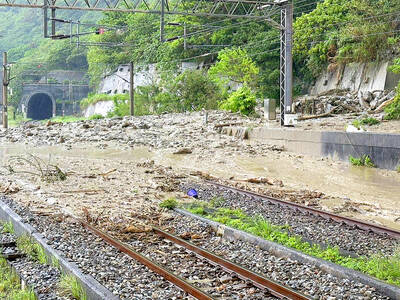
ROLLER-COASTER RIDE: More than five earthquakes ranging from magnitude 4.4 to 5.5 on the Richter scale shook eastern Taiwan in rapid succession yesterday afternoon Back-to-back weather fronts are forecast to hit Taiwan this week, resulting in rain across the nation in the coming days, the Central Weather Administration said yesterday, as it also warned residents in mountainous regions to be wary of landslides and rockfalls. As the first front approached, sporadic rainfall began in central and northern parts of Taiwan yesterday, the agency said, adding that rain is forecast to intensify in those regions today, while brief showers would also affect other parts of the nation. A second weather system is forecast to arrive on Thursday, bringing additional rain to the whole nation until Sunday, it
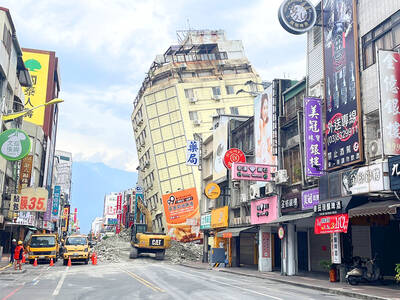
LANDSLIDES POSSIBLE: The agency advised the public to avoid visiting mountainous regions due to more expected aftershocks and rainfall from a series of weather fronts A series of earthquakes over the past few days were likely aftershocks of the April 3 earthquake in Hualien County, with further aftershocks to be expected for up to a year, the Central Weather Administration (CWA) said yesterday. Based on the nation’s experience after the quake on Sept. 21, 1999, more aftershocks are possible over the next six months to a year, the agency said. A total of 103 earthquakes of magnitude 4 on the local magnitude scale or higher hit Hualien County from 5:08pm on Monday to 10:27am yesterday, with 27 of them exceeding magnitude 5. They included two, of magnitude
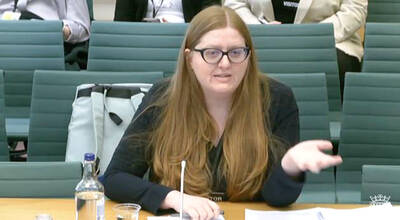
CONDITIONAL: The PRC imposes secret requirements that the funding it provides cannot be spent in states with diplomatic relations with Taiwan, Emma Reilly said China has been bribing UN officials to obtain “special benefits” and to block funding from countries that have diplomatic ties with Taiwan, a former UN employee told the British House of Commons on Tuesday. At a House of Commons Foreign Affairs Committee hearing into “international relations within the multilateral system,” former Office of the UN High Commissioner for Human Rights (OHCHR) employee Emma Reilly said in a written statement that “Beijing paid bribes to the two successive Presidents of the [UN] General Assembly” during the two-year negotiation of the Sustainable Development Goals. Another way China exercises influence within the UN Secretariat is
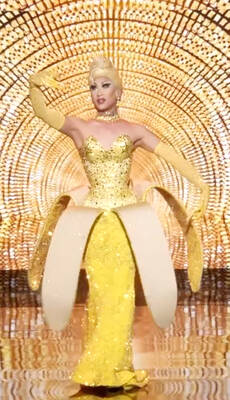
Taiwan’s first drag queen to compete on the internationally acclaimed RuPaul’s Drag Race, Nymphia Wind (妮妃雅), was on Friday crowned the “Next Drag Superstar.” Dressed in a sparkling banana dress, Nymphia Wind swept onto the stage for the final, and stole the show. “Taiwan this is for you,” she said right after show host RuPaul announced her as the winner. “To those who feel like they don’t belong, just remember to live fearlessly and to live their truth,” she said on stage. One of the frontrunners for the past 15 episodes, the 28-year-old breezed through to the final after weeks of showcasing her unique


 RSS
RSS