


Turkish Foreign Minister Ali Babacan warned yesterday that Turkey could launch an attack on Kurdish militants in northern Iraq on the heels of a similar threat by Prime Minister Tayyip Erdogan on Saturday after diplomatic talks with Iraq failed.
"The moment an operation is needed, we will take that step," Erdogan told a flag-waving crowd in Izmit. "We don't need to ask anyone's permission."
Turkish-Iraqi talks collapsed late on Friday after Ankara rejected proposals by Iraqi Defense Minister General Abdel Qader Jassim for tackling Kurdish guerrillas based in northern Iraq as insufficient. The Iraqi delegation left on Saturday.
After talks with his Iranian counterpart, Manouchehr Mottaki, Babacan said that Ankara had ruled out no option in its fight against Kurdistan Workers' Party (PKK) rebels who have carried out a string of attacks in eastern Turkey.
"We have different instruments. We can use diplomacy or we can resort to military means," Babacan said in Tehran. "All of these are on the table."
"The Turkish people have lost their patience ... We are asking all our friends to support us in this endeavor, our fight against terror," he said.
However Mottaki gave a highly equivocal answer to a question over whether Iran would support a Turkish military strike on northern Iraq against the Kurdish militants.
"I think that we will be able to overcome these small grouplets," he said.
"There are various ways of going about this. We hope our cooperation will allow us to solve this," he said.
The Iraqi authorities also said Iranian President Mahmoud Ahmadinejad agreed with Iraqi Prime Minister Nouri al-Maliki that that crisis could still be solved by diplomacy.
"Both leaders agreed the activities of the PKK were damaging the interests of Iraq, Turkey and Iran but stressed that military action is not the only option to deal with it," Maliki's office quoted the leaders as saying.
Iran has in recent weeks been echoing Turkey's frustration over the failure of the authorities in northern Iraq to crack down on Kurdish rebels.
The PKK-linked militant Kurdish group Party of Free Life of Kurdistan has been behind a string of deadly attacks on security forces in northwestern Iran in recent months.
Iran's Kordestan, Kermanshah and West Azarbaijan provinces, which border northern Iraq, have substantial Kurdish populations.

DRONE CENTRAL: Taiwan aims to become Asia’s democratic hub for drones, with most exports focused on high-quality military-grade models, an official said Taiwan’s drone industry is expected to expand significantly by 2030, producing 100,000 units per month and exporting half of them, the Ministry of Economic Affairs said yesterday. Current drone production capacity is about 15,000 units per month, but the industry can quickly scale up as demand increases, Industrial Development Administration Director-General Chiou Chyou-huey (邱求慧) told a news conference in Taipei. Taiwan’s drone output grew 2.5-fold last year to NT$12.9 billion (US$408.3 million) under a government program to develop the uncrewed vehicle sector, he said. The Executive Yuan in October last year approved plans to invest NT$44.2 billion into domestic production of uncrewed aerial

A signaling system malfunction disrupted high-speed rail (HSR) services beginning at 8am today, with trains temporarily reduced to three northbound and three southbound trains per hour as authorities conduct inspections. The malfunction occurred on a section of track in Miaoli County during pre-operation checks early this morning, forcing northbound and southbound trains to use a single track, the HSR operator said. The regular schedule has been replaced with three hourly trains offering only nonreserved seating in each direction, stopping at every station, it said, adding that business class cars would still have reserved seating. Departures from terminal stations are scheduled at the top
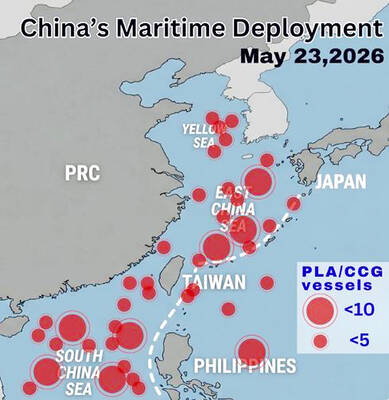
WARNING: China should stop engaging in actions that undermine regional peace and stability, as it would only build resentment among people across the Strait, the CGA said China has deployed more than 100 navy, coast guard and other vessels in waters from the Yellow Sea to the South China Sea and the western Pacific since US President Donald Trump and Chinese President Xi Jinping (習近平) met in Beijing, National Security Council Secretary-General Joseph Wu (吳釗燮) said yesterday. “In this part of the world, #China is the one & only PROBLEM wrecking the #StatusQuo & threatening regional peace & stability,” Wu wrote on X. In a separate post, he said Beijing was coercing Taiwan’s maritime domain, calling it illegal and provocative, after the Coast Guard Administration (CGA) expelled a

VERBOSE VESSELS: A CGA cutter and a China Coast Guard exchanged verbal barbs for more than a day in Taiwanese-controlled waters before the Chinese vessel left The Taiwanese and Chinese coast guards had a standoff near the strategically located Pratas Islands (Dongsha Islands, 東沙群島) in the north of the South China Sea, the Coast Guard Administration (CGA) said yesterday. The two sides engaged in intense radio exchanges over sovereignty claims during the 33-hour standoff. China Coast Guard vessel 3501 eventually left the restricted waters, 26.6 nautical miles (49.2km) west of the Pratas Islands, at 5pm yesterday, the CGA said. Lying approximately between southern Taiwan and Hong Kong, the Taiwan-controlled Pratas are seen by some security experts as vulnerable to Chinese attack due to their distance — more than


 RSS
RSS