


Almost a third of all apes, monkeys and other primates are in danger of becoming extinct because of rampant destruction of their tropical habitat, the commercial sale of bush meat and the trade in illegal wildlife, a report released yesterday said.
Twenty-five of the most endangered primates are singled out in the report, which was to be presented at the International Primatological Society in Hainan, China.
Among those most at risk are the Miss Waldron's red colobus of Ivory Coast and Ghana, the Golden-headed langur of Vietnam and China's Hainan gibbon, whose numbers have dwindled to 17. The Horton Plains slender loris of Sri Lanka has been sighted just four times since 1937.
"You could fit all the surviving members of the 25 species in a single football stadium; that's how few of them remain on Earth today," said Conservation International president Russell Mittermeier, who also chairs the World Conservation Union's (IUCN) Primate Specialist Group which prepared the report with the International Primatological Society and Conservation International.
"The situation is worst in Asia, where tropical forest destruction and the hunting and trading of monkeys puts many species at terrible risk," he said. "Even newly discovered species are severely threatened from loss of habitat and could soon disappear."
Overall, 114 of the world's 394 primate species are classified as threatened with extinction by the IUCN. The 25 most endangered primates include 11 from Asia, seven from Africa, four from Madagascar and three from South and Central America.
The list includes well-known primates as well as lesser known species. Six species are on the biannual report for the first time, including a recently discovered Indonesian tarsier that has yet to be formally named and the Kipunji from Tanzania, which was discovered in 2003.
Habitat loss due to the clearing of tropical forests for agriculture, logging and the collection of fuel wood continues to be the major factor in the declining number of primates, the report said. In addition, climate change is altering the habitats of many species, leaving some of them more vulnerable.
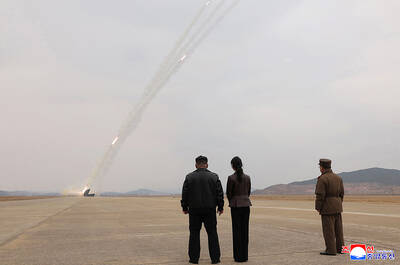
North Korea tested nuclear-capable rocket launchers, state media reported yesterday, a day after Seoul detected the launch of about 10 ballistic missiles. The test comes after South Korean and US forces launched their springtime military drills, due to run until Thursday. North Korean leader Kim Jong-un on Saturday oversaw the testing of the multiple rocket launcher system (MRLS), the Korean Central News Agency (KCNA) said. The test involved 12 600mm-caliber ultra-precision multiple rocket launchers and two artillery companies, it said. Kim said the drill gave Pyongyang’s enemies, within the 420km striking range, a sense of “uneasiness” and “a deep understanding

RECOGNITION: Former Fijian prime minister Mahendra Chaudhry said that Taiwan’s New Southbound Policy serves as a stabilizing force in the Indo-Pacific region Taiwan can lead the unification of the Chinese people, Nobel Peace Prize laureate and former Polish president Lech Walesa said in Taipei yesterday, adding that as the world order is changing, peaceful discussion would find good solutions, and that the use of force and coercion would always fail. Walesa made the remarks during his keynote address at a luncheon of the Yushan Forum in Taipei, titled “Indo-Pacific Partnership Prospects: Taiwan’s Values, Technology and Resilience,” organized by the Taiwan-Asia Exchange Foundation with the Ministry of Foreign Affairs. Walesa said that he had been at the forefront of a big peaceful revolution and “if

North Korea yesterday fired about 10 ballistic missiles to the sea toward Japan, the South Korean Joint Chiefs of Staff (JCS) said, days after Pyongyang warned of “terrible consequences” over ongoing South Korea-US military drills. Pyongyang recently dashed hopes of a diplomatic thaw with Seoul, Washington’s security ally, describing its latest peace efforts as a “clumsy, deceptive farce.” Seoul’s military detected “around 10 ballistic missiles launched from the Sunan area in North Korea toward the East Sea [Sea of Japan] at around 1:20pm,” JCS said in a statement, referring to South Korea’s name for the body of water. The missiles

‘UNWAVERING FRIENDSHIP’: A representative of a Japanese group that co-organized a memorial, said he hopes Japanese never forget Taiwan’s kindness President William Lai (賴清德) yesterday marked the 15th anniversary of the Tohoku earthquake and tsunami, urging continued cooperation between Taiwan and Japan on disaster prevention and humanitarian assistance. Lai wrote on social media that Taiwan and Japan have always helped each other in the aftermath of major disasters. The magnitude 9 earthquake struck northeastern Japan on March 11, 2011, triggering a massive tsunami that claimed more than 19,000 lives, according to data from Japanese authorities. Following the disaster, Taiwan donated more than US$240 million in aid, making it one of the largest contributors of financial assistance to Japan. In addition to cash donations and


 RSS
RSS