


The dispute between the central government and the Taipei City Government over the former's UN bid torch relay, set for today, was resolved at the last minute when the city government approved a permit application for the event.
The application was filed on Monday by the Chinese Taipei Road Running Association (CTRRA) on behalf of the Sport Affairs Council (SAC).
For several days, the city government and the SAC had engaged in a dispute over whether the torch relay -- intended to promote the country's bid to join the UN -- is a political activity or a sports event.
The SAC, which considers the torch relay a sports event, notified the city government of its plans but did not apply for a permit.
However, Taipei Mayor Hau Lung-bin (郝龍斌) insisted that the relay event is a political activity, for which a permit is required. He said that holding the activity without a permit would be unlawful.
During a question-and-answer session on the legislative floor yesterday, Premier Chang Chun-hsiung (張俊雄) said the Cabinet had approached the dispute with three principles in mind: that it should try its best to resolve conflict between government agencies; that the event should be held in an orderly manner; and that political conflict should be avoided.
Chang denied that the central government had changed its mind on the nature of the event.
SAC Deputy Chairman Lee Kao-hsiang (
Cabinet Spokesman Shieh Jhy-wey (
CTRRA Deputy Secretary-General Ho Li-chiung (
Ho said a precedent had been set, as a permit had never before been required for a marathon event.
Meanwhile, the Taipei City Government will send more than 700 police officers to maintain order and to control traffic at the torch relay and the Chinese Nationalist Party's (KMT) cycling event, which also takes place today.
Taipei City Police Department Commissioner Wang Cho-chiun (
Wang estimated that more than 700 people will participate in the torch relay, which begins in front of the Presidential Office this morning.
He urged drivers and pedestrians who will pass the relay route to follow police instructions.
Hau said the city government would assist with traffic control because legal procedures had been followed.
"The city government doesn't like events being held during the week, as this will cause inconvenience for residents. But we will maintain order to ensure that the events run smoothly," Hau said.
The mayor added that the city government would draw up regulations to control events that are held during the week.
"We respect the public's right to parade and assembly, but we need to make sure that these events do not cause any inconvenience for the majority," he said.
With the dispute seemingly at an end, the DPP yesterday called on the public to participate in the torch relay.
DPP Secretary-General Cho Jung-tai (
Organizers have arranged a group of 17 athletes to complete the 1,200km torch relay across the country's 25 cities and counties in 11 days.
Cho said Chen would pass the torch to DPP presidential candidate Frank Hsieh (
Chen told reporters in Kaohsiung that he hoped both the central and local government had learned a lesson as a result of the dispute. He said the torch relay should not be contentious because the ruling and opposition parties were agreed that UN membership was an important goal.
Cho called on the public, regardless of political affiliation, ethnicity or religion, to participate in the event to show their support for the government's UN bid.
Cho said he hoped as many DPP party members as possible would take part.
DPP Legislator Hsieh Hsin-ni (謝欣霓), whoalso serves as director of the party's Culture and Information Department and is an avid jogger, called on the KMT to participate.
She said her understanding was that members of the KMT's Youth League had wanted to join the relay but had been instructed not to do so.
During an interview with a radio station in Kaohsiung yesterday, Chen said he would be neglecting his duty as president if he failed to push for UN membership under the name "Taiwan."
Chen said that "returning" to the UN under the name of the "Republic of China," as the KMT has suggested, would be a "major change of the status quo."
The president said the importance of the DPP's referendum proposal, which is in the second stage, rivals that of next year's presidential election.
He said the election equated to a choice between Taiwan and China and expressed confidence in the result, saying he believed Taiwan-centered consciousness would beat out China sentiment.
Chen dismissed speculation that he had tried to outshine Hsieh, saying that the presidential candidate had his full backing.
In a related development, KMT Legislator John Chiang (
Additional reporting by Shih Hsiu-chuan and CNA
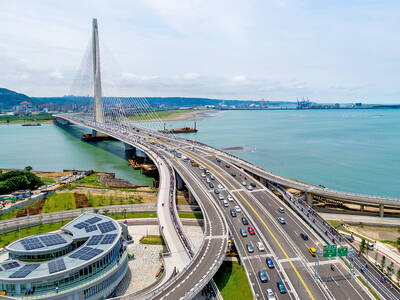
The Ministry of Transportation and Communications yesterday inaugurated the Danjiang Bridge across the Tamsui River in New Taipei City, saying that the structure would be an architectural icon and traffic artery for Taiwan. Feted as a major engineering achievement, the Danjiang Bridge is 920m long, 211m tall at the top of its pylon, and is the longest single-pylon asymmetric cable-stayed bridge in the world, the government’s Web site for the structure said. It was designed by late Iraqi-British architect Zaha Hadid. The structure, with a maximum deck of 70m, accommodates road and light rail traffic, and affords a 200m navigation channel for boats,
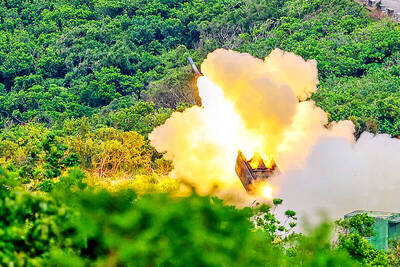
PRECISION STRIKES: The most significant reason to deploy HIMARS to outlying islands is to establish a ‘dead zone’ that the PLA would not dare enter, a source said A High Mobility Artillery Rocket System (HIMARS) would be deployed to Penghu County and Dongyin Island (東引) in Lienchiang County (Matsu) to force the Chinese military to retreat at least 100km from the coastline, a military source said yesterday. Taiwan has been procuring HIMARS and Army Tactical Missile Systems (ATACMS) from the US in batches. Once all batches have been delivered, Taiwan would possess 111 HIMARS units and 504 ATACMS, which have a range of 300km. Considering that “offense is the best defense,” the military plans to forward-deploy the systems to outlying islands such as Penghu and Dongyin so that

Taiwan Semiconductor Manufacturing Co (TSMC, 台積電), the world’s largest foundry service provider, yesterday said that global semiconductor revenue is projected to hit US$1.5 trillion in 2030, after the figure exceeds US$1 trillion this year, as artificial intelligence (AI) demand boosts consumption of token and compute power. “We are still at the beginning of the AI revolution, but we already see a significant impact across the whole semiconductor ecosystem,” TSMC deputy cochief operating officer Kevin Zhang (張曉強) said at the company’s annual technology symposium in Hsinchu City. “It is fair to say that in the past decade, smartphones and other mobile devices were
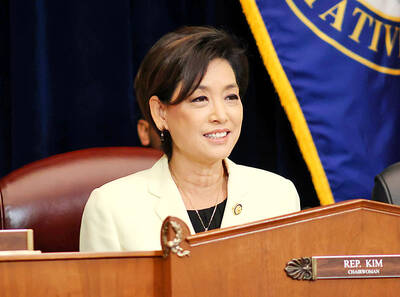
‘CLEAR MESSAGE’: The bill would set up an interagency ‘tiger team’ to review sanctions tools and other economic options to help deter any Chinese aggression toward Taiwan US Representative Young Kim has introduced a bill to deter Chinese aggression against Taiwan, calling for an interagency “tiger team” to preplan coordinated sanctions and economic measures in response to possible Chinese military or political action against Taiwan. “[Chinese President] Xi Jinping [習近平] has directed the People’s Liberation Army to be ready to invade Taiwan by 2027. China has a plan. America should have one too,” Kim said in a news release on Thursday last week. She introduced the “Deter PRC [People’s Republic of China] aggression against Taiwan act” to “ensure the US has a coordinated sanctions strategy ready should


 RSS
RSS