

Japanese Prime Minister Yasuo Fukuda yesterday told a resurgent opposition that Japan must not be a "bystander" in the US-led "war on terror" as he fought to extend a naval mission in the Indian Ocean.
The opposition won control of one house of parliament in July elections and has vowed to defeat government proposals to extend the naval mission providing fuel and logistical support to US-led forces in Afghanistan.
It has so far ignored a government compromise that would stop refueling operations backing combat troops, restricting support to ships policing the Indian Ocean.
Addressing a parliamentary committee attended by key lawmakers from the ruling coalition and opposition, Fukuda said that Japan, as the world's second-largest economy, needed to contribute to international security.
Saying that the international community was united after the 2001 terrorist attacks on the US, Fukuda said: "How can we sit back as a bystander?"
He also assured the opposition that the Indian Ocean mission does not violate Japan's pacifist Constitution, which was imposed by the US after World War II.
"First of all, the mission is not an act of force," Fukuda said. "It does not infringe on the Constitution at all."
Meanwhile, the US and Japan were locked in a dispute over Washington's demand that Tokyo shoulder more costs for water supplies and utilities at US military bases in Japan, media reports said on Monday.
Washington has urged Japan to cover rising costs of boosting US military capabilities in the Asia-Pacific region to deal with North Korea and China, Kyodo news agency quoted sources close to the matter as saying.
"It could cause a crack in the Japan-US relationship," Kyodo quoted a senior Japanese Foreign Ministry official as saying.
Japan, plagued by bulging public debts, wants to reduce the so-called "sympathy budget" it sets aside each year under bilateral agreements to help support nearly 50,000 US military personnel in Japan.
For the fiscal year ending in March, Japan allocated ?217.3 billion (US$1.86 billion) for the sympathy budget, ?115 billion to cover salaries for Japanese employees at the bases and ?25.3 billion for electricity, water and gas.
Meanwhile, in an apparent move to enhance its defenses against China, the Japanese Defense Ministry announced yesterday it would deploy F-15 fighter aircraft on Okinawa for the first time by early 2009.
The ministry also plans to deploy AH-64D Apache helicopters on the southern main island of Kyushu as part of the planned fleet relocation to step up defenses against China, the Nikkei said yesterday.
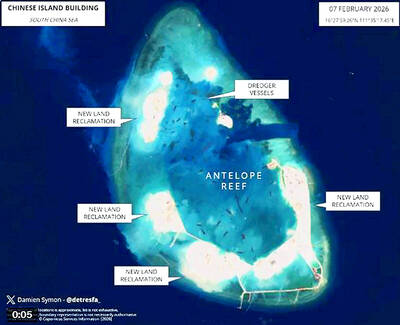
RUNWAY: Analysts said the first aircraft landing is expected by the middle of next year, while Chinese state media said it would serve civilian needs Chinese construction of a runway on Antelope Reef (Lingyang Reef, 羚羊礁) in the Paracel Islands (Xisha Islands, 西沙群島), is well under way with analysts estimating it could be completed by the middle of next year, strengthening Beijing’s military control over the disputed South China Sea. Satellite images reviewed by Reuters show grading work, piles of gravel and concrete, and compaction cranes in operation to build a full-scale runway that military attaches and security analysts say could be one of China’s most important offshore bases in the region. The images, taken on Friday last week by commercial satellite imagery provider Vantor, also show

SHIFTING COOPERATION: With the new arrangement, US representatives would be able to participate directly in defense discussions, including weapons procurement Taiwan-US military cooperation is deepening, with the Pentagon expected to station personnel at the Ministry of National Defense (MND), sources said. The NT$470 million (US$14.77 million) joint program is scheduled to run from this year through 2028, under which the Pentagon would dispatch representatives from the Office of the Under Secretary of Defense for Policy and the Institute for Defense Analyses, a senior military official said on condition of anonymity, adding that one representative from each organization would be stationed at the ministry’s headquarters. The Office of the Under Secretary of Defense for Policy is one of the US’ bodies responsible for

The Presidential Office today condemned China's transnational repression after an alleged Chinese foreign agent was arrested in California yesterday on suspicion of surveilling President William Lai's (賴清德) son, Lai Ting-yu (賴廷與), the FBI said. The 34-year-old woman, named Wanying Heather Zhang (張婉瑩), was arrested on suspicion of acting as an unregistered foreign agent, US news agency CBS reported. She was apprehended at Los Angeles International Airport yesterday attempting to fly to Shanghai, it said. This represents a “typical case” of China’s transnational repression, Presidential Office spokeswoman Karen Kuo (郭雅慧) said today. "Our country expresses the strongest condemnation of such barbaric conduct that

Former president Tsai Ing-wen (蔡英文) on Monday arrived in San Francisco, receiving a warm welcome from hundreds of overseas Taiwanese as she launched a week-long visit. Accompanied by Representative to the US Alexander Yui (俞大?), and head of Taiwan’s San Francisco office Wu Chih-hsiang (伍志翔), Tsai arrived at her hotel, waving, smiling and giving high-fives to Taiwanese compatriots amid cheers of “Taiwan’s democracy involves you and me” to welcome her to the San Francisco Bay Area. It is Tsai’s first visit to the US since she left office in May 2024 after serving two four-year terms as president. Tsai is today to deliver


 RSS
RSS