


Detained opposition leader Aung San Suu Kyi's party dismissed the Myanmar junta's offer of talks as surreal yesterday, while China said the ruthless suppression of pro-democracy protests did not require international action.
Senior General Than Shwe, who caused international outrage by sending in soldiers to crush peaceful monk-led demonstrations, was asking Suu Kyi to abandon the campaign for democracy that has kept her in detention for 12 of the last 18 years, a spokesman said.
"They are asking her to confess to offenses that she has not committed," said Nyan Win, spokesman for the Nobel peace laureate's National League for Democracy (NLD), whose landslide election victory in 1990 was ignored by the generals.
Than Shwe, head of the latest junta in 45 unbroken years of military rule of Myanmar, set out his conditions for direct talks at a meeting with special UN envoy Ibrahim Gambari on Tuesday, state-run television said.
It announced the terms on the eve of Gambari's report on his mission to the UN Security Council, saying Suu Kyi must abandon "confrontation," give up "obstructive measures" and support for sanctions and "utter devastation," a phrase it did not explain.
Nyan Win demanded Suu Kyi be allowed to respond in public.
That is unlikely. The only time Suu Kyi has been seen in public since she was last detained in May 2003 was during one monk-led demonstration when protesters were inexplicably allowed through the barricades sealing off her street.
People who applauded protest marches from the sidewalk could face two to five years in jail, said Win Min, who fled to Thailand in 1988 as the army crushed an uprising at the cost of around 3,000 lives. Leaders could face 20 years, he said.
The Norway-based opposition Democratic Voice of Burma quoted relatives as saying about 50 students who demonstrated in Mandalay had been sentenced to five years hard labor.
Meanwhile, the top US diplomat in Myanmar Shari Villarosa held rare talks yesterday with the military junta yesterday.
Villarosa, who has been a vocal critic of the crackdown, met with Deputy Foreign Minister Maung Myint in Naypyitaw, the regime's remote capital, a US embassy official said.
The official said she returned to Yangon yesterday, but refused to elaborate.
He said the details would be revealed by the State Department spokesman later yesterday.
China, however, continued to oppose international action.
"There are problems there in Myanmar, but these problems still, we believe, are basically internal," Chinese Ambassador to the UN Wang Guangya (王光亞) told reporters.
"No international-imposed solution can help the situation," Wang said.
"We want the government there to handle this issue," he said.
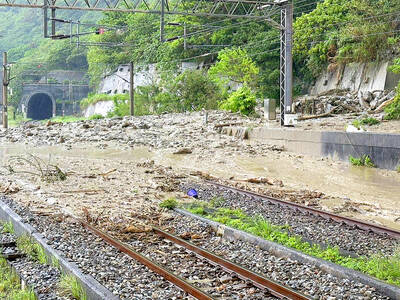
ROLLER-COASTER RIDE: More than five earthquakes ranging from magnitude 4.4 to 5.5 on the Richter scale shook eastern Taiwan in rapid succession yesterday afternoon Back-to-back weather fronts are forecast to hit Taiwan this week, resulting in rain across the nation in the coming days, the Central Weather Administration said yesterday, as it also warned residents in mountainous regions to be wary of landslides and rockfalls. As the first front approached, sporadic rainfall began in central and northern parts of Taiwan yesterday, the agency said, adding that rain is forecast to intensify in those regions today, while brief showers would also affect other parts of the nation. A second weather system is forecast to arrive on Thursday, bringing additional rain to the whole nation until Sunday, it
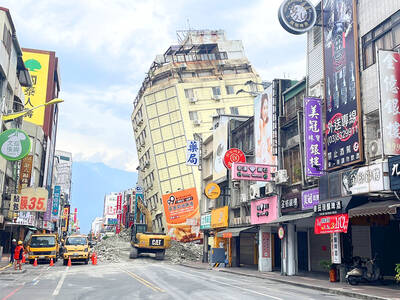
LANDSLIDES POSSIBLE: The agency advised the public to avoid visiting mountainous regions due to more expected aftershocks and rainfall from a series of weather fronts A series of earthquakes over the past few days were likely aftershocks of the April 3 earthquake in Hualien County, with further aftershocks to be expected for up to a year, the Central Weather Administration (CWA) said yesterday. Based on the nation’s experience after the quake on Sept. 21, 1999, more aftershocks are possible over the next six months to a year, the agency said. A total of 103 earthquakes of magnitude 4 on the local magnitude scale or higher hit Hualien County from 5:08pm on Monday to 10:27am yesterday, with 27 of them exceeding magnitude 5. They included two, of magnitude

CONDITIONAL: The PRC imposes secret requirements that the funding it provides cannot be spent in states with diplomatic relations with Taiwan, Emma Reilly said China has been bribing UN officials to obtain “special benefits” and to block funding from countries that have diplomatic ties with Taiwan, a former UN employee told the British House of Commons on Tuesday. At a House of Commons Foreign Affairs Committee hearing into “international relations within the multilateral system,” former Office of the UN High Commissioner for Human Rights (OHCHR) employee Emma Reilly said in a written statement that “Beijing paid bribes to the two successive Presidents of the [UN] General Assembly” during the two-year negotiation of the Sustainable Development Goals. Another way China exercises influence within the UN Secretariat is

Taiwan’s first drag queen to compete on the internationally acclaimed RuPaul’s Drag Race, Nymphia Wind (妮妃雅), was on Friday crowned the “Next Drag Superstar.” Dressed in a sparkling banana dress, Nymphia Wind swept onto the stage for the final, and stole the show. “Taiwan this is for you,” she said right after show host RuPaul announced her as the winner. “To those who feel like they don’t belong, just remember to live fearlessly and to live their truth,” she said on stage. One of the frontrunners for the past 15 episodes, the 28-year-old breezed through to the final after weeks of showcasing her unique


 RSS
RSS