


A senior leader of al-Qaeda in Iraq was killed in a US air strike in Iraq this week, a US military commander said on Friday, calling it a key loss to a group already fractured by US operations.
Brigadier General Joseph Anderson identified the man as Abu Usama al-Tunisi, a Tunisian described as in line to succeed Abu Ayyub al-Masri, al-Qaeda in Iraq's Egyptian leader.
Tunisi also led a cell in Yusifiyah that kidnapped and killed two US soldiers on June 16 last year -- Kristian Menchaca and Thomas Tucker, Anderson said.
"Abu Usama al-Tunisi was one of the most senior leaders within al-Qaeda in Iraq," said Anderson, the chief of staff of the Multi-National Corps Iraq.
The general said the Sept. 25 strike that killed al-Tunisi was a "significant blow" to al-Qaeda in Iraq, which he said has been severely disrupted by US operations and may now be reassessing its position in Iraq.
He said his opinion was that al-Qaeda would shift its forces from Iraq to Afghanistan, and try to expand its operations there.
"All we can tell you is that by numbers and how the groups are operating in very remote locations and not collaboratively they're fractured, ruptured, mitigated here. And the question becomes, where would they go? What would they do?" he said.
Anderson detailed a series of raids this month in Baghdad, Mahmudiyah, Yusufiyah and Musayyib in which scores of suspects were detained and nearly 20 others killed. Among those captured were other associates of Tunisi.
The military learned that the Tunisian was meeting with other al-Qaeda in Iraq members south of Baghdad in the vicinity of Musayyib on Tuesday.
"United States Air Force F-16 aircraft attacked the target," Anderson told reporters here via video linkup from Baghdad.
"Reporting indicated that several al-Qaeda members with ties to senior leadership were present at that time. Three were killed, including Tunisi," he said.
"His presence was confirmed by one of the two detainees from the operation, one who left the target area just prior to the air strike, who we eventually captured minutes later," he said.
An aerial video of the bombing shown to reporters at the Pentagon indicated that the target was a cluster of buildings in what appeared to be a rural area.
Ground forces recovered a handwritten note at the site that was believed to have been written by Tunisi, Anderson said, displaying photographs of the note.
"The key points in this hand-written note include, he's surrounded, communications have been cut and he's desperate for help," he said.
Anderson said that the surge in US forces since the start of the year had driven al-Qaeda in Iraq forces out of the Baghdad area into provinces north and west of the capital.

FALSE DOCUMENTS? Actor William Liao said he was ‘voluntarily cooperating’ with police after a suspect was accused of helping to produce false medical certificates Police yesterday questioned at least six entertainers amid allegations of evasion of compulsory military service, with Lee Chuan (李銓), a member of boy band Choc7 (超克7), and actor Daniel Chen (陳大天) among those summoned. The New Taipei City District Prosecutors’ Office in January launched an investigation into a group that was allegedly helping men dodge compulsory military service using falsified medical documents. Actor Darren Wang (王大陸) has been accused of being one of the group’s clients. As the investigation expanded, investigators at New Taipei City’s Yonghe Precinct said that other entertainers commissioned the group to obtain false documents. The main suspect, a man surnamed

DEMOGRAPHICS: Robotics is the most promising answer to looming labor woes, the long-term care system and national contingency response, an official said Taiwan is to launch a five-year plan to boost the robotics industry in a bid to address labor shortages stemming from a declining and aging population, the Executive Yuan said yesterday. The government approved the initiative, dubbed the Smart Robotics Industry Promotion Plan, via executive order, senior officials told a post-Cabinet meeting news conference in Taipei. Taiwan’s population decline would strain the economy and the nation’s ability to care for vulnerable and elderly people, said Peter Hong (洪樂文), who heads the National Science and Technology Council’s (NSTC) Department of Engineering and Technologies. Projections show that the proportion of Taiwanese 65 or older would

The government is considering polices to increase rental subsidies for people living in social housing who get married and have children, Premier Cho Jung-tai (卓榮泰) said yesterday. During an interview with the Plain Law Movement (法律白話文) podcast, Cho said that housing prices cannot be brought down overnight without affecting banks and mortgages. Therefore, the government is focusing on providing more aid for young people by taking 3 to 5 percent of urban renewal projects and zone expropriations and using that land for social housing, he said. Single people living in social housing who get married and become parents could obtain 50 percent more
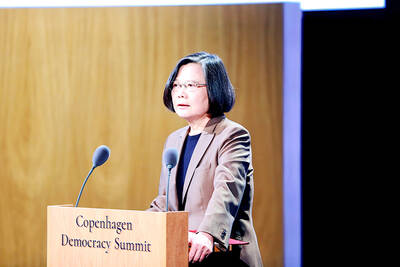
Democracies must remain united in the face of a shifting geopolitical landscape, former president Tsai Ing-wen (蔡英文) told the Copenhagen Democracy Summit on Tuesday, while emphasizing the importance of Taiwan’s security to the world. “Taiwan’s security is essential to regional stability and to defending democratic values amid mounting authoritarianism,” Tsai said at the annual forum in the Danish capital. Noting a “new geopolitical landscape” in which global trade and security face “uncertainty and unpredictability,” Tsai said that democracies must remain united and be more committed to building up resilience together in the face of challenges. Resilience “allows us to absorb shocks, adapt under


 RSS
RSS