


Non-stick chewing gum that can be washed off streets and degrades naturally in the environment has been developed by a team of British scientists.
The gum contains an ingredient that coats it with a thin film of water, making it easier to remove.
Researchers at Bristol University created it in an attempt to rid the streets of unsightly mess and save authorities the money they spend on removing it from pavements.
A survey by the borough of Westminster, in London, found it took 17 weeks to clean chewing gum from Oxford Street, but within 10 days, cleaners counted 300,000 new pieces stuck to the street.
The Bristol team, led by Terence Cosgrove, stuck chewed gum in set places on the streets of Bristol and various towns in north Wales and returned later to record its fate. In all the tests, the non-stick gum washed away with rain or street cleaning within 24 hours, while standard gum remained stuck for the eight days of the experiment.
The scientists -- whose firm is a spinoff from their work with the university -- also pressed lumps of non-stick and standard chewing gum into the hair of their boss' daughter, who was planning to have her hair cut anyway.
Cosgrove said the non-stick gum was removed after several washes with shampoo, while the commercial brand had to be cut out.
What his team has developed is a polymer that can be mixed into chewing gum. Each molecular chain that makes up the polymer contains one end that repels water and another that attracts water. When the gum is chewed, the polymer attracts water in saliva, forming a thin film around it, which acts as a lubricant and prevents it from becoming sticky.
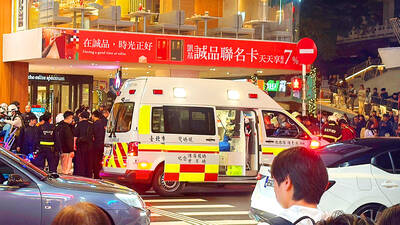
TRAGEDY STRIKES TAIPEI: The suspect died after falling off a building after he threw smoke grenades into Taipei Main Station and went on a killing spree in Zhongshan A 27-year-old suspect allegedly threw smoke grenades in Taipei Main Station and then proceeded to Zhongshan MRT Station in a random killing spree that resulted in the death of the suspect and two other civilians, and seven injured, including one in critical condition, as of press time last night. The suspect, identified as a man surnamed Chang Wen (張文), allegedly began the attack at Taipei Main Station, the Taipei Fire Department said, adding that it received a report at 5:24pm that smoke grenades had been thrown in the station. One man in his 50s was rushed to hospital after a cardiac arrest

SAFETY FIRST: Double the number of police were deployed at the Taipei Marathon, while other cities released plans to bolster public event safety Authorities across Taiwan have stepped up security measures ahead of Christmas and New Year events, following a knife and smoke bomb attack in Taipei on Friday that left four people dead and 11 injured. In a bid to prevent potential copycat incidents, police deployments have been expanded for large gatherings, transport hubs, and other crowded public spaces, according to official statements from police and city authorities. Taipei Mayor Chiang Wan-an (蔣萬安) said the city has “comprehensively raised security readiness” in crowded areas, increased police deployments with armed officers, and intensified patrols during weekends and nighttime hours. For large-scale events, security checkpoints and explosives
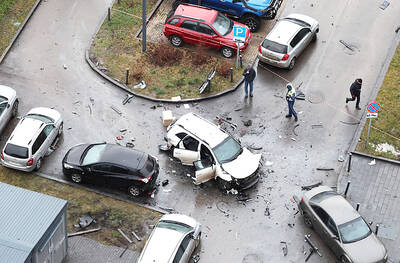
A car bomb killed a senior Russian general in southern Moscow yesterday morning, the latest high-profile army figure to be blown up in a blast that came just hours after Russian and Ukrainian delegates held separate talks in Miami on a plan to end the war. Kyiv has not commented on the incident, but Russian investigators said they were probing whether the blast was “linked” to “Ukrainian special forces.” The attack was similar to other assassinations of generals and pro-war figures that have either been claimed, or are widely believed to have been orchestrated, by Ukraine. Russian Lieutenant General Fanil Sarvarov, 56, head
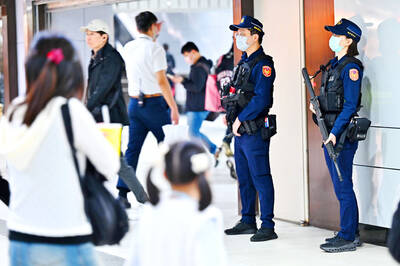
PUBLIC SAFETY: The premier said that security would be tightened in transport hubs, while President Lai commended the public for their bravery The government is to deploy more police, including rapid response units, in crowded public areas to ensure a swift response to any threats, President William Lai (賴清德) said yesterday after a knife attack killed three people and injured 11 in Taipei the previous day. Lai made the remarks following a briefing by the National Police Agency on the progress of the investigation, saying that the attack underscored the importance of cooperation in public security between the central and local governments. The attack unfolded in the early evening on Friday around Taipei Main Station’s M7 exit and later near the Taipei MRT’s Zhongshan


 RSS
RSS