


The Wikimedia Foundation, operator of the popular online encyclopedia Wikipedia, opened its annual international conference in Taipei yesterday with more than 500 Wikipedia enthusiasts from 43 countries attending to learn more about the open-source community.
The three-day event will address Wiki technology and Internet developments related to shared knowledge and the implications these have for educational and social trends.
With Taiwan's widespread Internet access and the emergence of vibrant, active online communities, an increasing number of Taiwanese have become involved in Wikipedia, Florence Devouard, member of the board of Trustees of the Wikimedia Foundation, told a press conference yesterday.
Founded in 2003 in St Petersburg, Florida, the foundation is a nonprofit organization funding nine free information projects to encourage the development and distribution of free content online. The most well-known of these projects is Wikipedia.
Launched in January 2001, Wikipedia, which relies on Internet users to contribute, edit and cite sources for information organized into an encyclopedia, Wikipedia now has more than 5 million articles in more than 250 languages.
The Chinese-language Wikipedia site was inaugurated in October 2002.
About 40 volunteers work with Wikimedia in Taiwan, said Titan Deng (
The foundation's main source of funding is public donations and grants, and most staff are unpaid.
If Wikimedia Taiwan receives stable funding, it will consider hiring employees to expand its activities, Teng said, adding that the organization would like to work with the government, schools or companies in developing open-source access to knowledge online.
Wikipedia has rapidly become a favorite resource for Web users and professionals worldwide, and Taiwan is no exception.
Last month, a Cabinet report on the 20th anniversary of the end of Martial Law cited Wikipedia.
"We don't mind our content being used by other media, even for commercial purposes, as long as they attribute the copyright to us," Devouard said.
Many Web sites and companies are not aware that they should cite Wikipedia when using information from the Web site, since the encyclopedia's content is collectively produced.
Most have complied with the copyright policy after receiving a notice from Wikipedia, but a few have refused to do so, such as Chinese search engine Baidu Inc (
Baidu frequently uses content from Wikipedia without citing the organization, even after several reminders, Devouard said.
"We provide free knowledge to everyone, but this is not what we want," Devouard said.
The organization will continue communicating with Baidu over the issue on friendly terms, rather than taking legal action against the company, said Jimmy Wales, Wikipedia cofounder.
Although some content from Wikipedia is used on other Web sites that can be viewed in China, Wikipedia is blocked by Beijing.
"Wikipedia has nothing to do with politics ... we'd like not to be blocked, considering the huge market size in China," Sandra Ordonez, the foundation's communication manager, told the Taipei Times. "The more contributors we have, the higher quality our site will be."

‘NO SECURITY RISK’: The Railway Bureau reassured the public that the technicians’ activities were limited to technical guidance and did not involve sensitive systems The Railway Bureau yesterday said it had invited eight Chinese technicians to assist with an airport MRT construction project. The bureau issued the confirmation after an Internet user said Chinese nationals had entered the construction zone of Taiwan Taoyuan International Airport’s Terminal 3 project. They asked why “individuals from an enemy state” were allowed access to such a major national infrastructure project, which raised serious concerns over Taiwan’s industrial safety, sensitive systems and information security. The bureau’s Northern Region Engineering Branch Office said subcontractor Taiwan Handle Industrial Co (台灣手把工業) of the Taoyuan airport MRT’s “Contract No. CU05 Project A14 Station Civil, MEP &

A US uncrewed surface vessel (USV) encountered multiple Chinese warships during an autonomous transit of the Taiwan Strait, US defense company Seasats said in a statement on Wednesday. Seasats announced that a Lightfish USV had completed the first autonomous transit of the Taiwan Strait. Over five days, the USV traversed the entire length of the Strait while constantly monitoring surface vessel traffic, the company said. The Lightfish encountered multiple Chinese warships, one of which was a Chinese People’s Liberation Army Navy (PLAN) Type 056 corvette, it said. The Chinese vessels were operating “well within Taiwan’s exclusive economic zone without transmitting their identity via the
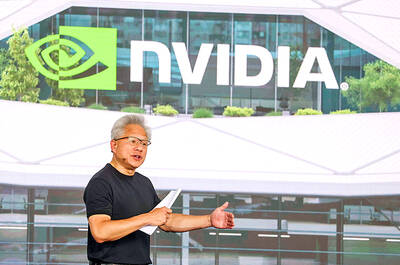
‘BOOMING’: ’ The number of partners we have here is incredible. You can see from their stock prices. They’re doing so well, they’re so happy,’ Jensen Huang said Nvidia Corp’s spending in Taiwan has ballooned to about US$150 billion a year, 10 times the US$10 billion to US$15 billion the company spent five years ago, Nvidia chief executive officer Jensen Huang (黃仁勳) said yesterday, suggesting Taiwan’s strategic importance in the global artificial intelligence (AI) supply chain. “Taiwan is the epicenter of the AI revolution. This is where the chips come, packaging comes. This is where the systems are made. This is where AI supercomputers were created,” Huang said at a meeting for the company’s employees in Beitou-Shilin Technology Park (北投士林科技園區) in Taipei, the planned site of Nvidia’s Taipei headquarters. “Taiwan
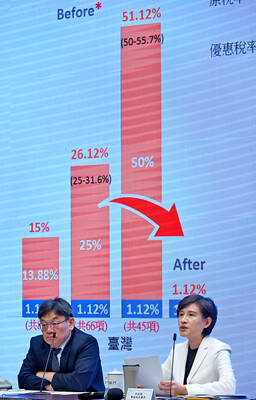
GREATER REACH? Auto parts and wood products would face tariffs of up to 15%, matching those targeting the EU, Japan and South Korea, Vice Premier said The US has announced that preferential tariff treatment for Taiwan’s non-semiconductor Section 232 goods would take effect retroactively from May 1, the Executive Yuan said yesterday. The US government yesterday posted a notice on the Federal Register’s public inspection Web site previewing tariff concessions for Taiwan under a memorandum of understanding (MOU) on Taiwan-US investment after two months of negotiations. The MOU signed on Jan. 15 stipulated three major preferential tariff arrangements: a 15 percent “reciprocal” tariff rate for Taiwan without stacking most-favored nation (MFN) rates; preferential Section 232 treatment for semiconductors and related products; and preferential Section 232 treatment for non-semiconductor


 RSS
RSS