


US President George W. Bush, trying to reverse ebbing support for the Iraq war, sought on Tuesday to tie deadly violence there directly to al-Qaeda terrorist chief Osama bin Laden.
Facing mounting calls for a US withdrawal, and intelligence findings that the unpopular war is a recruiting tool for al-Qaeda, Bush warned that a hasty US pullout would increase the risk of an attack in the US.
"However difficult the fight is in Iraq, we must win it, and we can win it," Bush said in a speech to uniformed military personnel. "Surrendering the future of Iraq to al-Qaeda would be a disaster to our country."
Bush said that bin Laden, the mastermind of the September 11, 2001, attacks on the US, pulled the strings of al-Qaeda in Iraq, a group that did not exist before the March 2003 US-led invasion.
"Some say that Iraq is not a part of the broader war on terror," he said. "They claim that the organization called al-Qaeda in Iraq is an Iraqi phenomenon, that it's independent of Osama bin Laden and it's not interested in attacking America. That would be news to Osama bin Laden."
Bush did not mention a newly public US intelligence report that found that al-Qaeda had been reinvigorated and was plotting new attacks from a safe haven in remote tribal areas of Pakistan.
The report, a National Intelligence Estimate (NIE) grouping the consensus findings of the US spy agencies, also declared that al-Qaeda in Iraq was the terrorist network's "most visible and capable affiliate and the only one known to have expressed a desire to attack the Homeland," meaning the US.
A previous NIE found that the war in Iraq was an effective recruiting tool for Islamist extremists, including al-Qaeda.
"The president is trying to scare the American people into believing that al-Qaeda is the rationale for continuing the war in Iraq," said Democratic Senator John Kerry.
"9/11 was not plotted in Iraq, 9/11 did not happen from an al-Qaeda in Iraq," he said. "The fact is, al-Qaeda has grown in its strength and its presence in Iraq because we are there."
The Pentagon, in its latest quarterly report to the US Congress, said last month that al-Qaeda in Iraq was "the primary threat" in restive Anbar Province but that they played a smaller role in the overall picture.
"The increasingly complex conflict has remained a struggle among and within ethno-sectarian, criminal, insurgent and terrorist groups to wrest political and economic power from the elected GoI [government of Iraq]," it said.
"Much of the violence is attributable to sectarian friction, and each faction is driven by its own political and economic power relationships," the US military said.
Also see story:
UK troops on `suicide missions' in Iraq, MPs say

CROSS-STRAIT COLLABORATION: The new KMT chairwoman expressed interest in meeting the Chinese president from the start, but she’ll have to pay to get in Beijing allegedly agreed to let Chinese Nationalist Party (KMT) Chairwoman Cheng Li-wun (鄭麗文) meet with Chinese President Xi Jinping (習近平) around the Lunar New Year holiday next year on three conditions, including that the KMT block Taiwan’s arms purchases, a source said yesterday. Cheng has expressed interest in meeting Xi since she won the KMT’s chairmanship election in October. A source, speaking on condition of anonymity, said a consensus on a meeting was allegedly reached after two KMT vice chairmen visited China’s Taiwan Affairs Office Director Song Tao (宋濤) in China last month. Beijing allegedly gave the KMT three conditions it had to
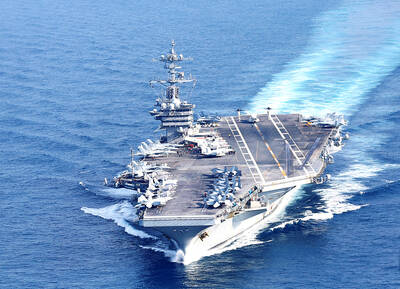
‘BALANCE OF POWER’: Hegseth said that the US did not want to ‘strangle’ China, but to ensure that none of Washington’s allies would be vulnerable to military aggression Washington has no intention of changing the “status quo” in the Taiwan Strait, US Secretary of Defense Pete Hegseth said on Saturday, adding that one of the US military’s main priorities is to deter China “through strength, not through confrontation.” Speaking at the annual Reagan National Defense Forum in Simi Valley, California, Hegseth outlined the US Department of Defense’s priorities under US President Donald Trump. “First, defending the US homeland and our hemisphere. Second, deterring China through strength, not confrontation. Third, increased burden sharing for us, allies and partners. And fourth, supercharging the US defense industrial base,” he said. US-China relations under
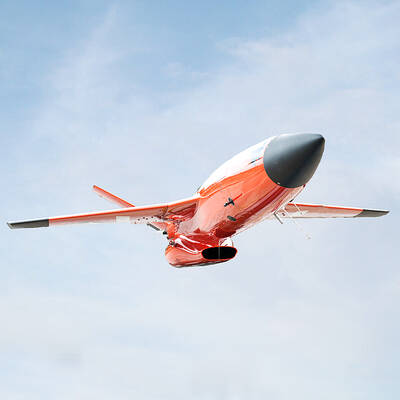
The Chien Feng IV (勁蜂, Mighty Hornet) loitering munition is on track to enter flight tests next month in connection with potential adoption by Taiwanese and US armed forces, a government source said yesterday. The kamikaze drone, which boasts a range of 1,000km, debuted at the Taipei Aerospace and Defense Technology Exhibition in September, the official said on condition of anonymity. The Chungshan Institute of Science and Technology and US-based Kratos Defense jointly developed the platform by leveraging the engine and airframe of the latter’s MQM-178 Firejet target drone, they said. The uncrewed aerial vehicle is designed to utilize an artificial intelligence computer
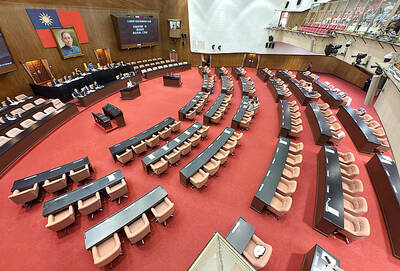
The Chinese Nationalist Party (KMT) caucus yesterday decided to shelve proposed legislation that would give elected officials full control over their stipends, saying it would wait for a consensus to be reached before acting. KMT Legislator Chen Yu-jen (陳玉珍) last week proposed amendments to the Organic Act of the Legislative Yuan (立法院組織法) and the Regulations on Allowances for Elected Representatives and Subsidies for Village Chiefs (地方民意代表費用支給及村里長事務補助費補助條例), which would give legislators and councilors the freedom to use their allowances without providing invoices for reimbursement. The proposal immediately drew criticism, amid reports that several legislators face possible charges of embezzling fees intended to pay


 RSS
RSS