


US President George W. Bush on Friday forbade the CIA from torturing suspected terrorists in its once-secret detention and interrogation program but was criticized for his vague, "trust us" approach.
Human rights groups said the executive order left out critical details, such as controversial tactics that administration officials often describe as "enhanced interrogation techniques."
The order says that the detention program, whose existence was confirmed last September, must abide by Common Article 3 of the Geneva Conventions on wartime detainees and requires the CIA director to enforce that standard.
It lists no specific practices that are affected, or punishments for violations, and does not describe in any further detail a secret CIA prison network that has drawn outrage from US allies in Europe.
Bush spokesman Tony Snow said the order barred "cruel, inhuman, or degrading treatment or punishment" and "acts of violence serious enough to be considered comparable to murder, torture, mutilation and cruel and inhuman treatment."
"It also prohibits `willful and outrageous acts of personal abuse done for the purpose of humiliating or degrading the individual in a manner so serious that any reasonable person, considering the circumstances, would deem the acts beyond the bounds of human decency,'" he said.
"And the order forbids acts intended to denigrate detainees' religion, religious practices or religious objects," Snow said.
However, New York-based Human Rights Watch (HRW) slammed the order as "contrary to the Geneva Conventions" because it essentially affirmed CIA secret detentions, a program that is "illegal to its core," it said in a statement.
"The key aspect of this is all the parts that aren't said," said Jennifer Daskal, HRW senior counterterrorism counsel, who charged that the order allowed "a system of incommunicado detention to continue, with the blessing of the president."
"What we have here is an administration basically reciting a number of legal principles and saying `trust us.' And that's hard to take from an administration that refuses to renounce waterboarding," she said.
On a White House-organized conference call -- organized on the condition that the briefer not be named -- one senior Bush aide refused to discuss whether any detention or interrogation practices, or how many detainees, were affected.
He refused to discuss specifically the order's impact on "waterboarding," in which a prisoner is tied down and water is poured over the face or over a cloth stretched over the face, producing the sensation of drowning.
The aide also sidestepped a question about why sleep was not included in a section explicitly granting detainees "the basic necessities of life, including adequate food and water, shelter from the elements, necessary clothing, protection from extremes of heat and cold, and essential medical care."
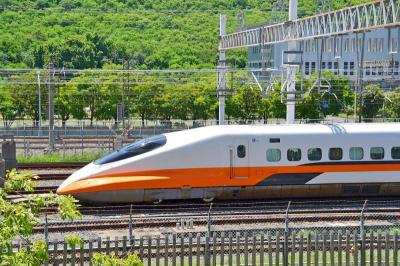
A signaling system malfunction disrupted high-speed rail (HSR) services beginning at 8am today, with trains temporarily reduced to three northbound and three southbound trains per hour as authorities conduct inspections. The malfunction occurred on a section of track in Miaoli County during pre-operation checks early this morning, forcing northbound and southbound trains to use a single track, the HSR operator said. The regular schedule has been replaced with three hourly trains offering only nonreserved seating in each direction, stopping at every station, it said, adding that business class cars would still have reserved seating. Departures from terminal stations are scheduled at the top
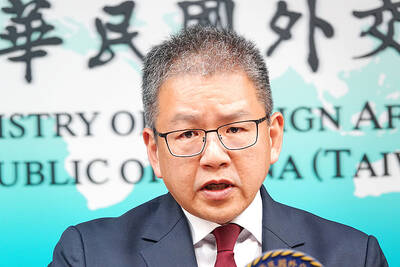
Taiwan is still in the process of assessing the possibility of recruiting workers from Eswatini, the Ministry of Foreign Affairs said yesterday, adding that its goal is to help Eswatini upgrade its vocational training centers. If there are plans to recruit workers from Eswatini, safeguarding national security, protecting public health and ensuring the employment rights of Taiwanese would be prerequisites, Department of West Asian and African Affairs Director-General Yen Chia-liang (顏嘉良) told a news conference. Key considerations would also include filling labor shortages in specific industries, and fostering bilateral professional and technical exchanges, he said. Yen was asked about the progress of labor
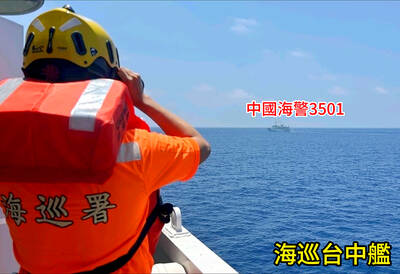
VERBOSE VESSELS: A CGA cutter and a China Coast Guard exchanged verbal barbs for more than a day in Taiwanese-controlled waters before the Chinese vessel left The Taiwanese and Chinese coast guards had a standoff near the strategically located Pratas Islands (Dongsha Islands, 東沙群島) in the north of the South China Sea, the Coast Guard Administration (CGA) said yesterday. The two sides engaged in intense radio exchanges over sovereignty claims during the 33-hour standoff. China Coast Guard vessel 3501 eventually left the restricted waters, 26.6 nautical miles (49.2km) west of the Pratas Islands, at 5pm yesterday, the CGA said. Lying approximately between southern Taiwan and Hong Kong, the Taiwan-controlled Pratas are seen by some security experts as vulnerable to Chinese attack due to their distance — more than

A US uncrewed surface vessel (USV) encountered multiple Chinese warships during an autonomous transit of the Taiwan Strait, US defense company Seasats said in a statement on Wednesday. Seasats announced that a Lightfish USV had completed the first autonomous transit of the Taiwan Strait. Over five days, the USV traversed the entire length of the Strait while constantly monitoring surface vessel traffic, the company said. The Lightfish encountered multiple Chinese warships, one of which was a Chinese People’s Liberation Army Navy (PLAN) Type 056 corvette, it said. The Chinese vessels were operating “well within Taiwan’s exclusive economic zone without transmitting their identity via the


 RSS
RSS