


Australian police yesterday dropped a request to extend the detention of a suspect in the failed British terrorism attacks, but he was not likely to be released immediately and could still be charged.
Australian Federal Police withdrew their application to a magistrate to extend the detention of Indian doctor Muhammad Haneef beyond yesterday under counterterrorism laws, a spokesman said on condition of anonymity.
The move meant that police had 12 hours left to question Haneef before either charging him or releasing him. Under the laws, the clock runs only when police are actively interviewing Haneef -- meaning that, with breaks included, the deadline could be further off in real time.
Haneef, 27, who came to Australia from Britain last year, was arrested on July 2 as he tried to leave the eastern city of Brisbane for India on a one-way ticket.
Police say they are investigating links between Haneef and some of the seven suspects held in connection with two bomb-laden cars found in London on June 29 and an attack on a Glasgow airport the next day.
Police lodged an application on Wednesday to keep Haneef in custody -- but not under questioning -- while they collected potential evidence and sifted through a vast amount of computer data, phone records and other material already seized.
Haneef's lawyers opposed the extension, arguing that he was being denied natural justice, and the case returned to court yesterday, where the application was withdrawn.
Meanwhile, a newspaper report cited police documents lodged with the court as saying they suspected Haneef "provided support to the terrorist organization responsible for the terrorist acts in London and/or Glasgow."
But the massive investigation has failed to uncover enough evidence to charge him, the documents said, according to the Australian newspaper yesterday.
Police had sought to keep Haneef in custody because if he were free it would be more difficult to monitor his movements and his communication with others, the report said.
"If he was to communicate with people who were either involved in or associated with the terrorist acts he could take steps to have potentially incriminating evidence that has not been located destroyed," the documents said.
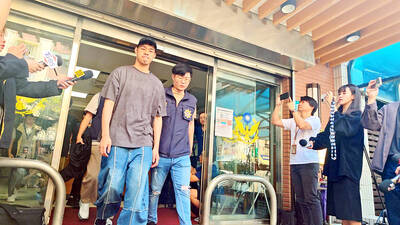
FALSE DOCUMENTS? Actor William Liao said he was ‘voluntarily cooperating’ with police after a suspect was accused of helping to produce false medical certificates Police yesterday questioned at least six entertainers amid allegations of evasion of compulsory military service, with Lee Chuan (李銓), a member of boy band Choc7 (超克7), and actor Daniel Chen (陳大天) among those summoned. The New Taipei City District Prosecutors’ Office in January launched an investigation into a group that was allegedly helping men dodge compulsory military service using falsified medical documents. Actor Darren Wang (王大陸) has been accused of being one of the group’s clients. As the investigation expanded, investigators at New Taipei City’s Yonghe Precinct said that other entertainers commissioned the group to obtain false documents. The main suspect, a man surnamed

DEMOGRAPHICS: Robotics is the most promising answer to looming labor woes, the long-term care system and national contingency response, an official said Taiwan is to launch a five-year plan to boost the robotics industry in a bid to address labor shortages stemming from a declining and aging population, the Executive Yuan said yesterday. The government approved the initiative, dubbed the Smart Robotics Industry Promotion Plan, via executive order, senior officials told a post-Cabinet meeting news conference in Taipei. Taiwan’s population decline would strain the economy and the nation’s ability to care for vulnerable and elderly people, said Peter Hong (洪樂文), who heads the National Science and Technology Council’s (NSTC) Department of Engineering and Technologies. Projections show that the proportion of Taiwanese 65 or older would
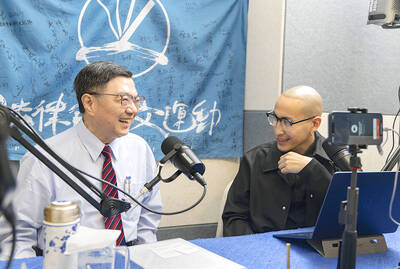
The government is considering polices to increase rental subsidies for people living in social housing who get married and have children, Premier Cho Jung-tai (卓榮泰) said yesterday. During an interview with the Plain Law Movement (法律白話文) podcast, Cho said that housing prices cannot be brought down overnight without affecting banks and mortgages. Therefore, the government is focusing on providing more aid for young people by taking 3 to 5 percent of urban renewal projects and zone expropriations and using that land for social housing, he said. Single people living in social housing who get married and become parents could obtain 50 percent more
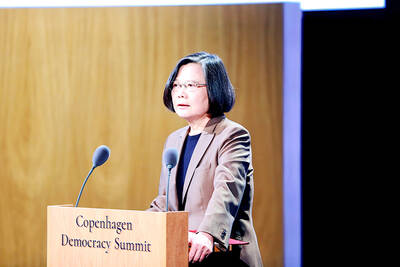
Democracies must remain united in the face of a shifting geopolitical landscape, former president Tsai Ing-wen (蔡英文) told the Copenhagen Democracy Summit on Tuesday, while emphasizing the importance of Taiwan’s security to the world. “Taiwan’s security is essential to regional stability and to defending democratic values amid mounting authoritarianism,” Tsai said at the annual forum in the Danish capital. Noting a “new geopolitical landscape” in which global trade and security face “uncertainty and unpredictability,” Tsai said that democracies must remain united and be more committed to building up resilience together in the face of challenges. Resilience “allows us to absorb shocks, adapt under


 RSS
RSS