


The nation's chief representative in the US called on Washington on Monday to counter China's massive military buildup in Asia.
Beijing has repeatedly threatened to attack should Taiwan formalize its de facto independence.
"Taiwan is prosperous economically, but Taiwan is also under threat," Joseph Wu (
The US has maintained an ambiguous "one China" policy, but has also pledged defensive weapons for Taiwan and hinted that it would provide military backing if China attacked.
In its annual report to Congress, the US Defense Department said that China has been acquiring better missiles, submarines and aircraft and should more fully explain the purpose of the buildup. Nearly 1,000 Chinese missiles are aimed at key Taiwanese military and civilian targets across the 160km-wide Taiwan Strait.
"Taiwan's sovereignty is being put in danger by Chinese tactics," Wu said.
Taiwan and the US should consult more regularly to ease Taipei's concerns about China, he said.
Wu listed China's many advantages over Taiwan: economic, military and political strength; a huge population; and a growing lobbying effort aimed at US lawmakers.
"There's only one thing in which Taiwan has an advantage at this moment: Taiwan is a democracy and China is not," he said.
Wu called on the US to encourage Japan to hold more security talks with Taiwan.
"In future, if there's going to be any conflict between Taiwan and China, I'm sure there will be some actors, including Japan and the United States, that will be drawn into the situation," Wu said.
Wu also acknowledged US concerns about a Taiwan referendum on rejoining the UN under the name Taiwan, which has drawn fierce objections from China and US warnings not to hold the poll.
He said, however, that the referendum enjoys public support.
Taiwan, he said, has "its own domestic momentum."
Wu said the US opposition could boost Taiwanese support for the referendum, noting that the Chinese Nationalist Party (KMT) had promoted a referendum proposal similar to that put forward by the Democratic Progressive Party -- an indication that it is "the mainstream view of Taiwanese."
Washington has repeatedly said that any resolution of cross-strait disputes would have to respect the wishes and gain the consent of Taiwanese, he pointed out.
Wu said he believed that the democratic process, including the holding of referendums, would be the key to resolving cross-strait disputes.
He claimed that "China has pushed Taiwan against the wall," noting that Taiwan cannot use its official name of "Republic of China" in the international community and that the other names imposed by China -- such as "Chinese Taipei" or "Taiwan, China" -- had aroused resentment among Taiwanese.
If Taiwan cannot use its official name, then it is "most natural" for it to apply to take part in international activities under the name "Taiwan," he said.

FALSE DOCUMENTS? Actor William Liao said he was ‘voluntarily cooperating’ with police after a suspect was accused of helping to produce false medical certificates Police yesterday questioned at least six entertainers amid allegations of evasion of compulsory military service, with Lee Chuan (李銓), a member of boy band Choc7 (超克7), and actor Daniel Chen (陳大天) among those summoned. The New Taipei City District Prosecutors’ Office in January launched an investigation into a group that was allegedly helping men dodge compulsory military service using falsified medical documents. Actor Darren Wang (王大陸) has been accused of being one of the group’s clients. As the investigation expanded, investigators at New Taipei City’s Yonghe Precinct said that other entertainers commissioned the group to obtain false documents. The main suspect, a man surnamed

The government is considering polices to increase rental subsidies for people living in social housing who get married and have children, Premier Cho Jung-tai (卓榮泰) said yesterday. During an interview with the Plain Law Movement (法律白話文) podcast, Cho said that housing prices cannot be brought down overnight without affecting banks and mortgages. Therefore, the government is focusing on providing more aid for young people by taking 3 to 5 percent of urban renewal projects and zone expropriations and using that land for social housing, he said. Single people living in social housing who get married and become parents could obtain 50 percent more

DEMOGRAPHICS: Robotics is the most promising answer to looming labor woes, the long-term care system and national contingency response, an official said Taiwan is to launch a five-year plan to boost the robotics industry in a bid to address labor shortages stemming from a declining and aging population, the Executive Yuan said yesterday. The government approved the initiative, dubbed the Smart Robotics Industry Promotion Plan, via executive order, senior officials told a post-Cabinet meeting news conference in Taipei. Taiwan’s population decline would strain the economy and the nation’s ability to care for vulnerable and elderly people, said Peter Hong (洪樂文), who heads the National Science and Technology Council’s (NSTC) Department of Engineering and Technologies. Projections show that the proportion of Taiwanese 65 or older would
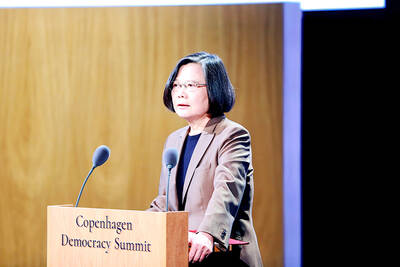
Democracies must remain united in the face of a shifting geopolitical landscape, former president Tsai Ing-wen (蔡英文) told the Copenhagen Democracy Summit on Tuesday, while emphasizing the importance of Taiwan’s security to the world. “Taiwan’s security is essential to regional stability and to defending democratic values amid mounting authoritarianism,” Tsai said at the annual forum in the Danish capital. Noting a “new geopolitical landscape” in which global trade and security face “uncertainty and unpredictability,” Tsai said that democracies must remain united and be more committed to building up resilience together in the face of challenges. Resilience “allows us to absorb shocks, adapt under


 RSS
RSS