

The US space shuttle Atlantis headed for the International Space Station (ISS) early yesterday on this year's first mission, aimed at boosting the station's power-generating capacity.
The shuttle rocketed into a clear blue sky late on Friday and reached orbit less than nine minutes after liftoff.
"It's a very good day for NASA and this nation's space program," said Rex Geveden, NASA associate administrator for space operations, speaking at a press conference after the blastoff.
"What a great way to start the year and this mission," shuttle launch director Mike Leinbach said. "It's a great launch, it's the first step in a very challenging mission."
A team of NASA specialists studied the launch video, "and the preliminary word is that we lost no foam off, at least in the preliminary report," shuttle program manager Wayne Hale said.
The space shuttle Columbia's heat shield was pierced by foam insulation that peeled off its fuel tank during liftoff, causing the shuttle to disintegrate as it returned to Earth with seven astronauts aboard in February 2003.
NASA engineers since modified the external fuel tank to prevent large pieces of foam from falling off during liftoff, and set procedures to check the shuttle's heat shield while in orbit.
During their 11-day trip, the seven Atlantis astronauts plan to install a new, 16-tonne truss segment on the ISS and deliver a third set of solar panels, as well as batteries for the orbiting laboratory.
When unfolded, the arrays will provide additional power to the station in preparation for the arrival of new science modules from the European and Japanese space agencies.
The crew will also retract a solar array to allow for the rotation of the new arrays to track the sun.
Three spacewalks lasting six-and-a-half hours each are planned on the fourth, sixth and eighth days of the mission.
The ISS is a key stepping stone for preparing future manned missions to Mars.
The shuttle blastoff had been originally scheduled for March 15, but was delayed after hail from a freak February storm damaged the shuttle's external fuel tank as it sat on the launch pad. The damage forced NASA to bring the shuttle back to its hangar for repairs.
NASA officials plan at least 13 more shuttle missions to finish the US$100 billion station by 2010, when the US space agency retires its three-shuttle fleet.

SOFT TENNIS: Yu Kai-wen and Huang Shih-yuan narrowly defeated their Japanese rivals to capture Taiwan’s first gold at the Asian Games in Nagoya Yu Kai-wen (余凱文) and Huang Shih-yuan (黃詩媛) won Taiwan’s first gold of this year’s Asian Games, defeating a Japanese duo in a nail-biter in the soft tennis mixed doubles final in Nagoya, Japan, while Johnny Sun (孫家閎) won silver in wushu and Shih Cheng-chung (石政中) won bronze in men’s kumite. Yu and Huang narrowly defeated Japan’s Toshiki Uematsu and Rena Temma 5-4 (2-4, 5-3, 4-2, 1-4, 1-4, 4-0, 1-4, 4-1, 7-5) to give Taiwan its first gold in soft tennis mixed doubles at an Asian Games since 2018. Sun secured Taiwan’s first wushu medal at this year’s game, with a combined score
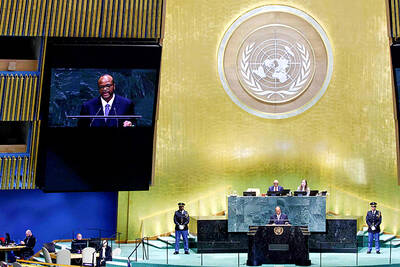
UNITY: Lai thanked the nations who spoke up for Taiwan, saying that democracies must stand together to face global authoritarian expansion Taiwan yesterday thanked eight European and Indo-Pacific countries for opposing unilateral changes to the “status quo” in the Taiwan Strait in a joint statement earlier this week, as well as three of Taiwan’s allies for speaking up for the nation’s participation in the UN at the body’s General Assembly in New York. Minister of Foreign Affairs Lin Chia-lung (林佳龍) welcomed the support and expressed his appreciation for the countries’ stance, the Ministry of Foreign Affairs said in a statement. Foreign ministers and senior representatives of Australia, France, Germany, Japan, New Zealand, Poland, South Korea and the UK issued a statement on Tuesday
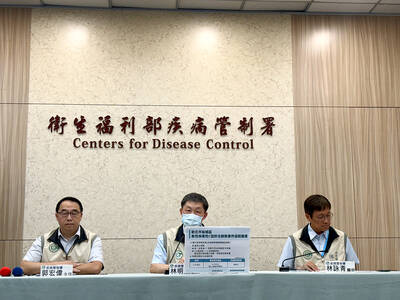
AT-RISK GROUPS: Of the accumulated 1,586 severe cases and 304 related deaths in this flu season, 65.8% were older people and 83.2% had chronic diseases, an official said The Centers for Disease Control (CDC) yesterday said that 165 severe flu cases and 30 flu-related deaths were reported last week, the highest weekly numbers in this flu season, and that cases might continue to increase, urging people to take precautions. Medical visits for flu-like illnesses increased by 1.4 percent to 141,374 last week, with 11.8 percent being emergency visits, showing that the seasonal flu is still in its epidemic period, CDC Epidemic Intelligence Center Director Guo Hung-wei (郭宏偉) said. From Tuesday last week to Monday, 165 severe flu cases and 30 flu-related deaths were confirmed, the highest weekly numbers

FACTS DISTORTION: The MAC rejected Xi’s remarks that the US and ‘China’ fought side-by-side during WWII, saying the ROC was Washington’s true ally during the war Taiwan yesterday denounced Chinese President Xi Jinping’s (習近平) comments to US President Donald Trump on the nation’s future, after Xi appeared to push Trump for a subtle change in stance that could erode US support for Taiwan. Xi told Trump in Washington on Thursday that he hoped the US would adhere to the “correct position” of opposing Taiwanese independence, according to a Chinese readout of the talks. That would be a tougher version of Washington’s long-standing formulation that it does not “support” independence. There was no immediate White House readout of the exchange. Xi’s remarks represent “the consistent Chinese approach of distorting facts


 RSS
RSS