


UN inspectors warned that insurgents in Iraq are using chlorine to kill and wound civilians and could, given the country's expertise in chemical arms in the past, develop other weapons-grade toxic agents.
Media reports have showed that insurgents are using toxic chemicals, such as chlorine, combined with explosives for dispersal, the UN Monitoring, Verification and Inspection Commission (UNMOVIC) said in a report to the UN Security Council posted on its Web site on Tuesday.
"Such attacks have resulted in the killing of tens and injuring of hundreds of people throughout Iraq," UNMOVIC said.
There have been at least 10 attacks using chlorine, and several others were attempted and foiled by security forces, UNMOVIC said in its quarterly report.
"Given the current security situation in Iraq, it is possible that some non-state actors will continue to seek to acquire toxic agents or their chemical precursors in small quantities," the report said.
In addition, "non-state actors could also seek to acquire other, more toxic agents that are either indigenously produced or procured from abroad," it said.
The survey, prepared by UNMOVIC acting executive chairman Dimitri Perricos, pointed to the expertise Iraq had in producing chemical weapons "with hundreds of scientific and technical personnel having been involved in the past chemical weapons program."
Another danger was the availability and possible misuse of dual-use chemical production equipment, previously monitored by UN inspectors until they left Iraq shortly before the US-led invasion in 2003. Coalition forces have not allowed the monitors to return since then.
Through satellite imagery, UNMOVIC said, it identified a number of buildings and structures that had contained such equipment but had been demolished or damaged by 2004.
However, the fate of the equipment, even in buildings that remained intact, was unknown, UNMOVIC said.
The report also warned that during the Iran-Iraq war in the 1980s, the Iraqi military "received and used both conventional and chemical weapons."
After that war, many units were relocated, raising the possibility that "chemical munitions became inadvertently mixed with conventional weapons" with markings that did not differ from standard weapons.
With UNMOVIC no longer in Iraq, the UN Security Council faces the task of shutting down the commission, which the US has advocated for two years. In March, the US and the UK drew up a resolution to dissolve it.
But Russia has said that Iraq's disarmament has to be formally confirmed by UNMOVIC.
UNMOVIC was created late in 1999 as a successor to the UN Special Commission, which was known as UNSCOM. But former Iraqi president Saddam Hussein's government barred it until shortly before the invasion.
Meanwhile, car bombings shook the streets leading to Baghdad's most revered Shiite Muslim shrine yesterday and police reported at least seven people killed and 27 others wounded.
The simultaneous blasts at two key intersections in the Kazimiyah district were the latest blows in an series of attacks by Sunni extremists bent on terrorizing Iraq's Shiite majority and inflaming hostilities between the two sects.
In several sections of the violence-wracked city of Baqubah, Iraqi troops and US helicopter gunships were reported attacking al-Qaeda Sunni militants.
A medical source said the bodies of eight gunmen were brought to the hospital.
The US military said it was looking into the report.
Elsewhere, assassins killed a police official and an aide to Iraq's pre-eminent Shiite cleric.
The new bloodshed came a day after followers of Shiite cleric Moqtada al-Sadr pushed through a resolution in Iraq's parliament requiring the Baghdad government to obtain parliament's approval for future extensions of the UN mandate for US-led forces in Iraq.
The present mandate doesn't expire until Dec. 31, but Tuesday's action added to the debate.
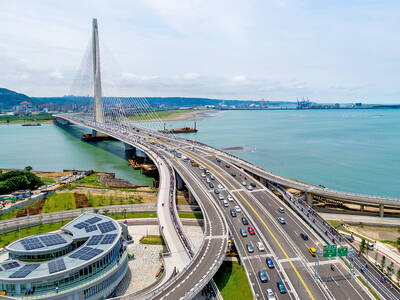
The Ministry of Transportation and Communications yesterday inaugurated the Danjiang Bridge across the Tamsui River in New Taipei City, saying that the structure would be an architectural icon and traffic artery for Taiwan. Feted as a major engineering achievement, the Danjiang Bridge is 920m long, 211m tall at the top of its pylon, and is the longest single-pylon asymmetric cable-stayed bridge in the world, the government’s Web site for the structure said. It was designed by late Iraqi-British architect Zaha Hadid. The structure, with a maximum deck of 70m, accommodates road and light rail traffic, and affords a 200m navigation channel for boats,
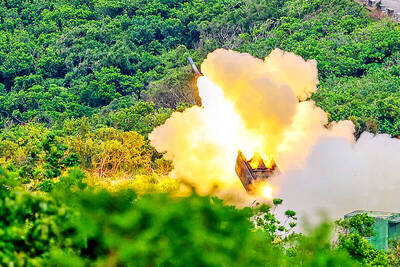
PRECISION STRIKES: The most significant reason to deploy HIMARS to outlying islands is to establish a ‘dead zone’ that the PLA would not dare enter, a source said A High Mobility Artillery Rocket System (HIMARS) would be deployed to Penghu County and Dongyin Island (東引) in Lienchiang County (Matsu) to force the Chinese military to retreat at least 100km from the coastline, a military source said yesterday. Taiwan has been procuring HIMARS and Army Tactical Missile Systems (ATACMS) from the US in batches. Once all batches have been delivered, Taiwan would possess 111 HIMARS units and 504 ATACMS, which have a range of 300km. Considering that “offense is the best defense,” the military plans to forward-deploy the systems to outlying islands such as Penghu and Dongyin so that

Taiwan Semiconductor Manufacturing Co (TSMC, 台積電), the world’s largest foundry service provider, yesterday said that global semiconductor revenue is projected to hit US$1.5 trillion in 2030, after the figure exceeds US$1 trillion this year, as artificial intelligence (AI) demand boosts consumption of token and compute power. “We are still at the beginning of the AI revolution, but we already see a significant impact across the whole semiconductor ecosystem,” TSMC deputy cochief operating officer Kevin Zhang (張曉強) said at the company’s annual technology symposium in Hsinchu City. “It is fair to say that in the past decade, smartphones and other mobile devices were

‘CLEAR MESSAGE’: The bill would set up an interagency ‘tiger team’ to review sanctions tools and other economic options to help deter any Chinese aggression toward Taiwan US Representative Young Kim has introduced a bill to deter Chinese aggression against Taiwan, calling for an interagency “tiger team” to preplan coordinated sanctions and economic measures in response to possible Chinese military or political action against Taiwan. “[Chinese President] Xi Jinping [習近平] has directed the People’s Liberation Army to be ready to invade Taiwan by 2027. China has a plan. America should have one too,” Kim said in a news release on Thursday last week. She introduced the “Deter PRC [People’s Republic of China] aggression against Taiwan act” to “ensure the US has a coordinated sanctions strategy ready should


 RSS
RSS