


A sexual tryst gone awry threatened to become an international incident yesterday, after a local newspaper ran a sensational story involving a Taiwanese woman and a US West Point cadet.
The Chinese-language United Daily News, a pro-unification newspaper, printed front page coverage of allegations by an unidentified woman who said she had sex with a visiting student from the US Military Academy at West Point. In the article, the woman did not make any specific claims that the man raped her, but said she felt "uncomfortable" after the hotel room tryst.
The United Daily News reported that a student surnamed Chuang (
The West Point cadet, who will be not identified because he has not been charged with any crime, was in Taiwan on a three-week exchange program.
According to the United Daily News report, Chuang invited several women to the club, including one of his elementary school classmates.
The woman, a 24-year-old college student, drank with Chuang, the cadet and others until Chuang left late in the evening, the newspaper reported.
The United Daily News report said that the West Point cadet then took the woman, who said she was "half drunk" at the time, to the Evergreen Hotel in Tainan and had sex with her.
However, a source who spoke to the cadet said that the woman's story as reported in the United Daily News misrepresented events.
The source said that the cadet -- who speaks no Mandarin or Taiwanese, and has been in Taiwan for only a week -- asserts that the woman accompanied him into a taxi, gave the driver directions to a hotel, booked a room, and took a shower before voluntarily engaging in intercourse.
According to the United Daily News report, the woman said that she was still "considering" whether she should say no when intercourse began and ended in less than one minute.
She told the United Daily News that the West Point cadet had then said "I am sorry" to her.
The next day, the United Daily News said, the woman felt "uncomfortable about what happened" and reported the "incident" to the academy. She also talked to a United Daily News reporter.
When the paper hit the streets, politicians quickly turned the matter into a political issue.
Chinese Nationalist Party (KMT) Legislator Lin Nan-sheng (
He blamed the Ministry of National Defense (MND) and, more specifically, Vice Minister of National Defense Lin Chen-yi (
"Shame on you, vice minister!" Lin Nan-sheng said.
Echoing Lin Nan-sheng, KMT Legislator Lin Yu-fang (
"So, is this how you treat West Point cadets? Maybe it is also the same way you treat any soldier from one of our allies?" Lin Yu-fang said. "This is absurd! This is a shame! This is a disgrace!"
Meanwhile, the military said it would investigate the allegations to determine if any criminal act had occurred.
Lin Chen-yi said that if it were determined that the West Point cadet had acted criminally, he could face prosecution.
"The alleged victim in the case and the West Point cadet told us different stories about what happened that night. If the result of our investigation decides that the cadet must take certain legal responsibilities, we will indict him," Lin Chen-yi said.
Yesterday afternoon, the ROC Military Academy Spokesman Colonel Lin Hsieh-hsiang (林協詳) said that the woman had contacted the academy by telephone on Sunday, but added that she had not claimed to have been raped at any time during the call.
Lin Hsieh-hsiang told her that the academy would handle the case by the book.
The woman said that she wanted to remain anonymous.

A signaling system malfunction disrupted high-speed rail (HSR) services beginning at 8am today, with trains temporarily reduced to three northbound and three southbound trains per hour as authorities conduct inspections. The malfunction occurred on a section of track in Miaoli County during pre-operation checks early this morning, forcing northbound and southbound trains to use a single track, the HSR operator said. The regular schedule has been replaced with three hourly trains offering only nonreserved seating in each direction, stopping at every station, it said, adding that business class cars would still have reserved seating. Departures from terminal stations are scheduled at the top

DRONE CENTRAL: Taiwan aims to become Asia’s democratic hub for drones, with most exports focused on high-quality military-grade models, an official said Taiwan’s drone industry is expected to expand significantly by 2030, producing 100,000 units per month and exporting half of them, the Ministry of Economic Affairs said yesterday. Current drone production capacity is about 15,000 units per month, but the industry can quickly scale up as demand increases, Industrial Development Administration Director-General Chiou Chyou-huey (邱求慧) told a news conference in Taipei. Taiwan’s drone output grew 2.5-fold last year to NT$12.9 billion (US$408.3 million) under a government program to develop the uncrewed vehicle sector, he said. The Executive Yuan in October last year approved plans to invest NT$44.2 billion into domestic production of uncrewed aerial

VERBOSE VESSELS: A CGA cutter and a China Coast Guard exchanged verbal barbs for more than a day in Taiwanese-controlled waters before the Chinese vessel left The Taiwanese and Chinese coast guards had a standoff near the strategically located Pratas Islands (Dongsha Islands, 東沙群島) in the north of the South China Sea, the Coast Guard Administration (CGA) said yesterday. The two sides engaged in intense radio exchanges over sovereignty claims during the 33-hour standoff. China Coast Guard vessel 3501 eventually left the restricted waters, 26.6 nautical miles (49.2km) west of the Pratas Islands, at 5pm yesterday, the CGA said. Lying approximately between southern Taiwan and Hong Kong, the Taiwan-controlled Pratas are seen by some security experts as vulnerable to Chinese attack due to their distance — more than
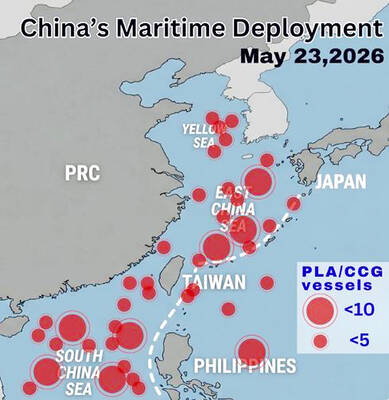
WARNING: China should stop engaging in actions that undermine regional peace and stability, as it would only build resentment among people across the Strait, the CGA said China has deployed more than 100 navy, coast guard and other vessels in waters from the Yellow Sea to the South China Sea and the western Pacific since US President Donald Trump and Chinese President Xi Jinping (習近平) met in Beijing, National Security Council Secretary-General Joseph Wu (吳釗燮) said yesterday. “In this part of the world, #China is the one & only PROBLEM wrecking the #StatusQuo & threatening regional peace & stability,” Wu wrote on X. In a separate post, he said Beijing was coercing Taiwan’s maritime domain, calling it illegal and provocative, after the Coast Guard Administration (CGA) expelled a


 RSS
RSS