


"Australian Taliban" David Hicks, the the first Guantanamo Bay inmate to face a US military tribunal, was flown back to his hometown of Adelaide yesterday to serve out the remainder of his sentence in a maximum security prison cell.
Hicks pleaded guilty in March to providing material support to al-Qaeda, including attending terrorist training camps in Afghanistan.
Under a plea deal, he was sentenced to nine months in prison -- a fraction of the life term he faced for his crime -- and allowed to return to Australia to serve out his term.
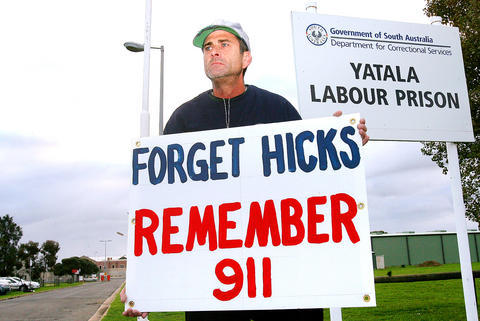
PHOTO: AFP
Accompanied by police and prison officials, Hicks was flown from Cuba in a Gulfstream G550 jet chartered by the Australian government and landed early yesterday at Edinburgh air force base on the outskirts of Adelaide.
Hicks, shackled and wearing an orange jumpsuit, was then taken to the Yatala Labour Prison, where he will serve the final seven months of his sentence.
Nevertheless, lawyer David McLeod said Hicks was thrilled to be home after more than five years at the US military camp at Guantanamo Bay, Cuba.
"He is happy to be back on Australian soil," McLeod told reporters outside Yatala prison. "He visibly was elated when we touched down."
Prison officials have said Hicks will be kept in a 2m wide single-bed cell similar in size to the one he left in Cuba.
The 31-year-old will be barred from having any personal items in his cell, and his visits with family will be strictly limited, with no physical contact allowed.
His telephone calls will be monitored, and he will be allowed little or no contact with other inmates, authorities have said.
Australian Attorney General Philip Ruddock declined to comment on security arrangements, saying only "public safety is the primary concern."
Hicks was captured in December 2001 in Afghanistan by the US-backed Northern Alliance, and became one of the first terrorist suspects to be transferred to the US naval base in Cuba.
He was tried by a military tribunal under a system created by US President George W. Bush after the Sept. 11, 2001 attacks.
Hicks was accused of attending al-Qaeda camps in Afghanistan and conducting surveillance on the British and US embassies as part of his training.
He had spent only two hours on the Taliban front line before it collapsed in November 2001 under attack by US Special Forces and the Northern Alliance.
While fleeing, Hicks came across a group of Arab fighters who told him they were heading back to the front to fight to the death. Hicks declined to join them and was captured as he tried to escape into Pakistan, according to the military's charge sheet.
As part of his plea deal, Hicks agreed to a 12-month order prohibiting him from talking to the media and stated he had "never been treated illegally" since he was captured in Afghanistan and taken to Guantanamo.

‘NO SECURITY RISK’: The Railway Bureau reassured the public that the technicians’ activities were limited to technical guidance and did not involve sensitive systems The Railway Bureau yesterday said it had invited eight Chinese technicians to assist with an airport MRT construction project. The bureau issued the confirmation after an Internet user said Chinese nationals had entered the construction zone of Taiwan Taoyuan International Airport’s Terminal 3 project. They asked why “individuals from an enemy state” were allowed access to such a major national infrastructure project, which raised serious concerns over Taiwan’s industrial safety, sensitive systems and information security. The bureau’s Northern Region Engineering Branch Office said subcontractor Taiwan Handle Industrial Co (台灣手把工業) of the Taoyuan airport MRT’s “Contract No. CU05 Project A14 Station Civil, MEP &

The National Chungshan Institute of Science and Technology yesterday showcased its locally developed variants of the Vision 60 robotic patrol dog, which it plans to deploy on the nation’s outlying territories in the South China Sea. The variants were produced under the Joint Lab project — created by the institute and domestic companies — and assembled with domestically produced motors, lenses and artificial intelligence (AI) systems alongside licensed tech from the US, Missile and Rocket Systems Research Division deputy director Jen Kuo-kang (任國光) told the media event at a military base in Taipei’s Dazhi (大直) area. Taiwan has built up its strengths

NOT IMMEDIATE: Taiwan has a chance to appeal the proposed 10 percent tariff before it starts, while other countries face a 12.5 percent tariff from the trade office Taiwan is among 60 economies determined by the US to have failed to impose or enforce a ban on the importation of goods produced with forced labor, according to a notice released on Tuesday by the Office of the US Trade Representative (USTR), which proposed imposing an additional 10 percent or more tariff on them. The USTR in a statement said that following an investigation, it had determined under Section 301 of the Trade Act of 1974 that the failure of the 60 economies to impose and effectively enforce a prohibition on the importation of goods produced with forced labor is

TIT-FOR-TAT: The US allegedly revoked the visa of a Chinese national working at Xinhua News Agency in the US in response to Beijing’s expulsion of Vivian Wang The Presidential Office yesterday condemned China for expelling a New York Times correspondent from Beijing following the newspaper’s interview with President William Lai (賴清德), saying the move highlighted Beijing’s suppression of press freedom and its threat to international news media. Taiwan has noted a series of recent incidents in which Beijing used similar tactics to “threaten and pressure international media outlets and journalists,” Presidential Office spokeswoman Karen Kuo (郭雅慧) said in a statement. “This concerns not only press freedom and freedom of expression, but also the safety of journalists, and Taiwan and relevant partners are paying close attention to the situation,” she


 RSS
RSS