


China's pledge to allow greater fluctuation in its currency's exchange rate failed to appease US lawmakers, who said they will push ahead with punitive legislation unless the yuan appreciates at a faster pace.
"We need more than signs, what's necessary is action," Democratic Representative Sander Levin, who chairs the trade panel of the House Ways and Means Committee, said in an interview yesterday. "I don't think the announcement will change the course of action in the Congress."
Negotiations next week led by US Treasury Secretary Henry Paulson and Chinese Vice Premier Wu Yi (吳儀) may be a final chance to head off legislation, analysts said.
Paulson has demanded "tangible results" from the talks and urged China to heed the message of a Congress considering "unattractive bills."
"Widening the band is of no significance and won't ameliorate congressional criticism," said Nicholas Lardy, who analyzes China's economy as a fellow at the Peterson Institute for International Economics in Washington.
Failure to make much progress next week "is likely to lead to some sort of currency legislation coming out of Congress," he said.
The People's Bank of China yesterday announced it would let its currency rise or fall 0.5 percent a day, up from 0.3 percent. Congress is considering legislation imposing duties on Chinese imports unless China lets the yuan climb more against the US dollar, a trend that may ease the record US trade deficit.
Lawmakers of both parties filed a formal complaint with the administration of US President George W. Bush over what they called the yuan's deliberate undervaluation. The US trade gap widened to a record US$232.5 billion last year. China's foreign exchange reserves jumped 37 percent to a record US$1.2 trillion in March from a year before.
Since China ended a strict peg to the US dollar in July 2005, the yuan has risen 7.9 percent, less than the 12 percent gains in currencies including the South Korean won and the Malaysian ringgit.
Wu, who on Thursday said the US shouldn't "politicize" trade issues, will get a chance to make her case directly before Congress next week. On the sidelines of the Strategic Economic Dialogue talks with Bush Cabinet officials, her delegation will meet with members of the Senate Finance and House Ways and Means committees.
"I want to talk to them, but if they're going to come up and we're going to ask them a 30-second question and they're going to read a 20-minute paper to us, forget it," said Senator Charles Grassley, the senior Republican on the Senate Finance Committee.
Yesterday's announcement was "a positive step but it's too early to tell whether it's substantive or just window dressing," he said.
Paulson will push China for more in the talks from Tuesday to Thursday in Washington, Alan Holmer, the Treasury's top China official, told reporters in Washington yesterday.
The gathering, which includes US Federal Reserve Chairman Ben Bernanke and nine Cabinet members, is the second session of a twice-yearly forum set up by Paulson and Wu in September.
"It's important now that Chinese authorities use the wider band and allow greater currency movement within each day and over time," Holmer said.

‘NO SECURITY RISK’: The Railway Bureau reassured the public that the technicians’ activities were limited to technical guidance and did not involve sensitive systems The Railway Bureau yesterday said it had invited eight Chinese technicians to assist with an airport MRT construction project. The bureau issued the confirmation after an Internet user said Chinese nationals had entered the construction zone of Taiwan Taoyuan International Airport’s Terminal 3 project. They asked why “individuals from an enemy state” were allowed access to such a major national infrastructure project, which raised serious concerns over Taiwan’s industrial safety, sensitive systems and information security. The bureau’s Northern Region Engineering Branch Office said subcontractor Taiwan Handle Industrial Co (台灣手把工業) of the Taoyuan airport MRT’s “Contract No. CU05 Project A14 Station Civil, MEP &

A US uncrewed surface vessel (USV) encountered multiple Chinese warships during an autonomous transit of the Taiwan Strait, US defense company Seasats said in a statement on Wednesday. Seasats announced that a Lightfish USV had completed the first autonomous transit of the Taiwan Strait. Over five days, the USV traversed the entire length of the Strait while constantly monitoring surface vessel traffic, the company said. The Lightfish encountered multiple Chinese warships, one of which was a Chinese People’s Liberation Army Navy (PLAN) Type 056 corvette, it said. The Chinese vessels were operating “well within Taiwan’s exclusive economic zone without transmitting their identity via the
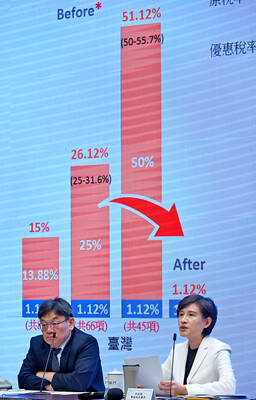
GREATER REACH? Auto parts and wood products would face tariffs of up to 15%, matching those targeting the EU, Japan and South Korea, Vice Premier said The US has announced that preferential tariff treatment for Taiwan’s non-semiconductor Section 232 goods would take effect retroactively from May 1, the Executive Yuan said yesterday. The US government yesterday posted a notice on the Federal Register’s public inspection Web site previewing tariff concessions for Taiwan under a memorandum of understanding (MOU) on Taiwan-US investment after two months of negotiations. The MOU signed on Jan. 15 stipulated three major preferential tariff arrangements: a 15 percent “reciprocal” tariff rate for Taiwan without stacking most-favored nation (MFN) rates; preferential Section 232 treatment for semiconductors and related products; and preferential Section 232 treatment for non-semiconductor

TIT-FOR-TAT: The US allegedly revoked the visa of a Chinese national working at Xinhua News Agency in the US in response to Beijing’s expulsion of Vivian Wang The Presidential Office yesterday condemned China for expelling a New York Times correspondent from Beijing following the newspaper’s interview with President William Lai (賴清德), saying the move highlighted Beijing’s suppression of press freedom and its threat to international news media. Taiwan has noted a series of recent incidents in which Beijing used similar tactics to “threaten and pressure international media outlets and journalists,” Presidential Office spokeswoman Karen Kuo (郭雅慧) said in a statement. “This concerns not only press freedom and freedom of expression, but also the safety of journalists, and Taiwan and relevant partners are paying close attention to the situation,” she


 RSS
RSS