


China's Foreign Ministry has rejected an Amnesty International report that accused Beijing of not living up to promises to improve human rights for the 2008 Olympics despite death penalty reforms and increased freedoms for foreign reporters.
The ministry released a statement yesterday that said the government was improving its legal system and promoting democracy: "We are conscientiously fulfilling our promise for the Olympics.
"The progress China has achieved in human rights cannot be slandered by a report from an individual organization with political prejudice," it said.
Amnesty's report, released yesterday, cataloged a wide range of continuing human-rights abuses, including extensive use of detention without trial by police, persecution of civil-rights activists and the use of new methods to rein in the domestic media and censor the Internet.
The report called on the International Olympic Committee to push Beijing more to improve its human rights record, especially on issues relating to the Olympics.
The report said if private discussions were not working, the "IOC should consider making these concerns public, especially with the Olympics little more than a year away."
The IOC said yesterday that it needed more time before commenting on the Amnesty report.
Andrew Nathan, chairman of Colombia University's political science department, said it wasn't a surprise that China hadn't lived up to its commitments since winning the bid.
He said the government had made a few "cosmetic changes," but generally they've been "tightening rather than liberalizing" rights restrictions.
Meanwhile, China is continuing to deny Canadian officials access to a Uighur-Canadian jailed earlier this month for terrorism, but Canada's foreign minister said yesterday that he had been told the man had not been mistreated.
Huseyin Celil was given a life sentence for "terrorist activities and plotting to split the country," state media said.
"I, of course, raised the case of Mr Celil and in particular expressed our deep disappointment that we have thus far been denied access to this Canadian citizen," Foreign Minister Peter MacKay told a news conference in Beijing.
MacKay said the Celil case had been one of the main talking points in a four-hour meeting with Chinese Foreign Minister Yang Jiechi (楊潔箎), adding that he was especially worried by allegations Celil had been tortured.
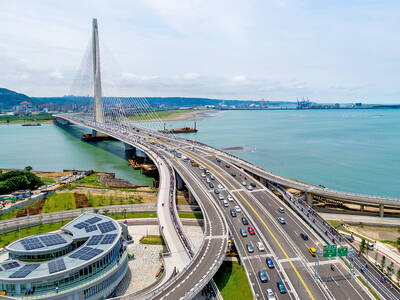
The Ministry of Transportation and Communications yesterday inaugurated the Danjiang Bridge across the Tamsui River in New Taipei City, saying that the structure would be an architectural icon and traffic artery for Taiwan. Feted as a major engineering achievement, the Danjiang Bridge is 920m long, 211m tall at the top of its pylon, and is the longest single-pylon asymmetric cable-stayed bridge in the world, the government’s Web site for the structure said. It was designed by late Iraqi-British architect Zaha Hadid. The structure, with a maximum deck of 70m, accommodates road and light rail traffic, and affords a 200m navigation channel for boats,
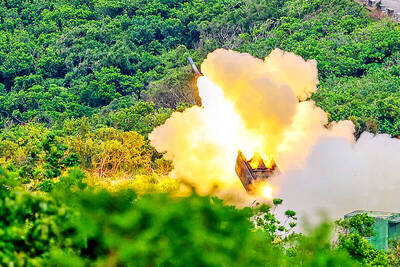
PRECISION STRIKES: The most significant reason to deploy HIMARS to outlying islands is to establish a ‘dead zone’ that the PLA would not dare enter, a source said A High Mobility Artillery Rocket System (HIMARS) would be deployed to Penghu County and Dongyin Island (東引) in Lienchiang County (Matsu) to force the Chinese military to retreat at least 100km from the coastline, a military source said yesterday. Taiwan has been procuring HIMARS and Army Tactical Missile Systems (ATACMS) from the US in batches. Once all batches have been delivered, Taiwan would possess 111 HIMARS units and 504 ATACMS, which have a range of 300km. Considering that “offense is the best defense,” the military plans to forward-deploy the systems to outlying islands such as Penghu and Dongyin so that

WHAT WAS ALL THAT FOR? Jaw Shaw-kong said that Cheng Li-wen had pushed for more drastic cuts and attacked him, just for the outcome to be nearly identical to his bill The legislature yesterday passed a supplementary budget bill to fund the purchase of separate packages of US military equipment, with the combined amount of spending capped at NT$780 billion (US$24.8 billion). The Chinese Nationalist Party (KMT) and Taiwan People’s Party (TPP) used their legislative majority to pass the bill, which runs until 2033 and has two main funding provisions. One was for NT$300 billion of arms sales already approved by the US for Taiwan on Dec. 17 last year, the other was for NT$480 billion for another arms package expected to be announced by Washington. The bill, which fell short of the NT$1.25

‘CLEAR MESSAGE’: The bill would set up an interagency ‘tiger team’ to review sanctions tools and other economic options to help deter any Chinese aggression toward Taiwan US Representative Young Kim has introduced a bill to deter Chinese aggression against Taiwan, calling for an interagency “tiger team” to preplan coordinated sanctions and economic measures in response to possible Chinese military or political action against Taiwan. “[Chinese President] Xi Jinping [習近平] has directed the People’s Liberation Army to be ready to invade Taiwan by 2027. China has a plan. America should have one too,” Kim said in a news release on Thursday last week. She introduced the “Deter PRC [People’s Republic of China] aggression against Taiwan act” to “ensure the US has a coordinated sanctions strategy ready should


 RSS
RSS