


Next year's Olympics is being used as a catalyst for repression in China, allowing hardliners to crack down on peaceful dissent in the name of stability, Amnesty International says.
The rights group gave China a failing grade in its third report since 2005 on the Olympic host nation's performance in living up to international human-rights standards in the run-up to the Beijing Games in August next year.
Citing "little evidence of reform" in several areas, the report, released today, painted a bleak picture, showing the Olympics "as a catalyst [for] a continued crackdown on human rights defenders, including prominent rights defense lawyers and those attempting to report on human rights violations."
Amnesty, accused by Beijing last year of mounting politically motivated attacks on China, welcomed new measures adopted recently by Chinese authorities concerning the death penalty and media freedoms. But it said they were overshadowed by the state's obsession with stability and a "strike hard" policy adopted to counter peaceful dissent.
The London-based group said the International Olympic Committee (IOC), which awarded China the 2008 Games, should use its "significant influence" on the Chinese authorities to continue to raise human rights issues in the run-up to the Games.
The IOC executive board, meeting in Beijing recently, said it was a sports organization with no political role.
The Amnesty report cited a call by China's minister of police last month for a crackdown on "hostile forces" including religious sects and separatists ahead of the Olympics.
"We must strike hard at hostile forces both in and outside the nation," said Zhou Yongkang (周永康), urging the crackdown by security to uphold the goal of creating the "harmonious society" advocated by President Hu Jintao (胡錦濤).
The so-called "strike hard" policy was apparent during the two-week session of the National People's Congress last month, Amnesty said.
A security clampdown on central Beijing accompanied the session and according to some sources thousands of people were locked up in what was widely seen as a security rehearsal for next year's Games.
The report emphasized relaxation of media rules for foreign reporters in the lead-up to the Games and a new measure granting the Supreme Court judicial review of death sentences. Amnesty applauded the granting of more freedom for foreign journalists. But it noted that censors have tightened control of the traditional news media and the Internet.

‘NO SECURITY RISK’: The Railway Bureau reassured the public that the technicians’ activities were limited to technical guidance and did not involve sensitive systems The Railway Bureau yesterday said it had invited eight Chinese technicians to assist with an airport MRT construction project. The bureau issued the confirmation after an Internet user said Chinese nationals had entered the construction zone of Taiwan Taoyuan International Airport’s Terminal 3 project. They asked why “individuals from an enemy state” were allowed access to such a major national infrastructure project, which raised serious concerns over Taiwan’s industrial safety, sensitive systems and information security. The bureau’s Northern Region Engineering Branch Office said subcontractor Taiwan Handle Industrial Co (台灣手把工業) of the Taoyuan airport MRT’s “Contract No. CU05 Project A14 Station Civil, MEP &

The National Chungshan Institute of Science and Technology yesterday showcased its locally developed variants of the Vision 60 robotic patrol dog, which it plans to deploy on the nation’s outlying territories in the South China Sea. The variants were produced under the Joint Lab project — created by the institute and domestic companies — and assembled with domestically produced motors, lenses and artificial intelligence (AI) systems alongside licensed tech from the US, Missile and Rocket Systems Research Division deputy director Jen Kuo-kang (任國光) told the media event at a military base in Taipei’s Dazhi (大直) area. Taiwan has built up its strengths

NOT IMMEDIATE: Taiwan has a chance to appeal the proposed 10 percent tariff before it starts, while other countries face a 12.5 percent tariff from the trade office Taiwan is among 60 economies determined by the US to have failed to impose or enforce a ban on the importation of goods produced with forced labor, according to a notice released on Tuesday by the Office of the US Trade Representative (USTR), which proposed imposing an additional 10 percent or more tariff on them. The USTR in a statement said that following an investigation, it had determined under Section 301 of the Trade Act of 1974 that the failure of the 60 economies to impose and effectively enforce a prohibition on the importation of goods produced with forced labor is
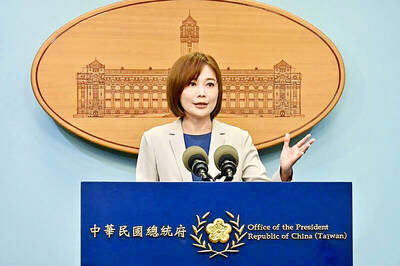
TIT-FOR-TAT: The US allegedly revoked the visa of a Chinese national working at Xinhua News Agency in the US in response to Beijing’s expulsion of Vivian Wang The Presidential Office yesterday condemned China for expelling a New York Times correspondent from Beijing following the newspaper’s interview with President William Lai (賴清德), saying the move highlighted Beijing’s suppression of press freedom and its threat to international news media. Taiwan has noted a series of recent incidents in which Beijing used similar tactics to “threaten and pressure international media outlets and journalists,” Presidential Office spokeswoman Karen Kuo (郭雅慧) said in a statement. “This concerns not only press freedom and freedom of expression, but also the safety of journalists, and Taiwan and relevant partners are paying close attention to the situation,” she


 RSS
RSS