


Turks will oppose efforts to erode their country's stability, Prime Minister Recep Tayyip Erdogan said yesterday, after the army warned that his government was not doing enough to defend the secular system.
"The political unity and social structure ... of this country can sometimes be subject to disasters," he told a gathering of the Turkish Red Crescent in Ankara.
"This nation has paid a heavy, painful price when the base of stability and confidence has been lost. But it no longer allows, nor will it allow, opportunists who are waiting and paving the way for a disaster," he said.
In an unusually strongly worded statement late on Friday, the Turkish army, responsible for three past coups, warned that it was determined to defend the country's secular system, weighing in on a controversial presidential vote that has sharply divided secularists and the Islamist-rooted government.
The warning came in an unusually stiff statement late on Friday, hours after parliament held an inconclusive first round of voting to elect a new president with Foreign Minister Abdullah Gul, the ruling Justice and Development Party's (AKP) pick, the sole candidate.
"The problem that recently came to the forefront of the presidential election process has focused on the issue of questioning secularism. The Turkish armed forces are observing this situation with concern," the army said.
"The Turkish armed forces ... will openly and clearly display their position and attitude when necessary. No one should doubt this," it warned.
The AKP's nomination of Gul has fanned unease in an increasingly polarized society where many fear the secular order is under threat from a growing Islamist influence.
Many are unconvinced by the AKP's arguments that it has disawoved its Islamist past and fear the government will have a free hand to implement a suspected Islamist agenda that will erode the separation of state and religion if Gul is elected.
The Turkish armed forces, which see themselves as the guardians of the secular system, seized power in 1960, 1971 and 1980 and forced the resignation in 1997 of the country's first Islamist prime minister, Necmettin Erbakan.
The main opposition Republican People's Party, which strongly opposes the idea of a former Islamist becoming president, on Friday evening petitioned the Constitutional Court to cancel the first round of voting, citing violation of a quorum rule.
If the court annuls the vote, general elections -- originally scheduled for Nov. 4 -- must be called within 90 days.
The EU yesterday also warned the Turkish army not to interfere in the country's democratic process.
"It is important that the military leaves the remit of democracy to the democratically elected government," EU Enlargement Commissioner Ollie Rehn said in a statement.
"This is a test case if the Turkish armed forces respect democratic secularism and the democratic arrangement of civil-military relations," Rehn said.
In Friday's presidential vote, Gul fell 10 votes short of the two-thirds majority of 367 required in ballotting boycotted by opposition parties.
If the Constitutional Court does not cancel the vote, parliament will hold a second round on Wednesday, probably with a similar result, but he is virtually certain to be elected in the third round on May 9, when an absolute majority of 276 will suffice.
Dozens of non-governmental organizations have called for a rally in Istanbul today to show their support for the secular system.
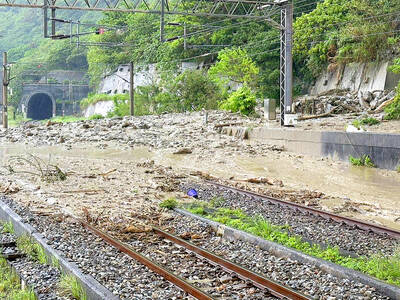
ROLLER-COASTER RIDE: More than five earthquakes ranging from magnitude 4.4 to 5.5 on the Richter scale shook eastern Taiwan in rapid succession yesterday afternoon Back-to-back weather fronts are forecast to hit Taiwan this week, resulting in rain across the nation in the coming days, the Central Weather Administration said yesterday, as it also warned residents in mountainous regions to be wary of landslides and rockfalls. As the first front approached, sporadic rainfall began in central and northern parts of Taiwan yesterday, the agency said, adding that rain is forecast to intensify in those regions today, while brief showers would also affect other parts of the nation. A second weather system is forecast to arrive on Thursday, bringing additional rain to the whole nation until Sunday, it

LANDSLIDES POSSIBLE: The agency advised the public to avoid visiting mountainous regions due to more expected aftershocks and rainfall from a series of weather fronts A series of earthquakes over the past few days were likely aftershocks of the April 3 earthquake in Hualien County, with further aftershocks to be expected for up to a year, the Central Weather Administration (CWA) said yesterday. Based on the nation’s experience after the quake on Sept. 21, 1999, more aftershocks are possible over the next six months to a year, the agency said. A total of 103 earthquakes of magnitude 4 on the local magnitude scale or higher hit Hualien County from 5:08pm on Monday to 10:27am yesterday, with 27 of them exceeding magnitude 5. They included two, of magnitude

CONDITIONAL: The PRC imposes secret requirements that the funding it provides cannot be spent in states with diplomatic relations with Taiwan, Emma Reilly said China has been bribing UN officials to obtain “special benefits” and to block funding from countries that have diplomatic ties with Taiwan, a former UN employee told the British House of Commons on Tuesday. At a House of Commons Foreign Affairs Committee hearing into “international relations within the multilateral system,” former Office of the UN High Commissioner for Human Rights (OHCHR) employee Emma Reilly said in a written statement that “Beijing paid bribes to the two successive Presidents of the [UN] General Assembly” during the two-year negotiation of the Sustainable Development Goals. Another way China exercises influence within the UN Secretariat is

Taiwan’s first drag queen to compete on the internationally acclaimed RuPaul’s Drag Race, Nymphia Wind (妮妃雅), was on Friday crowned the “Next Drag Superstar.” Dressed in a sparkling banana dress, Nymphia Wind swept onto the stage for the final, and stole the show. “Taiwan this is for you,” she said right after show host RuPaul announced her as the winner. “To those who feel like they don’t belong, just remember to live fearlessly and to live their truth,” she said on stage. One of the frontrunners for the past 15 episodes, the 28-year-old breezed through to the final after weeks of showcasing her unique


 RSS
RSS