


Former Chinese Nationalist Party (KMT) chairman Ma Ying-jeou (馬英九), who is expected to appear in court today for alleged misuse of his special allowance fund during his time as Taipei mayor, said yesterday that his indictment should not be a problem for his presidential bid because he is innocent until proven guilty after three trials.
"We all know that, in terms of the Criminal Procedure Law (
Ma, who said on Sunday that he would stay in the race even though he might be found guilty in the first trial, said he is not as confident as he used to be of the judiciary.
"I believe the judiciary is very important and I respect it, but my faith in it has been shaken because of a series of recent actions by the judiciary, particularly after I read my indictment and because of the recent controversy about the relocation of several prosecutors-general," he said.
Ma said he had not taken a lawyer with him when he answered the prosecutors' first summons because he believed he had been called as a concerned party, not a defendant.
Prosecutors only asked for his opinions about "the nature of the special allowance fund" instead of giving him a chance to explain that the nature of the fund and how he "subjectively used the money" were different, he said.
He said he did not understand why he was indicted because he was just following what the city government's treasurers and accountants had told him to do.
Ma said he thinks someone has tried to sabotage him by having him indicted. He said he had consulted his lawyers about how to prove his innocence in court today.
As to whether he approved of the KMT's bid to modify its "Black Gold Exclusion Clause" -- which prohibits members who have been indicted from joining the party's primary -- Ma said his case and the reason for the clause were "very different situations."
He said it would be inappropriate for the KMT to tailor party regulations for him.
Ma was indicted for corruption on Feb. 13 on charges that he had embezzled NT$11 million (US$332,400).
Prosecutors alleged that between December 1998 and last July, Ma wired half of his monthly special mayoral allowance -- NT$170,000 -- into a personal account.
They also claimed that Ma has NT$11,176,227 in bank accounts belonging to him and his wife.
Taiwan High Court Prosecutors' Office spokesman Chang Wen-cheng (
Prosecutors have said that Ma included the money in his mandatory annual declaration of assets, but that he had failed to explain what legal basis he had for keeping public funds in a personal bank account.
Ma was criticized over his interview by the pan-green camp.
Democratic Progressive Party (DPP) Chairman Yu Shyi-kun called him a "hypocrite," saying that Ma had a double standard when it came to his behavior and that of President Chen Shui-bian (陳水扁).
"How can a dishonest and corrupt person be Taiwan's president?" Yu said.
Former premier and DPP presidential hopeful Frank Hsieh (謝長廷) said Ma had created a dilemma by proclaiming he would still seek the presidency even if he were convicted in a first trial.
Taiwan Solidarity Union spokeswoman Chiang Yueh-chin (
She said if Ma would like to consider himself innocent until proven guilty after three trials, he should also apply the same standard to other people, such as the president.
But some pan-blue lawmakers were quick to defend Ma.
"No matter whether the court finds him guilty, Ma has to stick with his presidential plans. The indictment of Ma was a political move aimed at preventing him from running for president," KMT Legislator Justine Chou (

SILENCING CRITICS: In addition to blocking Taiwan, China aimed to prevent rights activists from speaking out against authoritarian states, a Cabinet department said The Ministry of Foreign Affairs (MOFA) yesterday condemned transnational repression by Beijing after RightsCon, a major digital human rights conference scheduled to be held in Zambia this week, was abruptly canceled due to Chinese pressure over Taiwanese participation. This year’s RightsCon, the world’s largest conference discussing issues “at the intersection of human rights and technology,” was scheduled to take place from tomorrow to Friday in Lusaka, and expected to draw 2,600 in-person attendees from 150 countries, along with 1,100 online participants. However, organizers were forced to cancel the event due to behind-the-scenes pressure from China, the ministry said, expressing its “strongest condemnation”
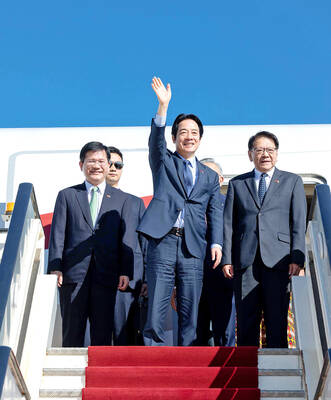
DELAYED BUT DETERMINED: The president’s visit highlights Taiwan’s right to international engagement amid regional pressure from China President Willaim Lai (賴清德) yesterday arrived in Eswatini, more than a week after his planned visit to Taiwan’s sole African ally was suspended because of revoked overflight permits. “The visit, originally scheduled for April 22, was postponed due to unforeseen external factors,” Lai wrote on social media. “After several days of careful arrangements by our diplomatic and national security teams, we successfully arrived today.” Lai said he looked forward to further deepening Taiwan-Eswatini relations through closer cooperation in the economy, agriculture, culture and education, as well as advancing the nation’s international partnerships. The president was initially scheduled to arrive in time to celebrate
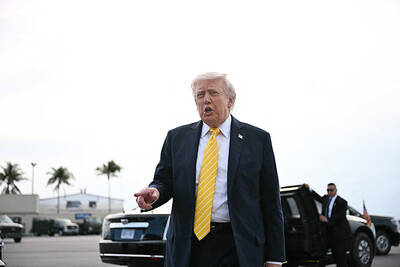
Iran’s Islamic Revolutionary Guard Corp (IRGC) yesterday said the US faced a choice between an “impossible” military operation or a “bad deal” with Tehran, after US President Donald Trump disparaged Iran’s latest peace proposal. Negotiations between the two countries have been deadlocked since a ceasefire came into effect on April 8, with only one round of direct peace talks held so far. Iran’s Tasnim and Fars news agencies reported that Tehran had submitted a 14-point proposal to mediator Pakistan, but Trump was quick to cast doubt on it. “I will soon be reviewing the plan that Iran has just sent to us, but

A group affiliated with indicted Chinese immigrant Xu Chunying (徐春鶯) is to be dissolved for monitoring Chinese immigrants in Taiwan, a source said yesterday. Xu, the secretary-general of the Cross-Strait Marriage and Family Service Alliance, was indicted on March 24 on charges of violating the Anti-Infiltration Act (反滲透法). The alliance “illegally monitored" Chinese immigrants living in Taiwan on behalf of the Chinese Communist Party (CCP) and the Ministry of the Interior is expected to dissolve the organization in the coming days under provisions of the Civil Associations Act (人民團體法), the source said. Xu, who married a Taiwanese in 1993 and became a Republic


 RSS
RSS