


Japanese Prime Minister Shinzo Abe's government said yesterday it did not believe there was proof Japan forced women into World War II brothels, reiterating remarks that caused an uproar earlier this month.
"The government did not find evidence showing forced recruitment by Japanese military authorities or bureaucrats," Abe's Cabinet said in a policy statement in parliament responding to a question by an opposition lawmaker.
It said, however, that the Cabinet would not change a landmark 1993 apology that the Japanese government issued to former sex slaves.
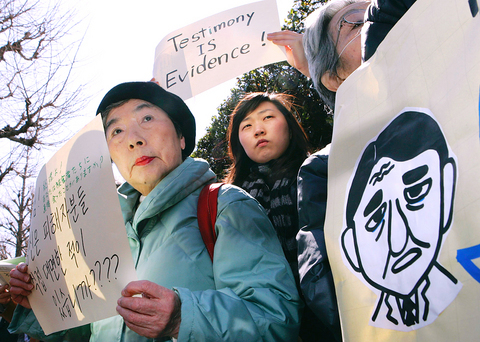
PHOTO: REUTERS
The 1993 apology "was not endorsed by the then Cabinet of Prime Minister Kiichi Miyazawa but successive Japanese Cabinets have inherited it," the statement said.
Abe, known for his conservative views on history, caused outrage earlier this month when he said there was no evidence that so-called "comfort women" were forced into sexual slavery "in the strict sense of coercion."
He later elaborated, saying he was talking about physical coercion, such as kidnappings of women by Japanese soldiers to put them into brothels.
After an uproar, Abe has said repeatedly that he stands "sincerely" by the 1993 apology.
Abe's remarks have provoked a furor in Asian countries that were invaded by Japan and in the US, where the US Congress is considering a bill that would demand Japan make an outright apology to comfort women.
South Korean lawmaker Yoo Ki-hong yesterday visited Tokyo to demand a "forward-looking settlement" to the comfort women row.
"The grudge and hatred of about 200,000 comfort women mobilized from Korea, China, the Philippines, Australia, etcetera, are being revived now," Yoo said in a statement he handed to Japanese government officials.
"We strongly ask the prime minister to pay attention to and sincerely listen to the voice of the world," said the statement by Yoo, a member of South Korea's ruling Uri party.
"Abe, as the prime minister of Japan, should come face to face with the victims of sex slavery and see the historical truth," the statement said.
Historians say up to 200,000 young women, mostly from Korea but also from Taiwan, Indonesia, the Philippines and China, were forced to serve as sex slaves in Japanese army brothels.
The 1993 statement, issued by the top government spokesman at the time, apologized to comfort women and said the Imperial Army was involved "directly or indirectly" in their recruitment and in the management of the brothels.
In Taipei, the Ministry of Foreign Affairs yesterday rebutted the Japanese government's claims that "no hard evidence" exists proving that the Japanese military forced scores of women into prostitution during World War II.
"Japan should face its history more squarely," said ministry spokesman David Wang (
"To dismiss the phenomenon because of a lack of evidence in a few, single cases is to ignore a historical happening that was broad and pervasive," Wang said.
The Japanese government should also offer material retribution, or closure, to those who suffered under Japan's practice of sex slavery in World War II, or their families.
"They deserve justice," he said, referring to the victims and their families.
Additional reporting by Max Hirsch

AGING: As of last month, people aged 65 or older accounted for 20.06 percent of the total population and the number of couples who got married fell by 18,685 from 2024 Taiwan has surpassed South Korea as the country least willing to have children, with an annual crude birthrate of 4.62 per 1,000 people, Ministry of the Interior data showed yesterday. The nation was previously ranked the second-lowest country in terms of total fertility rate, or the average number of children a woman has in her lifetime. However, South Korea’s fertility rate began to recover from 2023, with total fertility rate rising from 0.72 and estimated to reach 0.82 to 0.85 by last year, and the crude birthrate projected at 6.7 per 1,000 people. Japan’s crude birthrate was projected to fall below six,

US President Donald Trump in an interview with the New York Times published on Thursday said that “it’s up to” Chinese President Xi Jinping (習近平) what China does on Taiwan, but that he would be “very unhappy” with a change in the “status quo.” “He [Xi] considers it to be a part of China, and that’s up to him what he’s going to be doing, but I’ve expressed to him that I would be very unhappy if he did that, and I don’t think he’ll do that. I hope he doesn’t do that,” Trump said. Trump made the comments in the context
SELF-DEFENSE: Tokyo has accelerated its spending goal and its defense minister said the nation needs to discuss whether it should develop nuclear-powered submarines China is ramping up objections to what it sees as Japan’s desire to acquire nuclear weapons, despite Tokyo’s longstanding renunciation of such arms, deepening another fissure in the two neighbors’ increasingly tense ties. In what appears to be a concerted effort, China’s foreign and defense ministries issued statements on Thursday condemning alleged remilitarism efforts by Tokyo. The remarks came as two of the country’s top think tanks jointly issued a 29-page report framing actions by “right-wing forces” in Japan as posing a “serious threat” to world peace. While that report did not define “right-wing forces,” the Chinese Ministry of Foreign Affairs was

PREPAREDNESS: Given the difficulty of importing ammunition during wartime, the Ministry of National Defense said it would prioritize ‘coproduction’ partnerships A newly formed unit of the Marine Corps tasked with land-based security operations has recently replaced its aging, domestically produced rifles with more advanced, US-made M4A1 rifles, a source said yesterday. The unnamed source familiar with the matter said the First Security Battalion of the Marine Corps’ Air Defense and Base Guard Group has replaced its older T65K2 rifles, which have been in service since the late 1980s, with the newly received M4A1s. The source did not say exactly when the upgrade took place or how many M4A1s were issued to the battalion. The confirmation came after Chinese-language media reported


 RSS
RSS