


US President George W. Bush announced on Thursday that he was extending the stay of 3,200 US troops in Afghanistan to help the NATO-commanded force there combat an anticipated spring offensive by the Taliban.
Bush said the troops would remain there for another four months and then would be replaced by a new force of comparable size that would remain there for the "foreseeable future." The increase would boost US forces in the country to 27,000, the highest level since 2001.
Those new troops would be in addition to those being sent to Iraq or already deployed there.
Bush also said that NATO allies need to supply more soldiers to Afghanistan and must be willing to send them into the most violent battles with Taliban fighters.
"When our commanders on the ground say to our respective countries we need additional help, our NATO countries must provide it," Bush said Thursday.
Flush with money from heroin-producing poppy crops, Taliban fighters have proven much tougher than NATO expected when it deployed its first contingent of peacekeepers there in 2003.
"I've ordered an increase in US forces in Afghanistan," Bush said in a speech that came five years after US-led forces toppled Afghanistan's repressive Taliban regime. "We've extended the stay of 3,200 troops now in the country, for four months, and we'll deploy a replacement force that will sustain this increase for the foreseeable future."
The Pentagon said on Wednesday that 3,200 soldiers scheduled to go to Iraq would be sent to Afghanistan instead, replacing the troops extended for four months. Deployment of the 173rd Airborne Brigade, based in Italy, would keep the force at its current strength of 27,000 -- the highest of the war.
About 15,000 of the US troops in Afghanistan are serving in the NATO-led force, which now totals about 36,000. The other 12,000 are special operations forces or are training Afghan troops.
Calling poppy cultivation a threat, Bush implored Afghan President Hamid Karzai to address the marked increase in harvests last year, after a decline in 2005.
"I have made my concerns to President Karzai pretty clear -- not pretty clear, very clear -- and that in order for him to gain the confidence of his people, and the confidence of the world, he's got to do something about it, with our help," Bush said in an hour-long speech sponsored by the American Enterprise Institute in Washington.
Meanwhile, US Secretary of Defense Robert Gates said the planned offensive in Afghanistan was an attempt to react ahead of an expected seasonal Taliban offensive.
"What we want to do this spring is have this spring offensive be our offensive and have the initiative in our hands rather than reacting to them," Gates said.
The call for NATO nations to supply more soldiers and equipment was a nudge to Germany and others that have kept their troops out of the most violent parts of Afghanistan.
"Allies must lift restrictions on the forces they do provide so NATO commanders have the flexibility they need to defeat the enemy wherever the enemy may make a stand," Bush said.
also see story:
Human rights group highlights Afghan campaign abuses
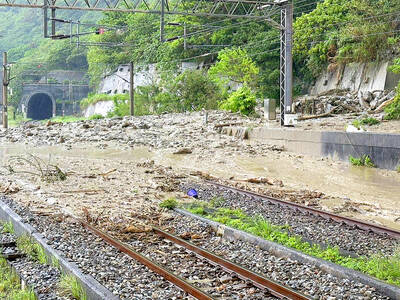
ROLLER-COASTER RIDE: More than five earthquakes ranging from magnitude 4.4 to 5.5 on the Richter scale shook eastern Taiwan in rapid succession yesterday afternoon Back-to-back weather fronts are forecast to hit Taiwan this week, resulting in rain across the nation in the coming days, the Central Weather Administration said yesterday, as it also warned residents in mountainous regions to be wary of landslides and rockfalls. As the first front approached, sporadic rainfall began in central and northern parts of Taiwan yesterday, the agency said, adding that rain is forecast to intensify in those regions today, while brief showers would also affect other parts of the nation. A second weather system is forecast to arrive on Thursday, bringing additional rain to the whole nation until Sunday, it

LANDSLIDES POSSIBLE: The agency advised the public to avoid visiting mountainous regions due to more expected aftershocks and rainfall from a series of weather fronts A series of earthquakes over the past few days were likely aftershocks of the April 3 earthquake in Hualien County, with further aftershocks to be expected for up to a year, the Central Weather Administration (CWA) said yesterday. Based on the nation’s experience after the quake on Sept. 21, 1999, more aftershocks are possible over the next six months to a year, the agency said. A total of 103 earthquakes of magnitude 4 on the local magnitude scale or higher hit Hualien County from 5:08pm on Monday to 10:27am yesterday, with 27 of them exceeding magnitude 5. They included two, of magnitude

CONDITIONAL: The PRC imposes secret requirements that the funding it provides cannot be spent in states with diplomatic relations with Taiwan, Emma Reilly said China has been bribing UN officials to obtain “special benefits” and to block funding from countries that have diplomatic ties with Taiwan, a former UN employee told the British House of Commons on Tuesday. At a House of Commons Foreign Affairs Committee hearing into “international relations within the multilateral system,” former Office of the UN High Commissioner for Human Rights (OHCHR) employee Emma Reilly said in a written statement that “Beijing paid bribes to the two successive Presidents of the [UN] General Assembly” during the two-year negotiation of the Sustainable Development Goals. Another way China exercises influence within the UN Secretariat is

Taiwan’s first drag queen to compete on the internationally acclaimed RuPaul’s Drag Race, Nymphia Wind (妮妃雅), was on Friday crowned the “Next Drag Superstar.” Dressed in a sparkling banana dress, Nymphia Wind swept onto the stage for the final, and stole the show. “Taiwan this is for you,” she said right after show host RuPaul announced her as the winner. “To those who feel like they don’t belong, just remember to live fearlessly and to live their truth,” she said on stage. One of the frontrunners for the past 15 episodes, the 28-year-old breezed through to the final after weeks of showcasing her unique


 RSS
RSS