


Following the indictment of former Chinese Nationalist Party (KMT) chairman Ma Ying-jeou (
While extending his support to Ma, Lien said that Ma's declaration had "limited" the negotiating space between Ma and Wang, who has hinted at a presidential bid of his own, and could cause a pan-blue split if he insists on running as a KMT candidate.
"Although I used the word `limit,' it doesn't mean that it is impossible for Ma and Wang to hold negotiations ? Let us combine our efforts using wisdom and experience to push for party integration," Lien said in a statement after meeting with Acting KMT Chairman Wu Poh-hsiung (
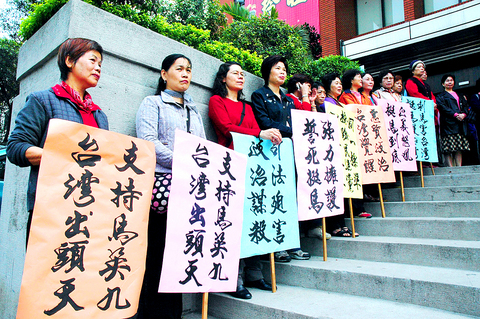
PHOTO: CNA
Lien, who reportedly has a problematic relationship with Ma and favors a "Wang-Ma" presidential ticket, also warned that revoking the party's black-gold exclusion clause could generate a negative response.
In a meeting on Tuesday night after Ma's resignation, the KMT's Central Standing Committee -- its highest decision-making body -- repealed a "black gold" exclusion clause to prevent Ma from being disqualified from running as the party's presidential candidate.
The clause was formulated by the Central Standing Committee and revised under Ma's chairmanship to stipulate that any party member who is indicted should be suspended.
The clause seems to have been revoked specifically for Ma, although Wu denied the accusation.
In response to Wu's request that he serve as a mediator between Ma and Wang, Lien said he would try to arrange a meeting before he heads to Australia for the Lunar New Year holiday on Saturday.
"It seems that the KMT is enduring a serious crisis, but we can turn it into an opportunity for victory in future elections," Lien said.
Wu repeated Lien's message for party integration, and said the meeting would be held before the end of the month or early next month if it could not be arranged before Saturday.
Meanwhile, although the KMT decided not to accept Ma's resignation at a provisional meeting on Tuesday night, Ma reaffirmed his decision after speaking to Wu.
KMT Secretary-General Wu Den-yih (
Wu Poh-hsiung would take over the chairmanship for the next three months until the party holds a new election for chairman, he said.
Ma made no public appearances yesterday.
The removal of the anti-graft clause drew the ire of several KMT lawmakers yesterday.
The pro-Wang lawmakers said the decision to repeal the clause would affect party unity.
"Revoking the clause in such a hurry without taking into account the feelings of Wang will damage coordination between [Ma and Wang]," KMT Legislator Hung Hsiu-chu (
Wang has not declared his candidacy, but has hinted at a presidential bid of his own.
KMT Legislator Huang Chao-shun (黃昭順) said that unexpected consequences might occur as the decision to repeal the law was made solely by members of Ma's camp.
Wang yesterday also voiced his opposition to Tuesday night's provisional Central Standing Committee meeting, but he didn't single anyone out for condemnation.
"Those who handle party affairs should do so in a respectable fashion. They should have considered all scenarios, and shown respect ? so that the party can win support from the public," Wang said, refusing to say whom he was referring to.
Wang said he had "no comment" when asked by reporters whether the removal of the clause was tailor-made to help Ma's chances of a presidential bid.
"We will launch a signature campaign calling for a Ma-Wang presidential ticket [today]," KMT Legislator Sun Ta-chien (
"When I met with Lien three weeks ago, he told me that he preferred Ma as the presidential candidate because his chances of winning the election were better, even though he had a strong friendship with Wang," Sun said, "Lien also said the same thing to Ma about 10 days ago."
Wang yesterday declined to comment on a presidential bid, saying that he was still "making an assessment."
An anonymous source from Wang's camp told the Taipei Times that Wang had set his mind on running for president, but Ma's announcement had put Wang in a difficult position.
"The report didn't come out without reason," he said, referring to a story published by the Chinese-language United Daily News last Saturday that said Wang had decided to compete in the party's primary and had started preparing for his campaign.
also see story:
Editorial: The blooding of Ma Ying-jeou

Taiwan Semiconductor Manufacturing Co (TSMC, 台積電), the world’s largest foundry service provider, yesterday said that global semiconductor revenue is projected to hit US$1.5 trillion in 2030, after the figure exceeds US$1 trillion this year, as artificial intelligence (AI) demand boosts consumption of token and compute power. “We are still at the beginning of the AI revolution, but we already see a significant impact across the whole semiconductor ecosystem,” TSMC deputy cochief operating officer Kevin Zhang (張曉強) said at the company’s annual technology symposium in Hsinchu City. “It is fair to say that in the past decade, smartphones and other mobile devices were
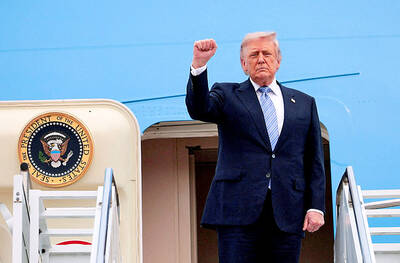
US-CHINA SUMMIT: MOFA welcomed US reassurance of no change in its Taiwan policy; Trump said he did not comment when Xi talked of opposing independence US President Donald Trump yesterday said he has not made a decision on whether to move forward with a major arms package for Taiwan after hearing concerns about it from Chinese President Xi Jinping (習近平). Trump’s comments on Taiwan came as he flew back to Washington after wrapping up critical talks in which both leaders said important progress was made in stabilizing US-China relations even as deep differences persist between the world’s two biggest powers on Iran and Taiwan. “I will make a determination,” Trump said, adding: “I’ll be making decisions. But, you know, I think the last thing we need right
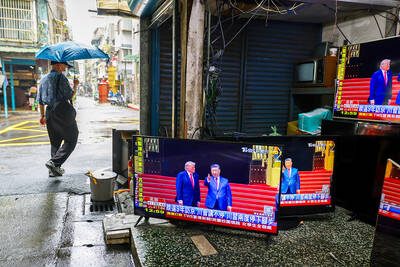
TAIWAN ISSUE: US treasury secretary Scott Bessent said on the first day of meetings that ‘it wouldn’t be a US-China summit without the Taiwan issue coming up’ There were no surprises on the first day of the summit between US President Donald Trump and Chinese President Xi Jinping (習近平), the Mainland Affairs Council (MAC) said yesterday, as the government reiterated that cross-strait stability is crucial to the Asia-Pacific region, as well as the world. As the two presidents met for a highly anticipated summit yesterday, Chinese state media reported that Xi warned Trump that missteps regarding Taiwan could push their two countries into “conflict.” Trump arrived in China with accolades for his host, calling Xi a “great leader” and “friend,” and extending an invitation to visit the White House
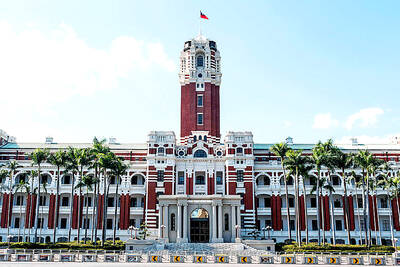
SECURITY: Taipei presses the US for arms supplies, saying the arms sales are not only a reflection of the US security commitment to Taiwan but also serve as a mutual deterrent against regional threats Taiwan is committed to preserving the cross-strait “status quo” and contributing to regional peace and stability, the Presidential Office said yesterday. “It is an undeniable fact that the Republic of China is a sovereign and independent democratic nation,” Presidential Office spokeswoman Karen Kuo (郭雅慧) reiterated, adding that Beijing has no right to claim sovereignty over Taiwan. The statements came after US President Donald Trump warned against Taiwanese independence. Trump wrapped up a state visit to Beijing on Friday, during which Chinese President Xi Jinping (習近平) had pressed him not to support Taiwan. Taiwan depends heavily on US security backing to deter China from carrying


 RSS
RSS