


Opposition protesters paralyzed Lebanon yesterday by setting fire to tires and cars at major thoroughfares in the capital and its approaches to enforce a general strike that aims to topple the government.
Clustering in small groups to man the blazing roadblocks, opposition supporters escalated their nearly two-month protest. Commuters were stranded and business came to a halt in many districts.
Scattered violence was reported involving stone throwing, fist fights and even firing of guns. Police said 14 people sustained gunshot wounds in disturbances between opposition supporters and pro-government activists in central and northern Lebanon. Michel Aoun, a senior opposition leader, told al-Arabiya television that the seven wounded were opposition members.
Several people were injured in scuffles in neighborhoods of Beirut, Lebanon's capital, as well as in central, eastern and northern Lebanon.
Police and troops deployed in their thousands across the country worked to open roads, sometimes negotiating with protesters, but they refrained from using force. In some instances, the military separated the two opposing sides and managed to open some roads.
Troops brandishing automatic rifles and batons kept hundreds of people from each side separated and away from motorists, and made a few arrests on the coastal highway north of Beirut near the Christian port city of Jounieh. Shots were fired in the air, apparently by security forces to disperse the crowds.
Clashes took place in areas of the capital and around the country where residents are divided between government supporters and opposition forces. Places spared the incidents tend to be home to mainly one side or the other of the political divide.
Hezbollah chief Sheik Hassan Nasrallah and other opposition leaders called the strike, which was backed by labor unions. Lebanese Prime Minister Fuad Saniora and his supporters urged Lebanese to ignore the call, a move endorsed by banking associations and business leaders.
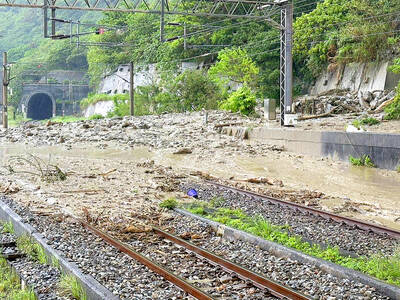
ROLLER-COASTER RIDE: More than five earthquakes ranging from magnitude 4.4 to 5.5 on the Richter scale shook eastern Taiwan in rapid succession yesterday afternoon Back-to-back weather fronts are forecast to hit Taiwan this week, resulting in rain across the nation in the coming days, the Central Weather Administration said yesterday, as it also warned residents in mountainous regions to be wary of landslides and rockfalls. As the first front approached, sporadic rainfall began in central and northern parts of Taiwan yesterday, the agency said, adding that rain is forecast to intensify in those regions today, while brief showers would also affect other parts of the nation. A second weather system is forecast to arrive on Thursday, bringing additional rain to the whole nation until Sunday, it
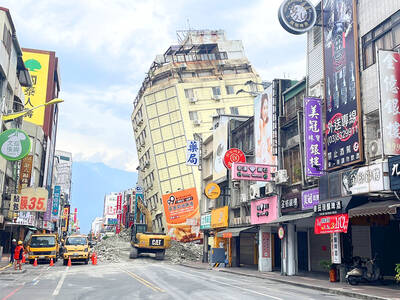
LANDSLIDES POSSIBLE: The agency advised the public to avoid visiting mountainous regions due to more expected aftershocks and rainfall from a series of weather fronts A series of earthquakes over the past few days were likely aftershocks of the April 3 earthquake in Hualien County, with further aftershocks to be expected for up to a year, the Central Weather Administration (CWA) said yesterday. Based on the nation’s experience after the quake on Sept. 21, 1999, more aftershocks are possible over the next six months to a year, the agency said. A total of 103 earthquakes of magnitude 4 on the local magnitude scale or higher hit Hualien County from 5:08pm on Monday to 10:27am yesterday, with 27 of them exceeding magnitude 5. They included two, of magnitude
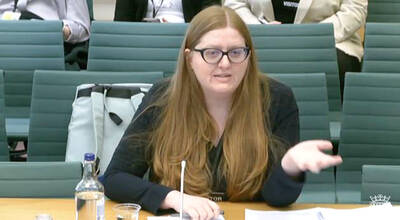
CONDITIONAL: The PRC imposes secret requirements that the funding it provides cannot be spent in states with diplomatic relations with Taiwan, Emma Reilly said China has been bribing UN officials to obtain “special benefits” and to block funding from countries that have diplomatic ties with Taiwan, a former UN employee told the British House of Commons on Tuesday. At a House of Commons Foreign Affairs Committee hearing into “international relations within the multilateral system,” former Office of the UN High Commissioner for Human Rights (OHCHR) employee Emma Reilly said in a written statement that “Beijing paid bribes to the two successive Presidents of the [UN] General Assembly” during the two-year negotiation of the Sustainable Development Goals. Another way China exercises influence within the UN Secretariat is

Taiwan’s first drag queen to compete on the internationally acclaimed RuPaul’s Drag Race, Nymphia Wind (妮妃雅), was on Friday crowned the “Next Drag Superstar.” Dressed in a sparkling banana dress, Nymphia Wind swept onto the stage for the final, and stole the show. “Taiwan this is for you,” she said right after show host RuPaul announced her as the winner. “To those who feel like they don’t belong, just remember to live fearlessly and to live their truth,” she said on stage. One of the frontrunners for the past 15 episodes, the 28-year-old breezed through to the final after weeks of showcasing her unique


 RSS
RSS