


Japan and the US are to discuss plans for their troops to jointly deal with a potential stand-off between China and Taiwan, Kyodo news agency reported, a move that has already raised Beijing's ire.
Defense and foreign affairs officials from Tokyo and Washington would open talks next month and assess various crises that might occur across the Taiwan Strait, including providing logistical support for US troops in the event of a conflict, the agency said late on Wednesday, citing officials from both countries.
Kyodo said the discussions were thought to reflect the wishes of Prime Minister Shinzo Abe, who is considered to be pro-Taiwan.
Abe's predecessor, Junichiro Koizumi, told the Diet in 2005 that Japan did not anticipate providing military cooperation to the US during any crisis in the Taiwan Strait, the report said.
Any Japanese military contribution would be limited under its Constitution, but the two sides would consider having Japanese troops provide rear-area support, including supplies, transport and medical services for US troops, as well as ship inspection and search and rescue work, Kyodo said.
China quickly expressed concern over the plans.
"Taiwan is an inseparable part of China's territory and any arrangement between Japan and the United States should respect the one-China principle," Chinese Foreign Ministry Spokesman Liu Jianchao (劉建超) told a news conference yesterday.
"We have expressed great concern," he added, calling "independence forces" in Taiwan "the greatest threat to peace and stability across the Taiwan Strait."
US-Japan talks on the issue could also stir controversy in Japan. The government has in the past been vague about whether Taiwan is part of Japan's "surrounding areas," meaning those to which its contingency legislation would apply.
Japan and the US will also discuss details of how they would deal with contingencies in North Korea following Pyongyang's missile and nuclear tests last year, the Asahi Shimbun said yesterday.
Tokyo and Washington last month began to study possible plans involving North Korea, including their response to a possible conflict on the peninsula or a missile attack on Japan, the Asahi Shimbun said.
Japanese troops could carry out search and rescue missions for US troops, refuel US military planes and ships, and allow them to use Japanese air bases and sea ports for attacks on North Korea, the report said, citing unnamed officials. The allies could also work together to shoot down missiles and attack Pyongyang's missile bases, the report said.
Tokyo and Washington already work together on security policy in the region.
The US stations about 50,000 troops in Japan under a security treaty, and the allies stepped up efforts to build a missile defense system following North Korea's nuclear test in October.
Foreign Ministry official Naoki Kumagai said Tokyo and Washington "are discussing responses to possible regional contingencies," but refused to elaborate.
He agreed, however, that the nuclear standoff with North Korea and tension between China and Taiwan were "key concerns" facing Japan and the US in the region.
Japan, which resumed ties with communist China in 1972, has so far balked at the prospect of getting involved in any conflict in the Taiwan Strait.
The reports came amid a recent drive by Tokyo to raise its political and military profile overseas.
Abe has promised to change the Japanese Constitution to give freer rein to its military missions overseas.
Japan is also considering an upgrade of its Defense Agency to a full-fledged ministry.

SILENCING CRITICS: In addition to blocking Taiwan, China aimed to prevent rights activists from speaking out against authoritarian states, a Cabinet department said The Ministry of Foreign Affairs (MOFA) yesterday condemned transnational repression by Beijing after RightsCon, a major digital human rights conference scheduled to be held in Zambia this week, was abruptly canceled due to Chinese pressure over Taiwanese participation. This year’s RightsCon, the world’s largest conference discussing issues “at the intersection of human rights and technology,” was scheduled to take place from tomorrow to Friday in Lusaka, and expected to draw 2,600 in-person attendees from 150 countries, along with 1,100 online participants. However, organizers were forced to cancel the event due to behind-the-scenes pressure from China, the ministry said, expressing its “strongest condemnation”
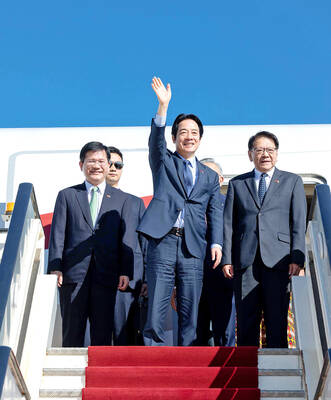
DELAYED BUT DETERMINED: The president’s visit highlights Taiwan’s right to international engagement amid regional pressure from China President Willaim Lai (賴清德) yesterday arrived in Eswatini, more than a week after his planned visit to Taiwan’s sole African ally was suspended because of revoked overflight permits. “The visit, originally scheduled for April 22, was postponed due to unforeseen external factors,” Lai wrote on social media. “After several days of careful arrangements by our diplomatic and national security teams, we successfully arrived today.” Lai said he looked forward to further deepening Taiwan-Eswatini relations through closer cooperation in the economy, agriculture, culture and education, as well as advancing the nation’s international partnerships. The president was initially scheduled to arrive in time to celebrate
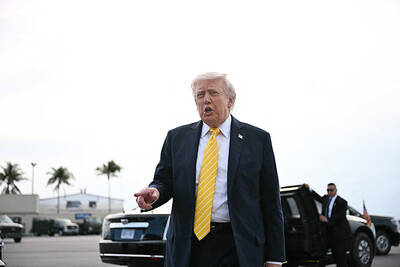
Iran’s Islamic Revolutionary Guard Corp (IRGC) yesterday said the US faced a choice between an “impossible” military operation or a “bad deal” with Tehran, after US President Donald Trump disparaged Iran’s latest peace proposal. Negotiations between the two countries have been deadlocked since a ceasefire came into effect on April 8, with only one round of direct peace talks held so far. Iran’s Tasnim and Fars news agencies reported that Tehran had submitted a 14-point proposal to mediator Pakistan, but Trump was quick to cast doubt on it. “I will soon be reviewing the plan that Iran has just sent to us, but

A group affiliated with indicted Chinese immigrant Xu Chunying (徐春鶯) is to be dissolved for monitoring Chinese immigrants in Taiwan, a source said yesterday. Xu, the secretary-general of the Cross-Strait Marriage and Family Service Alliance, was indicted on March 24 on charges of violating the Anti-Infiltration Act (反滲透法). The alliance “illegally monitored" Chinese immigrants living in Taiwan on behalf of the Chinese Communist Party (CCP) and the Ministry of the Interior is expected to dissolve the organization in the coming days under provisions of the Civil Associations Act (人民團體法), the source said. Xu, who married a Taiwanese in 1993 and became a Republic


 RSS
RSS