


Two people died and at least 42 suffered injuries during the two earthquakes measuring 6.7 and 6.4 on the Richter scale that shook southern Taiwan on Tuesday night, the National Fire Agency confirmed yesterday.
The quakes, which were felt throughout Taiwan, were followed by a series of minor tremors, including a 5.9-magnitude aftershock at 10:30am yesterday that was felt as far north as Miaoli County and Ilan County.
Three homes collapsed and 12 fires were triggered by the quakes, the agency said.
PHOTOS: HUANG CHIH-YUAN, TAIPEI TIMES
A mother was killed apparently trying to protect her twin sons when their four-story home collapsed in Hengchun Township (
Fang Shu-chuan (
She was found by rescuers in the ruins of the building three hours after the quake.
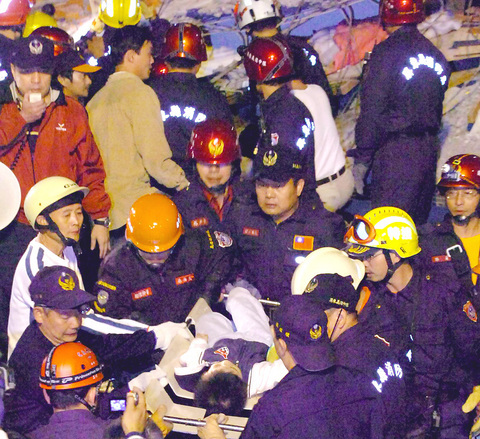
She was later pronounced dead at the hospital.
Fang's 34-year-old brother also died in the disaster. Four other family members survived.
One of the twins was seriously hurt and the other suffered minor injuries, the officials said.
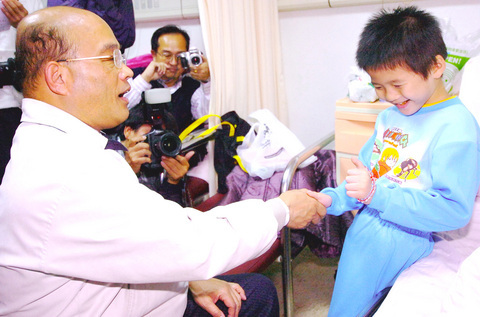
Premier Su Tseng-chang (蘇貞昌) yesterday afternoon traveled to Pingtung County to visit families of the victims.
Minister of the Interior Lee Yi-yang (李逸洋) and National Fire Agency Director-General Huang Chi-min (黃季敏) accompanied him at the scene.
The Cabinet yesterday donated NT$250,000 to the injured and grieving families, while private donations and local government financial assistance to quake victims totaled NT$500,000 and NT$300,000 respectively.
NGO help
The Ministry of the Interior also urged non-governmental organizations to raise money to assist quake victims and relief efforts in the hardest-hit areas in Kaohsiung and Pingtung counties.
The Ministry of Education yesterday said that 134 elementary and middle schools were damaged by Tuesday's tremors.
The majority of the damaged schools were in Pingtung and Kaohsiung counties.
Ten of these have been closed because of severe structural damage, the ministry said.
"Student safety is foremost in our minds. If schools are deemed dangerous because of the damage, then students will not be allowed to enter them," Minister of Education Tu Cheng-sheng (杜正勝) said yesterday during a press conference.
"Much of the damage is minor -- broken glass, fallen structures and the like. This damage will be taken care of immediately," he said.
Relief efforts
The ministry said that it would contribute NT$10 million (US$304,000) to disaster relief efforts in Pingtung County, and was evaluating how much to allocate to schools and local-level governments in addition to that amount to repair the damage.
Nuclear power officials said yesterday that the Third Nuclear Power Plant's No. 1 reactor was operating at full capacity.
The No. 2 reactor, although not posing any danger, had been stopped manually after the quakes by plant personnel as a precaution.
At press time last night, the second reactor was being reactivated after approval was granted by the Atomic Energy Council just after 5pm yesterday.
The state-owned oil refiner Chinese Petroleum Corp said yesterday that operations at a refinery in Kaohsiung had returned to normal after output was reduced for about four hours.
A boiler at the refinery in Kaohsiung automatically shut down after the earthquakes. The company is now operating at about 85 percent capacity at its three refineries, which can process a total of 720,000 barrels of crude oil a day, company vice president Tsao Mihn (
Taiwan Semiconductor Manufacturing Co (TSMC), the world's largest made-to-order chipmaker, said yesterday in a press statement that the company's operations in Hsinchu were unaffected by the quakes.
But at the company's Tainan site, TSMC said it had halted operation of several pieces of equipment to protect materials and to conduct inspections, but production lines quickly resumed.
Geologists have warned that more and perhaps stronger earthquakes may follow.
"The stratum [where the epicenter is located] has accumulated too much stress, and this is unusual," said Hongey Chen (陳宏宇), a geology professor at National Taiwan University. "The stress has now been released. What concerns us is that it might induce a hidden source of energy inside the layers."
Wen Kuo-liang (溫國樑), a chief researcher at the National Center for Research Earthquake Engineering, said it was difficult to determine whether stronger earthquakes would occur in the near future.
He said a 5-magnitude earthquake had occurred near the epicenter of the first quake four years ago.
However, no quake of such magnitude had struck the area in the past 100 years, he said.
According to the Central Weather Bureau, a 6.8-magnitude earthquake struck Hengchun in 1959.
The bureau said yesterday that the earthquake was triggered by movement between the Eurasia and Philippine tectonic plates.
Additional reporting by Jimmy Chuang
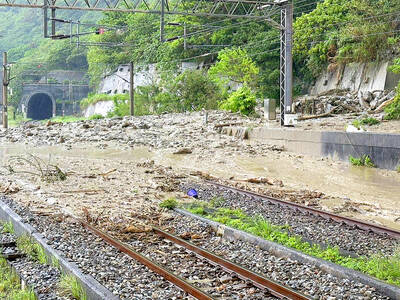
ROLLER-COASTER RIDE: More than five earthquakes ranging from magnitude 4.4 to 5.5 on the Richter scale shook eastern Taiwan in rapid succession yesterday afternoon Back-to-back weather fronts are forecast to hit Taiwan this week, resulting in rain across the nation in the coming days, the Central Weather Administration said yesterday, as it also warned residents in mountainous regions to be wary of landslides and rockfalls. As the first front approached, sporadic rainfall began in central and northern parts of Taiwan yesterday, the agency said, adding that rain is forecast to intensify in those regions today, while brief showers would also affect other parts of the nation. A second weather system is forecast to arrive on Thursday, bringing additional rain to the whole nation until Sunday, it
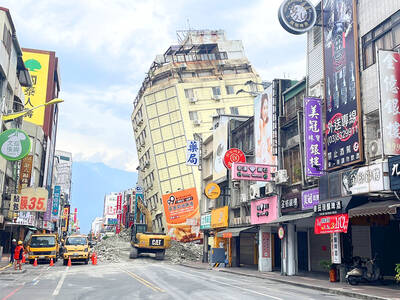
LANDSLIDES POSSIBLE: The agency advised the public to avoid visiting mountainous regions due to more expected aftershocks and rainfall from a series of weather fronts A series of earthquakes over the past few days were likely aftershocks of the April 3 earthquake in Hualien County, with further aftershocks to be expected for up to a year, the Central Weather Administration (CWA) said yesterday. Based on the nation’s experience after the quake on Sept. 21, 1999, more aftershocks are possible over the next six months to a year, the agency said. A total of 103 earthquakes of magnitude 4 on the local magnitude scale or higher hit Hualien County from 5:08pm on Monday to 10:27am yesterday, with 27 of them exceeding magnitude 5. They included two, of magnitude

CONDITIONAL: The PRC imposes secret requirements that the funding it provides cannot be spent in states with diplomatic relations with Taiwan, Emma Reilly said China has been bribing UN officials to obtain “special benefits” and to block funding from countries that have diplomatic ties with Taiwan, a former UN employee told the British House of Commons on Tuesday. At a House of Commons Foreign Affairs Committee hearing into “international relations within the multilateral system,” former Office of the UN High Commissioner for Human Rights (OHCHR) employee Emma Reilly said in a written statement that “Beijing paid bribes to the two successive Presidents of the [UN] General Assembly” during the two-year negotiation of the Sustainable Development Goals. Another way China exercises influence within the UN Secretariat is

Taiwan’s first drag queen to compete on the internationally acclaimed RuPaul’s Drag Race, Nymphia Wind (妮妃雅), was on Friday crowned the “Next Drag Superstar.” Dressed in a sparkling banana dress, Nymphia Wind swept onto the stage for the final, and stole the show. “Taiwan this is for you,” she said right after show host RuPaul announced her as the winner. “To those who feel like they don’t belong, just remember to live fearlessly and to live their truth,” she said on stage. One of the frontrunners for the past 15 episodes, the 28-year-old breezed through to the final after weeks of showcasing her unique


 RSS
RSS